Purpose Laws, round two!
I'm not re-explaining all the Purpose Law generalities. I already covered it at the beginning of Order Laws; go there if you need that explanation.
I also will be skimming some of these a little, because some Faith Laws heavily repeat with Order and as something of a consequence I already ended up talking about them in Order. This page isn't really designed to be read in isolation.
Anyway, first Law!
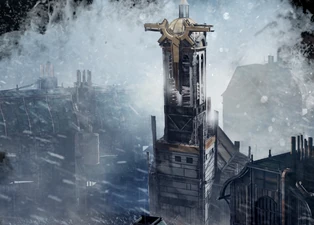
House of Prayer
Unlocks Houses of Prayer, initiates a quest to build 2 Houses of Prayer, and slightly raises Hope. Completing this quest slightly raises Hope.
Requires: Nothing. Incompatible with Naighborhood Watch, and thus locks off the entire Order tree.
Law Cooldown: 36 hours.
The House of Prayer is of course:

House of Prayer
Costs 30 Wood and 10 Steel.
Size 5x2 or 3x3
For every citizen assigned to housing within the House of Prayer's radius, Hope is slightly raised. Also has the Sermon ability, which raises Hope a small amount for free and has a 48 hour global cooldown. +2 Heat, not that this matters.
As I covered heavily in Order, it's a Watch Tower but massively better because it doesn't need people or warmth or some reason (Going to church normally involves, y'know, going inside the church, what is this?) and also covers WAY more space, with the only tradeoffs being it does cost more resources per building and does eat more space per building. Oh, and it throws in the Sermon ability as a freebie for some reason.
For reference, the radius of a House of Prayer can specifically fit about 40 units of housing in it. That's 400 people; no scenario lets you reach 800 citizens (You max out at a bit over 600), so if you place your two mandatory Houses of Prayer well, you'll never need to build a third.
It has one event, which doesn't do anything mechanical. To be fair, Watch Tower also has one event that doesn't do anything mechanical, but this parity isn't going to last long.
Oh, and just as passing Guard Stations changes the announcements you're hearing, so too does passing House of Prayer change those announcements: for Faith, you're going to be hearing church bells toll twice a day every day. I'm... actually not sure why Order has to wait longer than Faith to get its announcer voice modification. It's kind of weird.
Also, House of Prayer adds 'praying' as a possible activity to your citizen behavior. In practice this seems to basically just be an alternative form of the Rest activity in the sense of being something citizens do at night that has no mechanical meaning, but the most unexpected part is that citizens who are praying do not gather at Houses of Prayer, but rather gather around the Generator and pray to it. There's actually a handful of bits like this that suggest the devs were sort of thinking of Faith as being your city coming to worship the Generator itself, but they're all pretty low-key and in practice Faith largely gets written as 'a Christian faith whose serial numbers were filed off to avoid offending any specific denominations and/or to avoid offending any people who are unfond of Christianity'. Which is sort of too bad, as I think 'your city becomes Generator zealots' would work a lot better for what Frostpunk is doing with Faith... well, it would get a bit weird in The Fall of Winterhome, I guess?
Next Law!
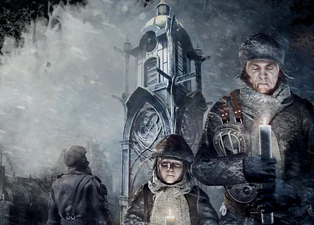
Shrines
Unlocks Shrines and initiates a quest to build 3 Shrines. Completing this quest slightly raises Hope.
Requires: House of Prayer
Law Cooldown: 18 hours.
Shrines are of course:

Shrine
Costs 10 Wood and 10 Steel.
Socketed into a street segment, and so competes with Steam Hubs but not other buildings. Raises Effiiency of most nearby worksites by 20% and raises Hope slightly for each citizen currently assigned to a worksite in its radius. Has no effect on worksites currently manned by an Automaton.
Agitators but with a free Hope bonus, because the devs just wanted Faith to be axiomatically superior I guess??
This includes the previously-covered point that where Agitator has a negative event, Shrines has an event that does nothing mechanical and just tells you that your citizens approve of the Shrines.
As I already said in Order, easy access to Shrines is a big appeal to going Faith. I have in fact contemplated the idea of trying to go for Faith immediately so I can grab Shrines as my second Law, and honestly the biggest flaw with this plan isn't the previously-covered issue of 'Houses of Prayer are painful to pay for early in a run', but rather is the part where Extended Shift is largely superior to Shrines (40% more worktime is better than 20% more Efficiency in general, and is massively superior for Workshops: Shrines is only better when talking cases Extended Shift is irrelevant to, such as medical structures) and can be brought online faster and cheaper since Emergency Shift's Law cooldown is only 18 hours and both shift Laws don't involve resource costs.
Next Law!

House of Healing
Unlocks Houses of Healing and initiates a quest to build a functioning House of Healing. Completing this quest slightly raises Hope.
Requires: Shrines.
Law Cooldown: 36 hours.
The House of Healing is of course:

House of Healing
Costs 35 Wood and 10 Steel.
Size 6x4
Staffed by up to 10 Workers, Engineers, or Safe Jobs Children. (Automatons can never work here) Admits up to 10 Ill or Gravely Ill patients at a time, treating Ill patients in 15 hours and Gravely Ill patients in 30 hours. (At 100% Efficincy) Base Heat of +2, must be at least Chilly to function (ie if it drops below -2 Heat, it ceases functioning), runs at all hours. Each patient successfuly treated by a House of Healing provides an extremely tiny boost to Hope.
When I say 'extremely tiny boost to Hope', I mean that multiple patients can be treated without changing the Hope meter's visuals at all. Even when a Hope increase does happen, it's a tiny sliver you might legitimately assume you imagined. It's so tiny I spent multiple real-life weeks unsure whether it was a real mechanic, until an Extreme Fall of Winterhome run successfully met the initial Hope threshold objective in the form of 'I'm just barely below it, I'm convinced I'm going to game over, I don't do anything that could possibly cause Hope to change, but when I'm less than a day away from defeat I meet it suddenly for no obvious reason, with all my medical care currently handled by Houses of Healing'. So yeah, it is a real benefit that actually functions, but it's super-tiny and most of the time you probably shouldn't pay attention to that aspect at all.
In broad terms, the House of Healing is best thought of as an Infirmary alternative. Its base curative speeds are 25% higher (As in: slower) than an Infirmary and it takes up slightly more space than an Infirmary, but it ooesn't cost a precious Steam Core, can be manned by any citizen instead of demanding Engineers in specific (Who are in short supply in most scenarios), and has that tiny Hope bonus thing. In the long haul it technically gains another disadvantage relative to Infirmaries in that Infirmaries can be upgraded to only require 5 citizens to max whereas Houses of Healing never go below 10, but no scenario really manages to be designed so this is an actually substantial disadvantage: if Purpose Laws were available in The Arks, I'd be telling you to just stick to an Infirmary there, but it doesn't have access to Purpose Laws, so nope. If some scenario gave you plenty of Steam Cores, a population whose overall headcount is a bit low but is noticeably skewed toward Engineers, AND gave you access to Faith Laws, then that could be a case where this is a consequential disadvantage... but The Arks is the closest you get to that. Also not helping is that Child Labor -Safe Jobs is a strong Law in general and lets you fill up Houses of Healing with Children, who you tend to get in large enough numbers that even when committing them to Cookhouses, Hothouses, and any Gathering Posts you might be running, you often have extra kids laying around you can assign to Houses of Healing for free.
By a similar token, the House of Healing can't have an Automaton assigned to it even once you finish the research that lets them work in medical facilities, but, uh, that research sucks and basically the only reason to leverage it is if you're playing The Fall of Winterhome and went Order instead of Faith.
I suppose it's probably possible to have an Endless Mode run happen to have everything line up so you do legitimately prefer Infirmaries for a while?
But yeah, Houses of Healing are great and as I touched on when criticizing the Propaganda Centre, they're a huge edge to Faith.
Their one flaw is the annoying quirk that you'll get an event where a citizen will die for no reason. You'll be told it's an old man dying peacefully in his sleep, but, uh, no, it just picks a random citizen. It can be a Child. It can even happen happen if nobody is actually in a House of Healing at the time, even though the event is premised under the dead person being a patient.
Narratively, House of Healing is such a strange Law/building for Frostpunk to throw in. I get that historically you did in fact get plenty of cases of religious centers basically doubling as hospitals, but this honestly just comes across like Frostpunk doing the video game meme of 'religion provides healing', but without any of the 'actually calling on a literal divinity to provide magical healing' stuff usually lurking in the background of such video games.
For one thing, historical Religious Hospitals generally did have some amount of hard-earned practical knowledge. Sure, they might have been assigning religious explanations to why their techniques worked, but 'we have a library of techniques that we know work because they've been working for decades or centuries' still means you have practical solutions regardless of what your mental framework for why they work might be. Frostpunk letting you just declare 'let's have any random citizen do medical work!' doesn't match to that historical context at all. It instead calls attention to the core mechanics of Frostpunk not trusting random regular people with anything medical and raises the question: why is that so, up until we put some church-y elements on our hospital? That you can even assign Children to a House of Healing is especially glaring about this, not to mention it calls attention to Safe Jobs lying when it claims Children can have accidents on the job; mechanically, a 12-year-old is only 25% worse at providing medical care than a licensed physician working in a properly-equipped facility!
To be clear, my actual point is 'if Frostpunk won't let me have regular folks do medical care, it shouldn't have an inexplicable religious exemption that has minimal competency issues'. Especially given The Last Autumn revisits the topic of entrusting regular people with medical duties, and in that scenario Frostpunk falls very firmly on the side of 'this is a terrible idea'; Frostpunk's devs clearly don't actually think that, say, medical experts are barely more qualified at treating illness than a rando grabbed off the street, or anything of that sort.
The fact that Houses of Healing even treat Gravely Ill patients basically just as well as an Infirmary is the particularly weird part to me. If they behaved more like a Medical Post (No treating Gravely Ill patients without Radical Treatment, and having risk of amputation when backed by Raical Treatment), it wouldn't come across so strangely, and would avoid the jank that it's actually entirely possible to get House of Healing online well before Infirmary; A New Home's design makes this unlikely, particularly on Medium difficulty, but in other scenarios where you can go to Purpose Laws immediately it can occur pretty readily, especially on higher difficulties. On Extreme, even A New Home has this happen relatively readily due to how heavily research gets slowed down, while Law cooldowns are unaffected and so too is your timing on unlocking Purpose Laws in it.
House of Healing is also a good example of how the Purpose Laws are designed to fit into A New Home's context in particular and get funky when going to other scenarios where Purpose Laws are available right away. The entire medical section of Adaptation drops heavily in value if you can tech to House of Healing pretty readily: it takes 54 hours to pass House of Healing, and same to get to Triage, and House of Healing is very good at rendering Triage irrelevant. That's a relatively minor bit of jank per se, but there's lots of bits like this here and there in the Purpose Laws, especially in Faith's side since it isn't nearly so burdened with badness as Order is.
Next Law!
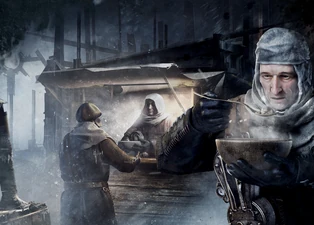
Field Kitchens
Unlocks Field Kitchens and initiates a quest to have two functioning Field Kitchens. Completing this quest slightly raises Hope.
Requires: Shrines.
Law Cooldown: 36 hours.
Alright, what's this building?

Field Kitchen
Costs 5 Wood and 10 Steel.
Size 2x2
Can be assigned up to 5 Workers, Engineers, or Safe Jobs Children. (Automatons can never work here) +3 Heat, operates from 8:00 to 18:00, spending 1 Food Ration per hour of operation to raise the Heat of all nearby worksites by +1. Cannot leverage Extended Shift or Emergency Shift.
It's a dubious building. (And weirdly tiny: no other building is quite as small as it)
First of all, let's reiterate that spending Food Rations doesn't feed people. Never mind that the explicit concept here is that you're feeding people food that just came out of the oven so it's very hot, hot enough to keep them warm, it doesn't feed people. Mechanically, your people are apparently just setting the food on fire and that's what's generating more warmth.
Second, let's note that it doesn't affect housing and for some reason can't have its hours changed at all. This notably limits its appeal: the inability to apply Extended Shift to it is particularly killer, as Extended Shift really ought to be used heavily if you're not doing a challenge run forbidding it or something, and you can't actually rely on Field Kitchen to pull buildings up to a safer temperature, not for the Extended Shift parts.
Third, being limited to +1 Heat keeps Field Kitchens low in value. If it was even +2, it would be a lot more tempting for keeping illness down. In conjunction with Food Rations tending to be more valuable or limiting than Coal, Field Kitchen is unlikely to be something you turn to as a way to save on Coal; not impossible, mind, but... unlikely.
It's also oddly Steel-intensive? Costing twice as much Steel as Wood is weird and makes it that little bit harder to fit into plans.
The Field Kitchen isn't horrible, mind, but it tends to be a struggle to smoothly fit it in and get good value out of it. It being a Law-based way to cope with temperature is genuinely unique, and it is possible to have your strategy and conditions such that it actually makes sense for you to, say, lower Generator Power because your Coal intake is a little too low but run Field Kitchens to keep workplaces warmer. (Maybe you've prioritized housing upgrades so it's okay to reduce their Heat but your workplaces are lagging in technology and thus warmth) It technically also has the unusual quality of being a way to improve the Heat in a resource pile; this can otherwise only be done through a Heat Zone. But generally you'd rather use a Gathering Post for collecting resources: collecting directly from a pile is mostly done at the beginning of a run, plus maybe assigning an Automaton directly to a Coal Thumper's Coal pile in the later game. (But Automatons don't care about temperature)
I actually started out feeling like it was more Faith Supremacy in action, honestly, and I do still feel like that's maybe true in the very specific sense of 'the devs gave Faith multiple clearly unique advantages over Order and only gave Order like one and a half clearly unique advantages over Faith', but given that eg I suspect Pledge of Loyalty was supposed to have more involved mechanics than what we got, it's possible that's not really accurate to the Dev Vision.
Oh, and Field Kitchens gets an event that's a free Hope bonus. That's one reason to consider passing it even if you don't have a strong interest in actually leveraging the building. You can always pass the Law, build the two Field Kitchens, man them briefly, then shut them off until the event fires and then demolish them.
Next Law!
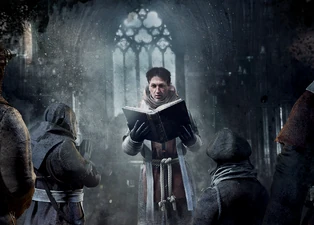
Evening Prayers
Adds the Evening Prayers ability to Houses of Prayer. This ability spends 20 Food Rations to immediately raise Hope and lower Discontent, but has a 48 hour global cooldown.
Requires: House of Prayer
Law Cooldown: 36 hours.
You'd think Evening Prayers would echo the mechanics of Morning Gathering over in Order, but, uh, nope. It's instead basically Faith's version of Patrol, with double the food cost; a rare example of Faith losing in a direct compare-and-contrast.
It's straightforwardly good in a boring way, since raising Hope is good. You have to get more selective about using it on higher difficulties because of that hefty food cost -because once again, though the presentation is 'we're feeding people extra', this has no effect on hunger- but otherwise I don't... really have anything to say about it. It's functional.
I'll point out it has another event with no mechanical effect, and furthermore clarify that every time Faith has an event like this, they're a feel-good statement about how happy people are to be rediscovering religion and doing community things and all. Big contrast with Order, which will be important... later. You can probably infer why, though.
Next Law!
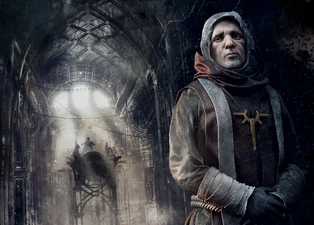
The Temple
Enables construction of the Temple and initiates a quest to build the Temple. Completing this quest slightly raises Hope.
Requires: Evening Prayers
Law Cooldown: 36 hours.
Who's that building?

Temple
Costs 40 Wood and 40 Steel.
Size 6x3
Raises Hope modestly for existing. Each night, slightly reduces Discontent. If playing A New Home, this effect also reduces the Londoner count by 10% of their current numbers. Has the Ceremonial Services ability, which raises Hope and significantly lowers Discontent, but costs 20 Food Rations and has a cooldown of 96 hours. (ie 4 days) Only one Temple can exist at any given moment. +3 Heat, not that this matters.
A nice convenience feature is that Sermon and Evening Prayers are also found on the Temple and so you can just select the Temple for all your Faith-based Hope-boosting needs.
The Temple itself is straightforwardly good and there's really no reason to not unlock it. Just like Houses of Prayer, it doesn't tie up labor and doesn't need to be placed in a Heat Zone, and in fact you can drop it wherever without issue; go ahead and build it at the edge of the city. Nobody actually goes to their magnificant temple. Apparently, just knowing it exists somewhere in the city is good enough to give them warm and fuzzy feelings.
It also has a couple of events tied to it. One occurs consistently and has no mechanical impact, unless you're playing A New Home in which case it will lower the Londoner count by 1.
The second event is our first Bad Event in Faith! Yes, they do exist! This one can only occur if you also have the Public House: your now-very-religious citizens give a puritanical Christian speech about how enjoying things is an evil bad thing for the soul, so they don't like the Public House and want you to do something about it. Your options are to blow them off, raising Discontent and lowering Hope, or to agree that their puritanical values are reasonable, raising Hope, reducing the hours the Public House operates by 2 hours, and ostensibly lowering its effect on Discontent by 20%. As the Public House's mechanics are extremely opaque, I'm not actually sure it does suffer this performance hit, but I also don't really care given I don't like passing Public House anyway because it's a poor use of labor and Heat Zone space. It's also, as my repeated emphasis on puritanicalness might've suggested to you, probably the clearest example of Frostpunk kind of failing to actually generify Faith's denomination the way it seems to intend: this 'pleasure is inherently suspect' mentality is not remotely universal to religion, not even to Christian denominations.
It's also pretty weird that this fires in response to a Public House but not, y'know, passing House of Pleasure. Frostpunk's Faith's puritanical values object to alcohol, but not to prostitution?...
Narratively, the Temple is the earliest sign of a deep problem with the Faith tree. Passing the Law will prompt two bits of written dialogue: one from a citizen expressing that we shouldn't push nonbelievers out of our society, and the other from a citizen cheering the Temple's construction as 'showing the unbelievers'. These lines sort of suggest we're meant to think the Temple is your city tipping too far into a cult-y mentality hostile to non-believers, but, uh... the mechanics aren't there. In fact, this is Law 6 of 11 I've covered, and all the other ones are met with enthusiasm in both non-mechanical signaling (The events, the dialogue) and in terms of mechanical implications. (Hope rising in response to Field Kitchens, for example) Why is building a big empty monument to Faith's religion a step too far?
I should probably mention here that I personally am a nihilistic atheist and in fact I have seen plenty of cases of a Christian-lensed piece of media where raised-Christian folks broadly found it warm and appealing, while I was put off very hard by it. If anyone should be responding to the Temple with 'yeah, this is upsetting! Stop bullying the poor atheists!', it's me. So... the fact that I'm genuinely just confused by Frostpunk doing this is not by virtue of me being a faithful Christian who thinks that such stuff is nice by default; I'm not that. Not at all. Frostpunk just... genuinely dropped the ball here.
But I'll return to this in more detail later. For now: next Law!
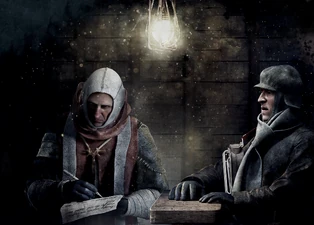
Righteous Denunciation
Immediately raises Discontent a little. From now on, every two days you'll 'get a tip'; if Discontent is high, the tip will lower Discontent. If Discontent is not high, you will gain free Food Rations, scaled to your maximum storage capacity of Food Rations.
Requires: The Temple
Law Cooldown: 36 hours.
Okay, now we have a Mean Faith Law. The concept here is pretty much the Faith version of Pledge of Loyalty: you are encouraging your citizens to tattle on one another. This one is couched in religious and moral terms, but it's the same concept, and just like Plege of Loyalty the game runs this as fostering mistrust and abuses of power. In addition to the repeating tipoff event, this has two one-off events: one where a child is crying because she got her mom in trouble, which for some reason has you choosing between 'raise Hope' and 'lower Discontent', with 'lower Discontent' being caused by... choosing to assume the kid is lying and punishing their mother? Huh? The other event is an actual Mechanically Bad For You event, where you choose between raising Discontent or lowering Hope, with the event narratively about a woman and a priest accusing each other of stuff and you just pick a side without bothering to try to figure out the truth.
Even so, this is mechanically a pretty positive Law. It's quite dissonant, especially since the game itself considers it to be a Mean Law: Frostpunk has this whole thing where when you complete a scenario successfully you get text playing over a fast-forwarding of your city's life, and this text varies based mostly on what Laws you did and did not pass. In A New Home's case, one of these lines passes jugment on your Faith or Order decisions, either suggesting you were kind of bad but didn't cross an invisible line of Too Awful, or instead declaring you did in fact cross that line of badness, and Righteous Denunciation is one of the Laws that gets the game to declare you went Too Far. You'd think the mechanics would involve more terrible results, given all that.
I especially dislike the aspect of this Law where it just... generates free Food Rations from nowhere, with the justification being somebody was 'hoarding food' and a tipoff directed you to this illicit food stash. Like... how do these stashes come into being? There's no mechanics for citizens to actually take more food than they need, and these stashes can easily be dozens of Food Rations, which is to say weeks of food for a single person; this is not somebody eating 90% of their allotment and storing the other 10%, or something else vaguely plausible.
I'm also not a fan of it for how it's another part of the dissonance in this being a Mean Law in the game's reckoning. Frostpunk's icepocalypse is a context in which if somebody actually was massively hoarding food, I'd consider it pretty fair to frame them as Being Bad! The gameplay is meant to have you struggling with starvation, not simply as a possibility if you play really badly, but as virtually guaranteed to be part of even a successful run; a single person hoarding weeks of meals while people are actively starving around them would obviously piss off most anyone! It really undermines the vibe of this being a Mean Law.
Anyway, next Law!
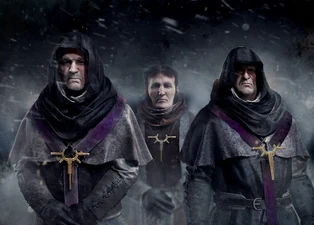
Faith Keepers
Unlocks the Faith Keepers building, initiates a quest to build it, and immediately raises Discontent a little. Completing this quest slightly raises Hope.
Requires: Evening Prayers
Law Cooldown: 36 hours
So let's look at- wait, what do you mean the building is called Faith Keepers? Not even Keeper HQ or something?

Faith Keepers
Costs 40 Wood and 40 Steel.
Size 5x2
Manned by up to 10 Workers or Engineers. (Children and Automatons can never work here) +2 Heat, runs at all hours, enables generally-superior resolutions to various events. Has a Nighttime Procession ability, which has a cooldown of 72 hours (3 days) and queues up a nighttime procession activity at a future midnight: when the activity actually occurs, Discontent will lower a lot. Only one Faith Keepers can exist at any given moment.
Nighttime Procession's behavior is unique and moderately janky; normally building abilities apply instantly upon pushing the button, regardless of what their flavor text might suggest (eg 'Evening Prayers' doesn't have to wait for evening), and furthermore Nighttime Procession doesn't necessarily kick in at the very next midnight after clicking it: I'm not sure what the window is exactly, but clicking the button late in the evening can result in the game pushing its effect off until the midnight after the next midnight, with absolutely no indication that this is so until the next midnight rolls around and nothing happens.
I have the impression the devs were pretty fond of the little procession effect that this produces; getting Faith Keepers functioning will interrupt play with a cinematic of exactly this procession occurring. It's also one of the more ambiguous Generator Worship tibits, in that the procession always marches in a circle around the Generator, but that could just as easily be the devs doing it because it's a simple routine that will always behave correctly, rather than because it's meant to be Generator Worship behavior.
Also interesting is that Faith Keepers is one of the most easily-noticed examples of a unique UI touch with Purpose Laws: the icon for the Purpose section when first clicking into 'the Book of Laws' changes based on what Laws you've passed! This isn't at all surprising as far as that initial Order vs Faith selection, but Faith Keepers is very noticeable because it just takes the Faith Keeper Law graphic and places that on the Purpose section; other Law-related changes are easy to not notice in part because they don't tend to be recycling art in an obvious way and it's easy to just not notice a change occurring.
Anyway, Faith Keepers is Faith's idea of Guard Stations, and also our second Faith Law I would describe as successfully being a Mean Law, but unlike Righteous Denunciation I don't have to heavily qualify that statement. You're assembling a bunch of thugs to enforce The Correct Way Of Being Religious As Defined By The People In Charge, and just like Guard Stations the event resolutions it unlocks tend to be 'use violence to get your way'. Not always, but usually. That's straightforwardly pretty ugly stuff.
I don't really have a lot to say about it, though, given basically everything I could say has been covered before, or is a slightly more detailed version of 'it's functional'.
Next Law!
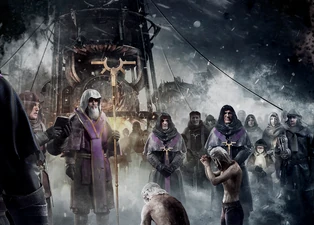
Public Penance
Unlocks the Public Penance ability at the Faith Keepers and immediately raises Discontent. Said ability has a cooldown of 72 hours (3 days), raises Hope and lowers Discontent on use, but injures (renders Ill) a randomized number of people on use.
Requires: Faith Keepers
Law Cooldown: 36 hours.
This is basically Faith's idea of Prison, but it doesn't tie up labor, doesn't risk massive Discontent, and in A New Home isn't a strong solution to the Londoner issue. It also, rather bizarrely, is not considered by the game to be a line-crossing Law: yep, encouraging people to tattle about food hoards is Too Far even if people are literally starving, but removing strips of skin from people as 'penance' is somehow not crossing a line.
Seriously. Pop culture seems to usually imagine that whipping someone is basically the same as just spanking a kid, but For Adults and hitting their back rather than their butt, but a proper whipping literally breaks the sound barrier for a moment and will tear chunks of skin off. And I don't mean like a little mark somewhere, I'm talking a big line from around the shoulderblades to just above the waist, the whole thing bleeding profusely. (If you've ever seen the first Starship Troopers movie, it has the only reasonably realistic public lashing scene I've ever seen in any piece of pop culture: it's viscerally horrible!) People who are whipped can die of blood loss, the wounds will usually get infected if they aren't properly cared for basically immediately, and a person can easily die from a whipping. This is an absolutely brutal punishment and I personally find it genuinely gross that the game seems to think this is way less horrible than imprisoning someone for 3 days.
I also personally don't like passing it simply because the effect it has on the morning and evening announcements genuinely unsettles me. So, uh, kudos to the game on that point I guess? Though I'd be more positive on that if the game actually considered it to be a line-crossing Law...
As a pure gameplay mechanic, it's another example of Faith getting to be strong at minimal cost, if one of the less egregious examples of such given that forcing people into treatment is liable to cost you some amount of labor value. But for one thing in the mid to late game of a run, scenarios tend to give the player a noticeable surplus of labor; injuring people may just mean you have to go manually de-assign the injured people and assign in healthy people and little more.
Mind, Hope isn't terribly important to raise so long as it's not low enough that dropping to 0% is a real possibility, unless you're in the middle of the Londoner movement in A New Home or still trying to get Hope over 50% in The Fall of Winterhome, so it's maybe overstating things to describe this as 'Faith getting to be strong'. But if Hope was a more consistently consequential mechanic the way the devs clearly wanted it to be... yeah, this would be a strong Law.
It also has three events tied to it: the first one fires after the first time you use the ability, and is just 'do you want to lower Discontent or raise Hope?' even though the narrative framing suggests one of these options would be deciding that lashing people is a bit much. After this event, you'll get a second event where your choices are 'lower Discontent but also lower Hope' and 'this event is a pointless waste of time'. After that second event, a third and final event will fire, where your options are 'raise Discontent slightly, or lower Disconteent moderately but risk a random citizen becoming Ill'. (Because Frostpunk broadly uses Ill and occasionally Gravely Ill to represent injury) These... don't exactly make this Law less appealing. Seriously, why does Frostpunk give Faith Laws so much better of events?
But whatever, I care way more about the absurdity of the game treating a public lashing as Not A Big Deal. Ugh.
Next Law!
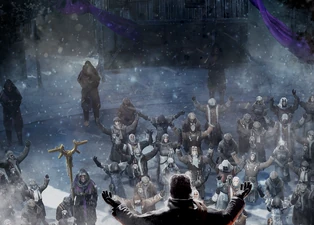
Protector of the Truth
Unlocks the Captain's Words ability at the Faith Keepers and Temple, but also immediately raises Discontent. Captain's Words has a 48 hour cooldown and heavily lowers Discontent.
Requires: Public Penance
Law Cooldown: 36 hours.
A reasonable person looking at this Law's name would likely assume I'm about to get into a rant equivalent to when I covered the problems with New Order and indeed with the Order branch as a whole, but inexplicably this is not actually Faith's equivalent to New Order and we have to go one further Law up to get to that part. This is instead another example of Faith just being treated way more nicely by Frostpunk than Order for no clear reason: conceptually, the Generator Tyrant is declaring theirself to be the only person who knows Truth who shall now dictate Truth to everyone else, their words beyond question, but this isn't responded to all that much like the insane dictatorship cult leader behavior it clearly is. You get a mild Discontent penalty that only matters at all because you can't pass Discontent-raising Laws if Discontent is currently high, and that's the only disadvantage. As Captain's Words is a free ability that lowers Discontent far more than this Law's passage raises it, that mild Discontent penalty is seriously a joke.
It does also have three events associated with it, one of which automatically kills someone, and one of which forces you to either permanently halve the effectiveness of Captain's Words or send in the Faith Keepers to injure a bunch of people, but the third event is just 'do you want free Hope, or do you want to lower Discontent and injure a citizen for no good reason?' That's... rather mild compared to the pushback that Order has to put up with as it advances through its Laws. The game also incorrectly refers to the Captain's Words ability as Captain's Voice in the event that can lower its effectiveness, oops.
Like, if you don't care about any of the narrative stuff or the game's judgmentalism and don't mind having a single extra death foisted on you, this is a weirdly free and good Law. What the heck, Frostpunk?
But whatever, I'm going to use this space to instead talk about the Generator Tyrant: the game itself calls this entity the Captain, but I've not been doing that and will continue not doing that because...
-It doesn't make sense in any of the scenarios. You are never given a backstory that logically applies the rank of captain to you, and in fact in most scenarios you're implicitly or explicitly some random nobody in the city. The Arks is the only scenario I can squint and imagine your character could actually be a captain of some kind, mmmmaybe also On The Edge if I generously assume New London just calls Outpost managers 'captain'.
-I have no respect for the game's extremely thin pretension that you are a human citizen somewhere in the game world. You are a ghost haunting the Generator: you do not eat food, you do not sleep in a home anywhere in the city (In fact, you don't sleep at all), you can't get sick like the mere mortals you boss around, you do not perform any physical labor of any kind, and the only threat citizens can present you with is banishing you for good. (That is: they cannot assault you, or take any nice things away from you, or otherwise punish you for being awful to them except by exorcising you from the Generator) 'The Captain' is an exasperating lie that just hurts the game.
I'm also moderately annoyed by the game explicitly and gratuiously assigning a male gender to the player character. Your regular citizens are roughly even between male and female and the game makes no effort to impose gender roles upon them in mechanics: your male citizns are not better suited to performing hard labor, your female citizens aren't arbitrarily better at running the Cookhouse, their gender is irrelevant in all ways. It's annoying to do all that but then insist the player is definately male, especially when Frostpunk is not constructing itself as a game strongly aimed at a male player base; this is not a game rejecting the idea it might draw female players.
Notably, the game strives very hard to keep the 'Captain' non-detailed. The handful of times the game is depicting the Geneerator Tyrant, they are fully kitted out in the Frostpunk all-body outfit, including with a hoodie, and are either being seen from behind or are viewed from in front and below in a stylized image that casts their face in complete shadow: visually, this could just as easily be a woman.
Maybe you think this is the understandable result of the English language being terrible at referring to people in a gender-neutral way. This is true, but this issue is actually largely-irrelevant when writing in a first-person perspective where other people tend to talk at the perspective characer, not about the perspective character; plenty of games have let the player pick their gender without needing to change anything anywhere in response precisely due to this principle. The rank of Captain is also gender-neutral; the game could simply have used Captain more consistently, no need for Sir and He to be sprinkled about. It's actually kind of baffling the game didn't leave the player character's gender undefined given I've seen a number of comparable games that did so on accident.
Ugh, whatever.
Next and final Law. (Until we get to talking about The Last Autumn)

New Faith
Hope is relabeled to Devotion, colored in black, and is maxed out and will never be a problem again. An Execution Platform building will automatically have its construction planned near the Generator. Passing this Law immediately kills a random number of people. In A New Home, instantly ends the Londoner movement regardless of how many people are in it.
Requires: Protector of the Truth
Law Cooldown: 72 hours.
Oh boy.
So I've been kind of hammering that Faith mostly isn't handled as being particularly unpleasant, mostly isn't responded to as being unpleasant by your citizens, and alluded to Faith's design being distorted by Frostpunk's intentions with Order, and New Faith is why: because Frostpunk wants your Purpose path to always be that you start with reasonable-seeming measures for coping with a crisis but they can (and hopefully will) tempt you down ever more terrible roads of vileness until you finally crown yourself king and rule with an iron fist. (Indeed, this is almost certainly why Purpose Laws are only revealed as you get close to them: so you can't peak ahead and see what your path's ultimate conclusion is)
In Faith's case, this is pretty severe whiplash. Order spends almost the entire tree continuously hammering how awful you're being and how hated you are, with only Neighborhood Watch, Morning Gatherings, and Foreman getting neutral or positive responses; 8 out of 11 Order Laws are committed to showing how horrific you are. Faith spends almost no time suggesting you're being bad as you progress through its Laws, and even when it remembers Faith is supposed to not be super-awesome-great, it gives mixed signals; even New Faith here doesn't commit very hard to using its events to paint you as an evil tyrant, and I've already been over the galling point that Public Penance is not considred 'too far' by the game's endscrawl judgment. Frankly, the Protector of the Truth and New Faith Laws feel completely 'unearned': they feel like the devs were broadly positive on Christian-type religion, built 85% of the Faith content in line with that feeling, and then abruptly remembered there was a mandate to end on the player becoming a brutal dictator and really quickly squeezed in 2-3 Laws for that.
The overall result if you work your way through the Faith Laws is that you're getting all these warm fuzzies about what a good leader you are, how much religion is bringing people together into a community that trusts each other, and then out of nowhere you decide to remind people that you're actually the Generator Tyrant and they still must bow to your rule. You don't slide down a trail of temptations to do more evil things, accumulating toward a horrendous outcome, you instead build up a mountain of kindness and then jump into the metaphorical pit of evil for no clear reason.
Faith is also actually so much worse than Order is about this final Law being mechanically kind of worthless. Faith is incredibly good at building Hope and also fine at reducing Discontent with minimal consequences: New Faith solving Hope forever is a joke when Faith solves Hope forever days before you could've possibly passed New Faith, and executing people to reduce Discontent is heavily undermined by the Captain's Words ability you by definition have if you even have the option of passing New Faith: Captain's Words is a completely free and frequent significant Discontent reducer!
The prior 'the devs seem pretty positive on Christianity, actually' point also ties into: what's the game trying to say here? This isn't an anti-religion message arguing that Religion Is The Opiate Of The Masses or whatever, the game isn't saying religion is fundamentally predatory or manipulative or whatever, it's going 'religion is pretty good, guys' and then swerving at the last second to 'unless you use it to become a dictator, in which case I guess that's kind of bad'. At least Order is consistent about arguing 'authoritariasm is bad'!
Anyway, just like New Order, New Faith has further design jank and a secret mechanics change. The 'further design jank' is of course that passing it neuters a noticeable chunk of the tree's relevance -but Faith is actually hit much less hard by this than Order! The only Faith Law that New Faith genuinely trashes in its entirety is House of Prayer, and even that is only true inasmuch as Evening Prayer is accessible through the Temple. If that convenience feature didn't exist, you'd still want to keep a House of Prayer up! Certainly, Shrines raising Hope ceases to matter as an advantage over Order's Agitators, but House of Prayer is the only Faith Law that is purely 'raises Hope' as its entire benefit. You won't click the Sermon button anymore, but eg Evening Prayers also lowers Discontent. As such, the only structure tear-down you might do upon passing New Faith is demolishing your Houses of Prayer.
Speaking of demolition, there's that secret mechanics change: just like New Order, New Faith makes tearing down structures in its tab freak out your citizens. Faith wins really hard here: first of all, as I just noted the Houses of Prayer are the only structures where passing New Faith makes them useless and worth demolishing, and furthermore you probably only have the two anyway. Second and more unexpected is that Houses of Healing do not trigger this Discontent penalty; I assume the game is just checking the tab a structure goes into, as Houses of Healing are in the medical tab rather than the Faith tab.
Oh, and just like New Order, New Faith can have the number of deaths it claims to cause higher than the number of actual deaths you suffer.
On a different topic, I mentioned the proliferation of Order's icon as you advanced down its tree. You might expect a similar proliferation for Faith as you commit to it, and, well... kind of?

The first impact -which I think House of Prayer causes immediately- is that street dead-ends will now be marked with Frostpunk's symbol for Faith, the mildly cross-ish spreading wings icon you can see here. This is really easy to overlook most of the time; I had no idea it was happening until I did my first Fall of Winterhome run, which has unique design that encourages having such dead ends come into being. I thus spent quite a while having no idea Faith had any visual effects at all, as the only other visual impact...
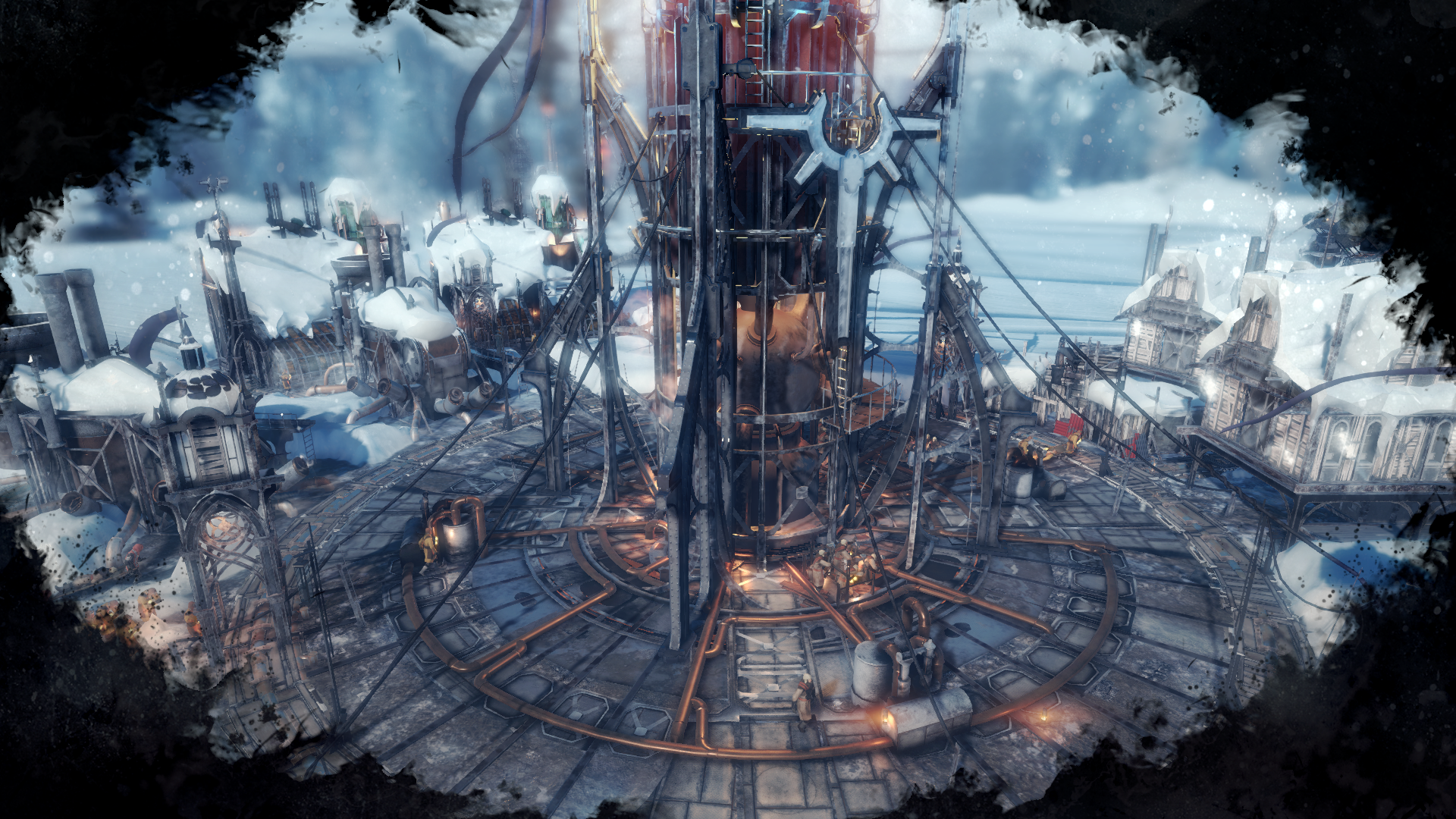
... occurs specifically after passing New Faith, at which point you'll get a little cinema of the Faith symbol being strapped onto the Generator. (Which is another one of those ambiguous 'maybe worshipping the Generator' bits to Faith) That's it: as far as I can tell, you don't get the Faith icon being slapped onto housing or workplaces or carried around by people, contrasting a lot with Order. For this and other reasons, I strongly suspect Order got substantially built by the devs first and Faith came later and got its development cut short.
Anyway, as for those events New Faith triggers...
One event chain starts with a house supposely 'harboring relics of the old faith', whatever that means; New Faith doesn't replace the pseudo-Christian iconography on Faith buildings with alternate versions or something, so relics of the old faith would seem to be indistinguishable from relics of the new faith... anyway, you can leave the folks alone and have Discontent rise, or you can take the relics and have Discontent lower. I'm bothering to describe the narrative framing because unlike most linked event chains, which you pick actually affects the following events in the chain!
If you left the family alone, your next event is about the family being shunned and the father asking you to do something about it. You can tell them, essentially, that this is their fault for clinging to the past, in which case Discontent will fall, or you can send the Faith Keepers to help... in which case nothing mechanical happens, because the Faith Keepers refuse!
Alternatively, if you took the relics, the next event is everybody collecting up and destroying books and other stuff, taking their cue from your decision. You just pick between raising Discontent or lowering Discontent, yay.
The other event chain involves a preacher (correctly) accusing you of being a tyrant. Your choices aren't very important here; I think he always dies no matter what you choose?
The final event requires you also signed House of Pleasure, and finally has our prudish Christian-y faith remember that it's the kind of organization that normally dislikes prostitution. You don't actually get to do anything here: you once again have a 'send the Faith Keepers' option, but even though you are the Generator Tyrant, Protector of the Truth, explicitly worshipped by your city in place of God, the Faith Keepers tell you 'no' because the New Faith considers being mean to prostitutes to be correct. Alternatively, you can just go 'I see', which skips directly to not having anything happen.
I'm pretty unfond of this last event given that prostitution only exists in Frostpunk if the Generator Tyrant wills it into legality, and New Faith is explicitly the Generator Tyrant taking on the mantle of the sole authority whose will is not only law but who defines what is (and is not) true. This event would make sense if people spontaneously engaged in prostitution in Frostpunk, but as-is, you've got your people going "Our god-king willed your job into existence, but we're going to ignore our blind trust in our god-king in this instance and insist your job is ungodly and you should stop!" and your Faith Keepers responding to their god-king going "Whoa, I literally legalized this, I define truth, obviously they're not sinful" with, "Screw off god-king boss, the citizens are correct to completely disagree wuth you!"
sigh
Thankfully, now that we're done with base-game Laws, I'm going to spend much less time frustrated by baffling, terrible decisions.
Frostpunk still has a fair few of those to get into, mind, but the non-DLC Laws are very much the highest concentration of 'did anybody think about this at all???' in all of Frostpunk.
------------------------------------
Next time, we're going to continue to not talk directly about core content the way other folks probably would, instead moving on to research mechanics, starting with Exploration and Industry.
See you then.