Purpose Laws!
These are kind of annoyingly complicated to cover the broad strokes of, because scenario design is moderately variable in regards to Purpose Laws, and in particular their 'default' behavior is not their behavior in the 'default scenario' of A New Home.
So first of all: Purpose Laws are entirely inapplicable in The Arks, The Last Autumn, and On The Edge; you simply don't get them in those scenarios. I'm... not sure why this is so for On The Edge, but the other two scenarios make perfect sense on this point.
Second: in The Refugees, The Fall of Winterhome, and all Endless Mode setups, you immediately have access to Purpose Laws with absolutely no fanfare. You probably shouldn't go straight to them, mind, but you can.
Third: in A New Home exactly and specifically, Purpose Laws will start out hidden, but eventually you will be forced into immediatly and permanently committing to either Faith or Order. This is presented as necessary to resolve the schism of the Londoners wanting to run back to London, and so both Purpose branches have some mechanics for interacting with the Londoner count. This utility unfortunately lacks an equivalent in other scenarios, producing jank here and there around Purpose Law design when you're playing other scenarios.
Purpose Laws themselves are much more, uh, purposeful about the 'Laws as a research tree' and 'Laws that are mutually exclusive' design elements that showed up in Adaptation. For starters, both of these are core to Purpose itself being divided into a Faith tree and an Order tree: House of Prayer gates all other Faith Laws and blocks all Order Laws by virtue of being incompatible with Neighborhood Watch, and of course Neighborhood Watch is the same in reverse.
That's, rather oddly, the only time Purpose uses Law incompatibility, which is... kind of weird... and the Law tree aspect is far from perfect in its design, but still, it's not nearly as confusing as Adaptation about these broad design elements.
Additionally, a thing with Purpose Laws where I can tell what the devs were going for but consider the execution ill-advised is that delving into a given Purpose tree doesn't reveal the whole set of Laws. At any given moment, the game only shows Laws you've currently passed, Laws you can potentially pass right now, and noticeably dimmed out are Laws that will be directly unlocked by the Laws you could pass right now: as Order and Faith are both designed as a pretty 'tall' tree, unlike the Adaptation cluster of Laws, this hides most of the future Laws when you are first breaking into them, only slowly unveiling future options. I think the notion of hiding some Laws is fine given what Frostpunk is going for here, but it probably shouldn't have been handled in such an aggressive way; hide some of the Laws at the end and only reveal them as the player gets closer, that would've been fine.
Anyway, this page is starting with Order predominately because the entire Purpose tree feels built around Order's concept with Faith kind of forced into Order's framework purely because of the dev desire to present the player with a Significant Choice regarding the Londoner movement. I'll explain this more properly at the end of this page, but for the moment I'll point out that The Last Autumn's new Law trees revisit all this stuff but integrate some Faith elements into the Adaptation-equivalent while Order elements get directly recycled for the new Purpose-type Big Choice In Response To A Crisis, consistent with my read of the Purpose tree.
Now it's time for the root of Order:

Neighborhood Watch
Requires: Nothing. Incompatible with House of Prayer, and thus locks off the Faith tree.
Law Cooldown: 36 hours.
Enables construction of the Watch Tower building, and initiates a quest to build 2 Watch Towers within 2 days. Completing this Quest slightly raises Hope.
Alright, what's a Watch Tower?

Watch Tower
Costs 10 Wood and 5 Steel.
Size 4x2
Can be manned by up to 5 Workers and/or Engineers. (Children and Automatons can never work here) Has a small radius around it; for each citizen currently assigned to housing within this radius, slightly raises Hope. (The radius is very similar to a Steam Hub's base radius) +1 Heat, is manned at all hours.
Oh boy.
Okay, this is the point where I wish I could justify starting with Faith first, because a running thread with Order vs Faith is that Order tends to be massively inferior to Faith for no clear design reason, and it would be nice to be able to go 'hey, remember the House of Prayer's parameters? Yeah, Watch Towers are massively inferior in really bizarre ways'.
Alas, I must do an annoying semi-out-of-order thing instead.
Alright, so there's a bunch of layers to this. House of Prayer and Watch Tower are both buildings that put out a radius to raise Hope based on how many people live nearby: their core functionality is essentially identical.
The details then skew heavily in favor of House of Prayer: Watch Towers must be manned, but inexplicably Houses of Prayer don't require assigning people to them to be priests or something. Order thus imposes a labor tax for getting this Hope bonus that Faith does not. A knock-off consequence to this is that Watch Towers must take up valuable Heat Zone space, and eventually must consume Coal on running their Heaters so their assigned citizens don't start losing limbs to frostbite and all, whereas Houses of Prayer apparently have everyone telecommute to prayer sessions or something because there's no need to keep them warm at all because nobody ever sets foot inside of them. Order thus imposes city planning strain and Coal strain that Faith just... doesn't.
Furthermore, Houses of Prayer have a much, much larger radius than Watch Towers. I suspect the internal number is only 50% higher, but a 50% radius increase is 125% more space actually covered by that radius; two Houses of Prayer just covers more people than 4 Watch Towers. (Specifically: A House of Prayer can cover about 40 units of housing if set up well, while a Watch Tower covers about 17 units of housing if set up well, so two Houses of Prayer is 800 people covered while 4 Watch Towers is 680 people covered)
This, by the way, directly undermines the two obvious advantages of Watch Towers: they cost half the Steel and a third the Wood and take up around half as much space relative to a House of Prayer, but if you're having to build at least twice as many to meet your citizens' needs, that's mmmmaybe a small Wood savings at best.
Oh, and for some reason the House of Prayer comes innately with an ability to inject some Hope in for literally free every 2 days, whereas Watch Towers get... nothing.
What the heck game, why is this so blatantly and heavily stacked against Watch Towers?
The only meaningful advantage Neighborhood Watch has over House of Prayer is that it's much easier to break into Order than Faith super-early if that's what you want to do, since both Laws require 2 copies of their respective structure for their quest: Faith demanding 60 Wood and 20 Steel upfront is genuinely quite taxing in the very early game, whereas Order demanding 20 Wood and 10 Steel to get started is much more reasonable to squeeze into an early-game budget. But this itself comes with big qualifiers regarding the respective payoffs for delving into each Purpose branch...
Watch Tower is even more baffling from a narrative standpoint. We set up prison-style watch towers with roving spotlights all across the city, and regular citizens feel better as a result? Excuse me? This is so self-evidently complete nonsense I'm having trouble finding the words to explain it, especially because I have difficulty imagining an actual human being even needing it explained to them. How does one look at this and go, 'Yeah, I'd feel happier if my neighborhood installed watch towers with spotlights so people could watch us quite literally like hawks at all hours of the day'.
I'm serious, look at this thing:
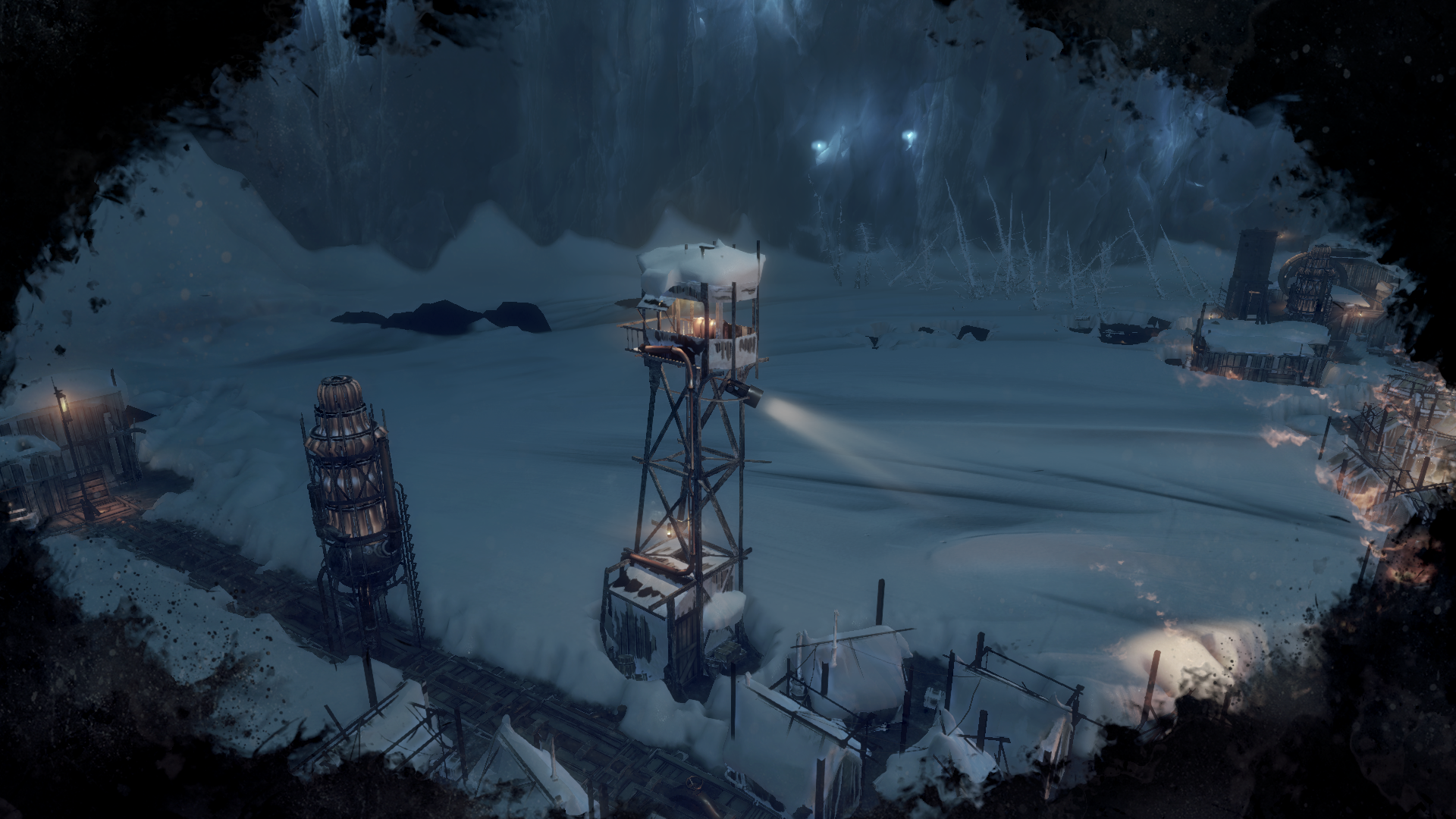
It's just a rickety prison tower with a roving spotlight!
I'd maybe be able to accept it if Frostpunk had actual external enemies as a core part of gameplay and Watch Towers were explained as 'our people feel safer knowing somebody is watching for potential attackers'. The mechanics and visuals would still be very, very incongruous, mind, but I'm plenty willing to accept gameplay simplifications that end up looking kind of absurd or terrible if taken literally. This isn't that, though.
I'm also not necessarily critical of the idea of your citizens cheering on the passing of a Law that's really obviously 1984-esque creepy dystopian behavior. While I personally will probably never understand the thought process of such people, there is an abundance of evidence that real people can and do cheer on laws that are self-evidently going to be extremely bad for them personally, somehow not predicting the obvious outcome and only becoming unhappy once those predictable consequences actually start happening to them.
But that's not what Frostpunk is doing here. You, the Generator Tyrant, are not passing this Law with rhetoric about safety and then having people slowly realize that what's actually being implemented is an unnerving police state dystopia; they're mechanically genuinely pleased to be sitting under Big Brother's watchful eye, and remain happy with the glare of spotlights on their home forever. The fact that Watch Towers raise Hope is especially wild; if they lowered Discontent, I'd be less sure how to read that, as Frostpunk's Discontent has similar undertones to eg Unrest in Master of Magic, where lowering this Unhappiness Quotient can mean 'people are less unhappy' but can also mean 'people are less willing to act upon their unhappiness'. In that case, I'd be unsure whether the game intended for the effect to be 'people like this' or 'your watchmen scare them into compliance'.
But Hope lacks this murkiness: with 1 (Or 2, depending on how you count it) very clear exception, Hope going up/being high is a very clear 'people approve' indicator.
I get that the devs probably wanted House of Prayer and Watch Tower to have mechanical symmetry, but then why are they so unalike in other problematic ways? I also get that the Londoners mechanic is anchored in Hope and both Purpose branches are supposed to be about the Londoners, but that could've been achieved some other way, such as borrowing the Temple's 'a wrongdoer has mended their ways' mechanic I'll be covering next page.
Watch Towers/Neighborhood Watch is one of Frostpunk's most baffling collages of decisions...
... oh, I guess I should mention it technically has an event. It has zero mechanical implications, but you'll get a thing where a child was climbing the Generator and the Watch Tower guys spotted the kid and grabbed them before they could get hurt, which people are happy about. Not happy enough to raise Hope or lower Discontent, mind, but the devs assure you the citizenry certainly like the Neighborhood Watch.
Ugh, next Law.

Morning Gathering
Requires: Neighborhood Watch.
Law Cooldown: 18 hours.
Each morning, citizens will gather around the Generator, slightly raising Hope each time this happens. Passing this Law also immediately raises Hope.
As a gameplay thing, Morning Gathering is pretty straightforward: you want it signed at some point since it's basically free Hope. It's slightly annoying that it adds a new daily task for citizens, as it affects pathing and whatnot, which can matter in janky ways, but that's more commentary on how careless Frostpunk was with citizen behavior design than anything else, and I'll get more into that mess another time.
My main frustration with Morning Gathering is that it makes so much more sense as the entry point to Order than Neighborhood Watch. You could dump Neighborhood Watch entirely -and I guess replace it with somehing else so both Purpose branches have the same total of 11 Laws- and make Order way less terrible of a branch just right there, and it would completely sidestep the absurdity of "I love being monitored at all hours by prison towers shining spotlights at me!" being the Order entry point.
Anyway, the biggest reason to want Morning Gathering is it leads to:
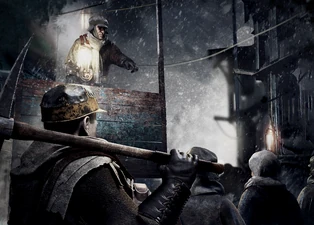
Foreman
Requires: Morning Gathering.
Law Cooldown: 18 hours
Enables the Foreman ability at most workplaces valid for Extended Shift and Emergency Shift. Activating this ability raises Efficiency at that workplace by 40% for the next 24 hours. This ability costs 10 Food Rations to activate and has a cooldown of 2 days.
Foreman is unique among Order Laws for genuinely having nothing meaningfully equivalent over in Faith. This makes it basically the only serious argument for committing to Order instead of Faith, and it's genuinely a pretty decent Law. 40% more Efficiency is a pretty big boost, especially if combined with Emergency Shift or applied to a workplace manned by an Automaton so the full 24 hours of its effect can be leveraged. Hothouses are particularly straightforward here, as applying Foreman to a Hothouse that's on Extended Shifts or under Emergeny Shift will be net positive on Food even when talking a basic Hothouse on Extreme (So long as it's fully manned), and if Food is a solved issue it can readily translate to bringing in all resources moderately faster with minimal issues by just spamming Foreman all over.
It goes especially well with Automatons, as its effect on Efficiency is additive with their innate Efficiency modifier. Thus, a workplace staffed by humans rises from 100% Efficiency to 140%, whereas one staffed by an Automaton rises from 60% Efficiency to 100% Efficiency; that makes such an Automaton produce about 67% more resources than it would without the Foreman. You'll still get more in total from a human-manned workplace under an Emergency Shift plus the Foreman, mind, and there's other problems I'll get to later, but it's good to be aware of this quirk when eg you have enough Food Rations to use Foreman some, but can't just spam it everywhere, and/or if you don't want to use Emergency Shift just then; prioritizing Automatons for Foreman usage will give bigger dividends than you might intuutively expect. Do note that upgrading an Automaton's innate Efficiency ablates this effect; Automatons can potentially reach up to 100% general internal Efficiency (Though probably almost no players have seen higher than 95%), at which point a 40% additive increase is, well, a 40% increase over their base.
Oh, and note that Foreman will eventually cause an event to trigger where a random active workplace gains +20% Efficiency for 24 hours. I'm moderately unfond of this event, as it's one of the more egregious events about the RNG being able to be (un)helpful in a manner that can genuinely swing a run's chances by a noticeable amount. The event can be amazing if eg it dumps itself on a Steelworks you just used Emergency Shift on because you have desperate need of more Steel right now, or it can be basically useless because it dumps itself on a Cookhouse that's already converting Raw Food into Food Rations faster than the Hothouses are generating Raw Food, or it picks a Gathering Post or Sawmill that's just about to deplete the resources around it, or it picks a resource type you're closing in on your storage capacity for. I especially find it frustrating that it's willing to target Cookhouses, as this is almost guaranteed to be a waste of the event, and furthermore you're not allowed to use Foreman on Cookhouses; why is this event allowed to hit them??
Anyway, from a pure game design standpoint, Foreman is basically fine. I'd have preferred a less repetitive mechanic, but whatever. My only serious complaint is that it not being available in The Arks to really show off that Automaton synergy is a really disappointing casualty of The Arks not having Purpose Laws.
In terms of thematics and narrative elements...
... well, I kind of like the funky synergy with Automatons. I have my doubts this was in any way a planned thing, mind, but the Order branch is broadly a very industrial set of Laws, and it's kind of nice that it's the Purpose branch that finds Automatons more appealing.
Otherwise, though, Foreman is... janky.
Like first of all that 10 Food Ration price is contextually absurd. I'm paying someone ten days of meals to boss around people for one day? The Food Ration prices on building abilities that spend rations are pretty wacky if you think about them realistically in general, but Foreman is the most egregious example in my book. Shouldn't this be more like 3 Rations? It's also probably the most egregious building ability about spending Rations but not affecting hunger at all: I bribed someone with, again, ten days of meals, but nobody is made less hungry by this? Are my foremen just setting their food bribes on fire? Are they hiding them for later and then forgetting where they squirreled away their food bribe? Seriously, what??
Related to the above is the janky point that I'm ostensibly putting an additional person in charge, but this has no mechanical reality to it. Just as I am the Tyrant Ghost Ruling From The Generator, I guess I'm bribing other Generator Ghosts to be the Foremen?? Because I clearly don't pull anybody from my actual human population for the job!
Probably most frustrating is... this mechanical implementation would honestly make so much more sense if it was 'feed the laborers well so they can work hard'. This would do away with the Ghost Foreman issue, it would make it genuinely more palatable for the food to mechanically vanish into the ether -I'd read it as 'their hard work is directly fueled by and quickly uses up the food'- and it would even make the 10 Ration price perfectly reasonable if a bit game-ified: all standard workplaces are 5, 10, or 15 citizens for a full work crew, so splitting 10 days of food among so many people is vastly more believable than piling it all onto one person somehow.
Of course, that wouldn't fit with what Frostpunk is trying to do with Order, but, well, I'll get more into that at the end of this page.
Next Law!
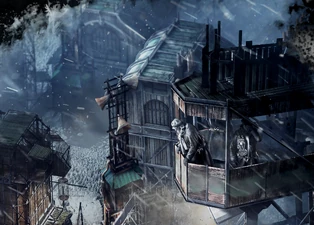
Guard Stations
Requires: Neighborhood Watch.
Law Cooldown: 36 hours.
Unlocks Guard Stations, which are a direct upgrade to Watch Towers. Immediately slightly raises Discontent, and initiates a quest to build 2 Guard Stations within 2 days. Completing this quest slightly raises Hope.
You probably can guess the generalities, but here's the details:

Guard Station
Costs 15 Wood and 10 Steel.
Size 4x2
Can be manned by up to 5 Workers and/or Engineers. (Children and Automatons can never work here) Has a small radius around it; for each citizen currently assigned to housing within this radius, slightly raises Hope and slightly lowers Discontent. (The radius is very similar to a Steam Hub's base radius) +2 Heat, is manned at all hours. Having at least one functioning Guard Station in existence also opens up new options for resolving various events, which are usually advantageous. Upgrade to Watch Towers.
Oh boy, round two.
First of all, let's note that Guard Stations and Watch Towers can stack: you can double-up on the Hope bonus if you want by making sure every home is watched by both types of buildings. This is almost certainly a developer oversight.
Second, let's note that this worsens the comparison to House of Prayer in regards to resource costs: a Guard Station costs half the Wood as a House of Prayer and the same amount of Steel, while still having a much tinier radius, no larger than the Watch Tower radius. Since the dev intention is pretty clearly you're supposed to move on fully to Guard Stations, Order is seriously just getting screwed on this front. The Guard Station reducing Discontent is technically an advantage Order gets over Faith -Faith is overall a bit worse at reducing Discontent than Order- but I've already been over how Discontent isn't a crucial thing to be able to reduce on demand. I also would in fact argue that Guard Stations are pretty clearly worse than the humble Fighting Arena for Discontent management; you can stack their benefits, of course, but it's still pretty wild that Order has this slightly advanced Law I can genuinely characterize as 'bad Fighting Arena', and actually arranging such stacking puts a fair amount of pressure on your city planning to boot.
Third, I find it incredibly frustrating that the event resolution mechanic is inexplicably delayed to here, rather than being tied to Watch Towers. One of the few advantages Order has over Faith is that it can access that mechanic quicker, but... only by 1 Law, or 36 hours, whichever aspect you prefer to focus on. That's something, but Order would be so much more viable if accessing it let you immediately start bullying people into shutting up and working without complaint while Faith had to slog through 2 Laws and 3 full days before it could do the same. It's especially frustrating because of how arbitrary it feels: why is it calling the prison towers 'guard stations' instead of 'watch towers' results in the Generator Tyrant being allowed to order his thugs to go threaten people with violence?
Again, have a screenshot:

It's just a Watch Tower, but... absurdly tall for some reason, and oh man, it has a second roving spotlight. One searchlight scouring our homes is reassuring, but two is too much! I guess this is the bizarre outlook of Frostpunk's citizens?
Anyway, third, while Guard Stations are warmer than Watch Towers, they're still frustratingly susceptible to temperature. Like Child Shelters and Care Houses, I'd really have preferred if housing technology passively improved the base Heat of these buildings; more precisely, I wish this was true and also you only had the one tier, either using Morning Gathering as the root for Order or simply going straight to Guard Stations and not bothering with the pretension of a slow slide into... the thing I'll be talking about later...
Also, notice that passing this Law raises Discontent: why were my citizens fine with installing a 24-hour surveillance network with, I must emphasize, prison-style searchlights, so long as I called them 'watch towers', but calling them 'guard stations' makes this a step too far?? What on Earth?!?
I seriously don't understood Frostpunk's logic with these buildings.
On a more trivial note, a bit with Frostpunk I actually do like a lot is the consideration of Mr Announcer Guy, the fellow who tells everyone to go to work every morning and go rest every evening. See, his announcements are actually changed by your Purpose Laws! In the case of Guard Stations, he switches from sounding like he's just doing Town Crier 'speak very loudly' stuff to now sounding like he's being heard through old-fashioned intercom-type speaker systems, specifically the kind you might see on a military base back in the day. It also changes his lines in the sense of using different words and even expressing completely new sentiments. Advancing further down Order will further change his lines; I've not pinned down the full list of exact 'this Law triggers this change' and probably won't ever bother, but the effect is pretty nice, especially regarding a topic I'll be getting to... later. Indeed, one of my frustrations with Order sucking so much is I really, really enjoy its audio here, whereas I don't like Faith's equivalent audio changes!
Anyway, next Law.

Patrol
Requires: Guard Stations
Law Cooldown: 36 hours.
Enables the Patrol ability at Watch Towers and Guard Stations. This ability has a global cooldown of 1 day, spends 10 Food Rations, but lowers Discontent and raises Hope.
Patrol has a brief event chain: event 1 is a man angry with your decisions, where you choose whether to have Discontent rise or Hope fall. Event 2 is that a woman claims guards have been harassing her under guise of doing their duty; you can suffer a Hope hit for no reason, get a slight Hope increase for free, or get a slightly larger Hope increase in exchange for permanently reducing Patrol's effectiveness in some unspecified way.
I'm not actually 100% sure the Patrol loss of effectiveness option actually, y'know, lowers Patrol's effectiveness. I'm inclined to think it does in fact do so, but it's difficult to be sure; it seems to be a pretty small reduction. If it doesn't work, well, then obviously it's the best choice, but if it does function, then the free Hope boost is probably the thing to go for.
This second event is, unfortunately, an example of how Frostpunk semi-regularly designs its events in a manner that is pretty common to this type of multiple choice test mechanic and that I've always been critical of: having multiple options but designing it so that if you know how it actually works at least one option makes zero sense to actually pick. In this case, I framed option 1 as 'you can suffer a Hope hit for no reason'; the game presents it as 'you punish the woman', presumably framing her as a liar or something, where the flavor text suggests there might be possible outcomes further down the line a player might plausibly want, but... no, it's just The Wrong Choice.
I suspect there is a specific reason Frostpunk does this in this particular case, but I'm not a fan.
Anyway, Patrol is, mechanically, something you ought to grab eventually. I wouldn't call it great or anything, but the option is nice, and in A New Home you ideally do aggressively raise Hope for a while, so spamming Patrol if feasible is what you want to do there. It's fine, I guess.
Narratively, we return once more to Frostpunk's deep confusion about Order's relationship to public opinion, where patrolling guards improves morale but also fires off events exclusively centered around your citizens being upset by your guards engaging in patrols.
sigh
Next Law!
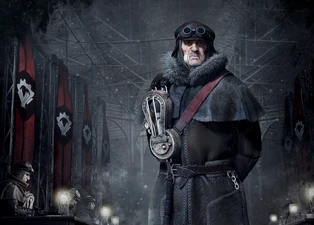
Propaganda Centre
Requires: Guard Stations
Law Cooldown: 45 hours.
Enables construction of the Propaganda Centre, initiates a quest to build the Propaganda Centre within 2 days, and immediately slightly raises Discontent. Completing this quest slightly raises Hope.
what
no
game
seriously
ugh
Okay, let's... cover the building whose name really ought to be something less on the nose...

Propaganda Centre
Costs 40 Wood and 40 Steel.
Size 6x4 size
Employs up to 10 Engineers. Significantly increases Hope so long as it's manned at all. Can use the Propaganda Bulletin ability, spending 10 Wood to slightly raise Hope, which has a cooldown of 2 days. (If New Order is signed, this ability instead slightly lowers Discontent) +3 Heat, is manned at all hours. Also completely uselessly provides flavor text on what your citizens are upset about. There can only be one Propaganda Centre in the city at any given time.
Oh boy, round three.
Alright, let's start with that weird, weirdly high Engineer staffing point. First of all, this is another way in which Order gets screwed for no clear reason in very obvious ways: Faith has absolutely no buildings that demand Engineers. Zero. In fact, Faith provides Houses of Healing, which are basically Infirmaries that don't cost a Steam Core and can be manned by anyone (Even Safe Jobs Children!) but slightly slower at healing people, so Faith can massively free up existing Engineer labor; as the game treats Engineers as a precious resource and is largely right to do so, this is a pretty big painpoint for Order.
And like... why does it want 10 Engineers? That's rather high: the only normal Engineer-demanding duties in Frostpunk are Medical Posts, Infirmaries, Workshops, Factories, and the Propaganda Centre. Three of these only want up to 5 Engineers innately. Infirmaries want up to 10 by default, but you can upgrade them so they only want 5. This leaves the Propaganda Centre as the only Engineer-demanding builing that just plain wants more than 5 Engineers. Why is it so demanding of Engineers??
This is confusing both from a 'pure game design' perspective and from an 'in-universe narrative' perspective, to be clear. The Propaganda Centre is absolutely not as valuable as... any of the other structures that demands Engineers, so this 'Engineer price' is pretty self-evidently overpriced, whereas narratively... yes, the Engineer vs Worker divide is a very broad and simplistic categorization, but outside of exactly the Propaganda Centre, Engineers are only really treated as a silly hybrid of medical experts and mechanical engineering practitioners; neither of these broad skillsets seems like it has any overlap with propaganda production. Even going more simplistic and framing Engineers as Smart Guys Of All Stripes... propaganda is not something that people stereotypically present as The Domain Of Particularly Intelligent And Educated Individuals. Why isn't this a 'Workers or Engineers' building?
Now, the Engineer cost isn't truly that high in practice, but this is, itself, a product of Frostpunk being incredibly janky. The game will pretend like the Propaganda Centre's Efficiency rating matters somehow, but this is not true: so long as any Engineers are assigned to the Propaganda Centre, it provides all of its benefits. And to be clear, I do mean 'assigned': if you assign exactly one Engineer, the Propaganda Centre will remain fully functional even during the shift that Engineer is not working, or if that Engineer is sick, or whatever. So technically you should just assign 1 Engineer, not 10 like the game expects you to, but this is very obviously not, y'know, intended play.
Returning more to 'pure game design', the Propaganda Centre also inexplicably repeats the strangeness of the root Purpose Laws: its most direct equivalent in Faithis The Temple, which just like the House of Prayer inexplicably does not need to be manned and by extension does not need to be kept warm, so Order once again is suffering a labor tax, a heated space tax, and a Coal tax for benefits Faith gets without any of those issues. Whyyyyy???
Then Propaganda Centre also gets screwed on the layer of event behavior, producing a three-event chain that's largely bad news. First, somebody will uncontrollably die, and you choose between whether to suffer a further Discontent penalty or a further Hope penalty. Then you get a dumb event where you choose between 'raise Discontent AND hurt a number of citizens' and 'raise Hope'. Finally, a third event will try to kill a bunch of people at a workplace, with no indication this has anything to do with the Propaganda Centre, and you get another dumb choice of 'have no further consequences' or 'suffer a further Hope penalty'. I say 'try to kill', because the wiki indicates the event can be cheesed both by not clicking on it and also by simply removing all the citizens from the workplace before you click the event.
And no, the Temple doesn't have an equivalently unpleasant event chain. It has an event that is good or does nothing depending on your scenario, and a mildly bad event that can fire if you also have a Public House.
Basically the only nice thing I can say about the Propaganda Centre is that its activated ability costing Wood to raise Hope is unique and Wood is often your easiest resource to part with in many scenarios. That's... something.
ughhhh why is Order designed like this it's so obviously terrible I don't understand how the devs arrived here
...
On a different note, an effect I kind of like with Order but that is painfully easy to overlook:
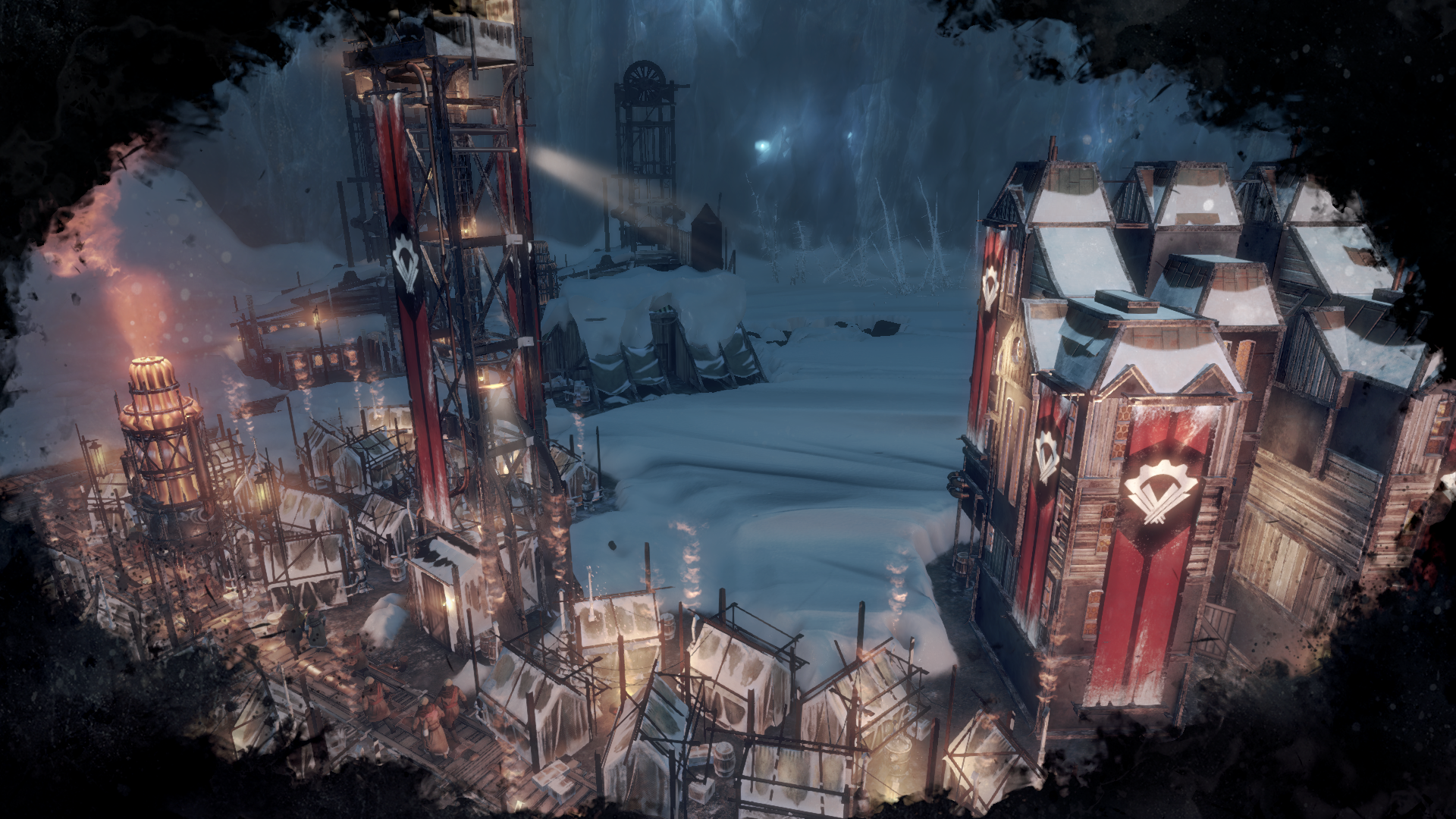
Propaganda Centre has an icon (That I'm... not sure what it's meant to be), and it proliferates onto Guard Stations once the Propaganda Centre is first manned. Indeed, it can then proliferate onto many other structures, including even some portion of housinng! I'm not entirely sure how that part works, but in any event this spreading of the literal icon of Order is genuinely a pretty nice effect... but it's easy to just not notice it happening at all. Guard Stations being so absurdly tall makes them relatively visible about this, but I imagine there are players who passed every Order Law and never noticed that the Order icon actually ends up almost everywhere if you do that.
Alas. Next Law!
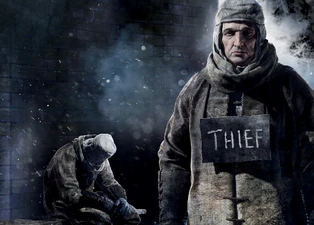
Prison
Requires: Guard Stations.
Law Cooldown: 45 hours.
Enables construction of the Prison, initiates a quest to build a functioning Prison within 2 days, and immediately slightly raises Discontent.
Well, let's get the building itself covered.

Prison
Costs 40 Wood and 40 Steel.
Size 5x3
Employs up to 10 Workers or Engineers (Children and Automatons can never work here), active all 24 hours, with a base Heat of +3. Only one Prison can exist in the city at any given time. Does literally nothing unless the Roundup ability is used. The Roundup ability has a cooldown of 1 day, greatly lowers Discontent, and locks up a partially-random number of people in the Prison. (Up to 10 at a time. The Prison can only store up to 30 prisoners) Prisoners live in the Prison continuously for 3 days, consuming half as many Food Rations, and cannot be assigned tasks of any kind. In the A New Home scenario, using Roundup immediately causes the Londoner count to drop by the number people it imprisoned. If a shift of Prison guards has nobody report to work on time, all prisoners will be instantly released and a huge Discontent penalty will be applied until at least one guard reports to work, at which point all prisoners will be locked back up. (The Discontent penalty only applies if prisoners were actually released) Using Roundup and ending up with more people selected as prisoners than the Prison has capacity will also leave prisoners free and result in a significant Discontent penalty until there's enough open space to lock them all up.
Oh boy, round 4.
If you're playing exactly A New Home, the Prison has... some appeal. Its ability to end the Londoner movement is uniquely great; most effects for peeling off Londoners work slowly and/or only peel off a low percentage of the current Londoner count; the Prison can be used once you get to 30 or less Londoners to rapidly end their movement, and only two very specific Laws are at all competitive with the Prison for this.
Outside this, it's an amazingly bad building. Including that once the Londoner movement is ended, it's sucky even in A New Home. A Discontent management tool that operates by grabbing random people and not letting them work for 3 days is terrible, especially one that can massively spike Discontent pretty easily on accident through its 'prisoners not in prison' issue. It's also an even further manpower drain just to keep it manned, needs to be placed in a Heat Zone to make sure it doesn't get way too cold, and comes with another bad event set; the first event happens automatically and forces you to choose between 'Discontent goes up' and 'lock this guy up and suffer a Hope penalty'; the latter option is an easy way to accidentally go over the prisoner limit!
The other events only occur if the Prison is sufficiently cold. The first event firing has you directly choose between raising Discontent and lowering Hope. If you choose to suffer the Hope hit, a prisoner will later die. If you choose to suffer the Discontent increase, a prisoner will become an Amputee but you get to choose between raising Hope or lowering Discontent.
Again: Faith has a pretty directly equivalent Law that's just nowhere near as terrible.
Yeesh.
Though on the topic of the Prison's temperature: it's kind of hilarious that its base Heat is +3. That's very high; Frostpunk largely caps passive building Heat at +3, and +3 is specifically reserved mostly for final-stage technology. Real prisons are infamously prone to having absolutely terrible protection from the weather, and indeed that reality is probably precisely why the Prison has an event chain for the Prison being dangerously cold; I'd expect the Prison to either have the default manned-building-minimum of +1 or the default value for Law-derived buildings of +2. Why is is it so warm?
Anyway, next Law!
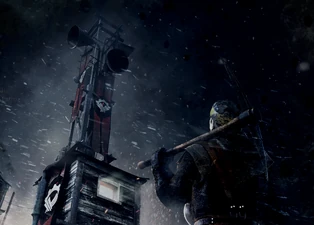
Agitator
Requires: Propaganda Centre
Law Cooldown: 63 hours
Enables construction of Agitators and initiates a quest to build 3 Agitators within 2 days. Completing this quest slightly raises Hope.
Alright, what's this building?

Agitator
Costs 10 Wood and 10 Steel.
Socketed into a street segment, and so competes with Steam Hubs but not other buildings. Raises Efficiency of most nearby worksites by 20%. Has no effect on worksites currently manned by an Automaton.
The Agitator is probably the most blatant example of Frostpunk just making Order very inferior to Faith. Faith has its own version of the Agitator -the Shrine- and it's just... better. The Shrine costs just as much, has the same placement mechanics, gives the same Efficiency bonus, and throws in increasing Hope for free. Furthermore, they both have one event, but the Shrine event is a nothing event with no mechanical impact, whereas the Agitator event forces you to choose between having a random Agitator stop working for 8 hours or sending guards to retrieve a stolen part: the latter option does nothing initially, then a few in-game minutes later either your guards succeed and the Agitator starts working, or your guards are injured and the Agitator is going to not work for 8 hours, just like if you'd picked the other option but with some people in medical care.
The Agitator Law furthermore has that bafflingly high cooldown of 63 hours, whereas the Shrines Law cooldown is a quick 18 hours?? And furthermore Shrines is a much more accessible Law, unlocked by House of Prayer: Shrines can come online 36 hours after you get started on Purpose, whereas Agitator requires Propaganda Centre and thus requires Guard Stations and thus can't be passed until 117 hours into running Order. That's a day and a half to get to Shrine vs just short of five days before Agitator go online -assuming you beelined for Agitator, mind. This isn't even touching on how Propaganda Centre's Intended Design would be a horrible burden, and so needing to route through the Propaganda Centre to get to Agitators is, in the Intended Experience, an extremely unpleasant extra burden.
Also, remember how I said Foreman is really the main thing Order has going for it? Note that it too is less accessible than Shrines, requiring working through Morning Gathering and so only coming online 18 hours after Shrines. Further, Shrine/Agitator behavior overlaps heavily with Foreman, but Shrines and Agitators are overall the better option: Foreman providing a 40% boost for 24 hours every 2 days is on average roughly equivalent to Shrines and Agitators providing a 20% boost continuously unless you assume Foreman is always combined with Emergency Shift. In that case... well, if you assume no Extended Shifts but do assume Emergency Shift is being used in both scenarios, then a Shrine or Agitator will add 6.8 'man-hours' every 2 days while the Foreman-on-Emergency Shift scenario is adding 9.6 'man-hours' of work every 2 days. (ie Foreman is around 40% more value) If you instead assume Extended Shifts are being used, Foreman is the same but Shrines and Agitators rise to 7.6 'man-hours' added, so Foreman is only about 29% ahead. And Foreman requires constantly burning Food Rations and consistently combining it with Emergency Shifts to look this good.
All that is to say that Foreman only really helps justify picking Order if you do in fact intend to also get Agitators, and furthermore Order just plain is screwed here in that Faith can immediately get to good Efficiency boosting and Order has to wait longer no matter how you cut it and is just plain worse off except maybe once it has both Foreman and Agitator. Ow!
Also, notice that bit about Agitator not affecting Automatons. I will be coming back to this another time.
Narratively, I... don't know how to take Agitators. Real folks in real reality have in fact done the Agitator routine, and they did in fact believe it would improve motivation and loyalty to drown people in slogans and all. I personally don't see how it could produce that effect and know for a fact that there certainly are people it doesn't produce that effect in, but I'm unsure if that's 'it just doesn't work that way' or if that's 'I'm largely familiar with the stories of people who it didn't work on, but they're not actually representative'. So I'm not really sure whether it'd be fair to criticize the game for having the Agitator successfully make people get more work done. I kind of want to criticize it on this, but... maybe I'm just wrong here.
Next Law!
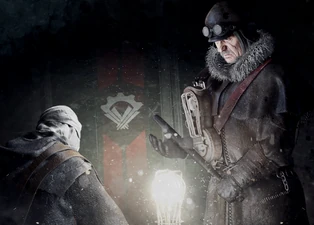
Pledge of Loyalty
Requires: Propaganda Centre
Law Cooldown: 36 hours.
Immediately raises Discontent, but from now on Hope will passively rise if it gets very low, and a variety of events around 'informers' will occur at random, regularly offering the opportunity to imprison a random citizen.
This is a Law that has me suspect that Order is so bad in part because developer ambitions outstripped their ability to execute those ambitions, as Pledge of Loyalty has a concept of 'informers' that seems to have been intended as an actual mechanic; one event has an option that informs you that if you pick it you'll gain 3 Informers, as if this is an in-game resource of mechanical consequence. It's easy to imagine that the Propaganda Centre was meant to be more involved in a similar manner, and more generally that Frostpunk might have intended to have a more detailed and complex modeling of the social conditions of your city that Order was meant to hook into mechanically.
In any event, Pledge of Loyalty is kind of a crappy Law, aside that it has unique utility in making Hope penalties less able to lead to unavoidable game overs.
Oh, I haven't explained that yet, have I?
Yeah, if Hope ever hits 0%, just like Discontent reaching 100% you'll get a quest demanding you fix this in short order, specifically getting Hope back over 15%, and if time runs out you instantly game over. While I'm dismissive of the Discontent-based game over threat, this is because most Discontent penalties go away over time or are caused by bad conditions you should endeavor to fix regardless, and also you get a lot of tools for managing Discontent; I'm dismissive of many Discontent management tools in part because there's so many that individual ones are easily ignored in favor of others.
Hope, by contrast, normally does not recover on its own, and most Hope boosts are quite small; the Discontent game over quest can sometimes be satisfied by a single Discontent-lowering event, whereas no Hope-raising event will ever deliver 16% all at once. Hitting 0% Hope can easily mean that you're now dead with zero recourse because you simply don't have enough Hope-raising capacity to have any possibility of meeting the goal within the timeframe. As such, where Discontent has barely any metaphorical teeth to it, Hope is something it's very important to at least not let zero out, and ideally to keep up as much as possible. There's some scenario-specific qualifiers to this, but I'll get to those when we get to them.
But yeah, Pledge of Loyalty is kind of lame. It's also one of the more egregious examples of the game's Law summaries often being really vague and sometimes downright misleading; in my very first run of Frostpunk, I signed Pledge of Loyalty because its summary made it sound like a free Hope boost, and was very put out by it turning out to mostly just cause trouble with barely any benefit to show for it. Among other points, it undermines that thing Order is trying to do that I'll be talking about... pretty soon, actually.
Next Law!
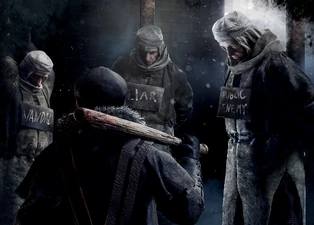
Forceful Persuasion
Requires: Prison
Law Cooldown: 45 hours.
Provides the Forceful Persuasion ability at the Prison. This ability has a 1 day cooldown and releases all current prisoners instantly, but some portion of them will become Ill, Gravely Ill, or even die. The ability also heavily lowers Hope. Passing this Law immediately raises Discontent as well.
This arguably makes the Prison less overwhelmingly bad since you can Roundup people and then get them back to work in much less than 3 days, but the whole 'can literally kill people' thing makes that only meaningfully true if you have more population than you need (And don't mind suffering unneeded deaths) and the part where using it is devastating to Hope is a big problem.
I've used it exactly once to test its mechanics, and will probably never do so again.
Oh, and passing the Law triggers some crappy events even if you never actually use the ability. Two events that force you to choose between raising Discontent or lowering Hope, with one of those events killing someone no matter what, and another event where the Hope-lowering option requires a functioning Guard Station, hurts or even kills people, and in exchange lowers Discontent some.
Yaaaaay.
Next Law!

New Order
Requires: Pledge of Loyalty OR Forceful Persuasion
Law Cooldown: 72 hours
Hope is relabeled to Obedience, colored in black, and is maxed out and will never be a problem again. An Execution Platform building will automatically have its construction planned near the Generator. Passing this Law immediately kills a number of people. In A New Home, instantly ends the Londoner movement regardless of how many people are in it.
New Order is completely unique in the game for having two Laws independently able to unlock it. Even The Last Autumn's brand-new Law sets don't ever repeat this, nor does Faith's directly equivalent Law. This, uh, is another way Prison sucks, as there's no need to bother routing through it even if you want New Order. New Order also has a display oddity: it and its Faith counterpart have a 'burning' effect on their icon that Laws don't normally have, and the descriptions they offer are vague, one might even call it ominuous, even by Frostpunk's standards of Laws tending to give very incomplete explanations.
New Order is what the entire Order tree is built around. Not building up to: I mean that every part of Order is anchored around what New Order is meant to be. That being the player falling into desperation and temptation and ultimately becoming an absolute dictator as a result of the dire circumstances Frostpunk is trying to force the player to cope with.
...
It, uh, doesn't work as a big artsy payoff thing.
Like, to be clear, I'm sure there are players out there who did in fact have the 'correct' experience. I'm... doubful they make up the majority of Frostpunk players, but such players most certainly do exist. Nonetheless, I'm going to contend that Frostpunk did a really bad job of laying the groundwork for the effect it wants.
I'll first briefly cover the least important and most subjective point: Frostpunk is just not that hard a game. In spite of labeling itself as the 'first society survival game', there are many much older civbuilding type games where survival is much more demanding, such as Outpost 2; I personally have never passed New Order or its Faith equivalent for any reason except testing, because no scenario has challenged me enough that by the time I'd worked through Order or Faith enough to have the option I had any possibility of finding it tempting. I'm sure other players did in fact struggle enough to experience the intended temptation, but I haven't, and poking around online my impression is that it's at least moderately uncommon for players to actually have that particular part of the Intended Experience.
That out of the way, the biggest reason I'm arguing This Does Not Work is something I've already kind of alluded to, but which a reader could be forgiven for dismissing these allusions as jokes:
In Frostpunk, you start from being an absolute tyrant dictator whose will is law.
That's just how the gameplay works by default. You choose what gets built, where it gets built, when to get to it. You choose what worksites are manned and which ones are ignored, and the game even gives you tools to micromanage this, where you can control who gets assigned where down to the individual if you're willing to fiddle with the relevant tidbits. You choose what Laws are passed, when, and in what order; the only 'input' your citizens have on Laws is that the game won't let you pass Discontent-raising Laws if you're too high on Discontent. You set work hours at will, you activate building abilities on command, you assign and direct Scout and Outpost Teams entirely at your discretion, you decide research direction, you decide whether to run the Generator and what temperature to run it at and how far to extend its heat, you decide whether buildings run their Heaters or indeed whether buildings run at all, and of course most scenarios perpetually pester you to Make A Decision with events.
You are the Generator Tyrant, absolute ruler of your domain, from day one of most every scenario.
(On The Edge and The Last Autumn make some efforts to make this less completely true, but they also don't have Purpose Laws at all, so they don't help with the current topic)
This is pretty standard for civilization-building or citybuilding games, of course, but normally such games tend to either kind of gloss over the fact that the player has such an iron grip over their society, or they deliberately embrace the implication of these mechanics and directly place the player character as a tyrant who probably rules with an iron fist. (Or they're the Civilization series, but this series isn't about Civilization's design problems, and anyway I'm not up to date on the exact nature of the more modern iterations of the Civilization games and don't want to be) Frostpunk is instead attempting to say the city's society starts from something vaguely democratic and then wants the player to respond to a crisis by slipping into authoritarian behavior, apparently clueless to the fact that its core mechanics automatically place the player as an absolute ruler; at best, following Order to its end could be described as shifting from a benevolent dictatorship to a malevolent dictatorship...
... and even that characterization is very strained given Adaptation gives the player plenty of tools and incentives to be an abusive taskmaster dictator whose cruelty is mostly limited by the risk of a complete revolt occurring if the abuse isn't kept at a vaguely tolerable level. Good play in Frostpunk already tends to be exploitive and abusive; in A New Home, which the Purpose Laws were clearly built primarily for its context, a successful player has probably spent over a week heavily mistreating their citizens by the time the game bothers to raise the Faith or Order question.
And unfortunately, this misguided design goal has deleterious impacts on Order's design well before the laughable New Order Law. For example, I commented earlier on how Foreman's mechanics are a much better fit to 'feed your people well so they can work hard', but there was probably never any possibility of the dev team pivoting to that, as the Foreman ability's concept is part of the broader Order umbrella of top-down authoritarianism; Order's Laws were pretty clearly conceptualized around the player turning their city into a police state dictatorship where the ruler's will is enforced through violence from above. I similarly wouldn't be surprised if this is why Order pays a labor tax on its basic Hope building while Faith lacks that tax; because part of representing the police state behavior is the process of factionalizing the citizens, 'othering' some people as bad actors while empowering other people to perform violence on the Bad Others, and this wouldn't land at all if eg Guard Stations didn't require assigning people to be those violent thugs.
By a similar token, this is probably why Order is so heavily burdened with bad event chains that worsen morale and even get people injured or killed; of course the police state is both deeply unpopular with the people placed at the bottom of the new social system and also directly shapes those with privilege and power into abusive bullies. Too bad this contributes to Order sucking as your Purpose choice, though.
The whole thing is a frustratingly predictable design failure. The main reason I have any hope Frostpunk 2 might be better at this than Frostpunk 1 is that The Last Autumn does a new idea that fits less poorly to Frostpunk's mechanics framework. (It's still not a good fit, mind, but 'less bad' is still improvement) Secondarily, while The Refugees and The Fall of Winterhome both give the player access to Purpose Laws, neither of them tries to actually repeat this broken design; they just don't trash the already-designed mechanics, simply letting you play with them in new contexts, which... fair.
Another unpleasant layer to this whole thing is that though Frostpunk is clearly criticizing authoritarianism, it has a frustrating level of buy-in to the correctness of the authoritarian justifications or reasoning. The Prison is a particularly clear example: purely punitive imprisonment of people, in the world of Frostpunk, can swiftly enact permanent change in their behavior and outlook. In real life, that's... not what happens with punitive imprisonment. Organized crime quite literally accepts a certain amount of prison time as part of the cost of doing business, governments imprisoning people hostile to the government pretty predictably just makes those people more hostile to the government, and tons of studies show over and over that if you want to do things like reduce crime rates, punitive imprisonments are one of the least effective things you could possibly try.
By extension, Frostpunk doesn't seem to understand that authoritarian governments like to imprison dissidents and whatnot because it's a way to silence voices, one that doesn't generally risk the kind of backlash that executing a popular opposing voice is prone to producing. The point of imprisoning dissidents isn't to 'reform' them into a loyal citizen -because humans just don't work that way- but to isolate them so they can't incite others into anger at the government, can't educate people on how to better fight it, and can't organize effective resistance.
However, this buy-in goes a bit deeper than just Order Laws; Emergency Shift and especially Extended Shift are arguably much worse than Prison about having fundamental buy-in to the correctness of authoritarianism and all. In real life, cracking the whip and demanding people work extremely long hours for weeks on end is not simply A Mean Thing To Do; it's also a dumb thing to do. Humans get tired, they get hungry; they need breaks to take care of themselves, to eat and sleep and so on, and tiredness starts causing problems well before the point someone is literally falling asleep at their workstation. People who are tired and/or hungry and/or ill work slower and make more mistakes...
... all of which means that Frostpunk's simple game-ified model of labor where an hour of labor is an hour of labor is simply not true to reality. Extended Shifts being a free 40% more everything in Frostpunk held back only by people getting mad at you is absurd; it should be causing illness, it should be resulting in accidents, it should not produce value just as fast per hour as those first ten hours of labor. Emergency Shifts should be even worse; insisting ten people work with heavy machinery without sleeping or eating, just staying on the job for 34 hours in a row, is a recipe for people to end up maimed or dead, not because of a Death Note heart attack killing them 'of overwork', but because somebody at the Sawmill will get themselves caught on the sawblade or end up crushed under a falling tree because of how dysfunctional they are from lack of sleep and lack of food.
You can argue 'oh, it's a game, the models are simplified, it doesn't mean anything', and honestly there's tons of games out there where I'd fully agree with such a defense, but Frostpunk is a game that's trying to make pointed remarks about how abusive and exploitive behavior is bad, authoritarianism is bad, etc. The fact that it so consistently goes to 'people don't like it when you're mean to them' is, unfortunately, one of the most common and frustrating ways people try to criticize such behavior; frustrating because it's just a bad angle for this type of conversation! The people you need to convince to stop exploiting and abusing people generally do in fact already understand that they are meany-faces and their employees don't like them; if they were going to be moved to stop by a plea to stop being so mean, they wouldn't have gotten to this level of exploitation in the first place.
It also intersects directly with the 'buy-in to authoritarianism' point I'm making. The authoritarian point of view looks at the premise of 'if you maximally exploit the common citizen, they will be upset, and they might revolt' and goes 'oh, okay, then I just need to punish resistance, propagandize at people that they shouldn't be upset by their miserable treatment, and ensure my military is so loyal and strong they will assuredly defend me and will certainly win by a landslide if a revolt does occur, that way nobody will consider revolting'. Emphasizing how mean it is to exploit people doesn't change authoritarianism's calculus; it is in fact an entire model of society premised under the awareness that the state is being mean and regular people won't like the state as a result, and so pointing out how mean authoritariasm is works much like telling a hunter that if they shoot that deer, the deer will die: saying this accomplishes nothing, because in both cases the effect you're pointing at is explicitly the goal.
It's much more effective to be pointing out how exploitation and abuse are actively counterproductive even when one just wants to maximize production or profit, as they increase the costs of operation and reduce how much work actually gets done. Frostpunk even has a little bit of this built in to its mechanics! But mostly in the temperature mechanic, where keeping people warm enough they don't get sick (Or at least get sick less often) reduces how much labor time gets lost to treatment. And even this is still kind of jankily handled; the regular Illness state doesn't prevent people from working or reduce their effectiveness as a laborer any, among other frustrating aspects of how Illness is handled I'll get more into another time, and it's only really the threat of becoming Gravely Ill if untreated that's why you ought to both minimize Illness and prefer to swiftly treat it. And outside sickness and temperature, Frostpunk... tends to model the world in a manner that makes authoritarianism's actual downsides largely irrelevant and even validates authoritarianism's belief that sufficient propaganda and military power can make the populace's anger functionally irrelevant.
Which, uh, makes it kind of amazing how terrible the Order branch actually is, but that's predominately by virtue of Frostpunk having it compete with Faith, make Faith way better in very bizarre ways, and saddles Order with weird gameplay disadvantages that often have nothing to do with reality. Like Law cooldowns and the Law 'tech tree' construction: these are very much pure gameplay mechanics, so the fact that Order suffers 450 hours of Law cooldown time if you pass all 11 of its Laws while Faith passing all 11 of its Laws only results in 378 hours of Law coolown time isn't some representation of a flaw with authoritiarism as a system, nor is Faith getting much easier access to Shrines than Order gets access to Agitators some reality-inspired point. They're just arbitrary gameplay decisions with basically no connection to reality. Order sucking is mostly off a mixture of those plus super-bizarre ways Faith gets mechanical advantages, like that Houses of Prayer inexplicably don't need to be staffed or kept warm; a version of Frostpunk that had gone the other way on these kinds of decisions (Randomly let Order not spend labor on buildings this makes no realistic sense on, reorganize the Purpose trees so it's Order that gets easy access to Agitators and Faith that takes weirdly long to get to Shrines, etc) would be a version of Frostpunk where I'd probably be arguing Order is the objectively superior choice (Especially if Houses of Healing were somehow made much worse), and this wouldn't involve changing any of the real-world representational aspects.
The whole thing is frustrating.
Anyway, now that I've talked about all that, let's actually discuss the useless Law that is New Order.
Firstly, the Execution Platform:

Execution Platform
Costs nothing.
Uses no buildable space: set just south of the Generator.
Has the Public Execution ability. This ability has a cooldown of 2 days, kills a random citizen at 22:00 (Regardless of when the button was clicked), and greatly lowers Discontent when clicked. (It doesn't wait for the execution to actually occur) Cannot be demolished.
If Discontent had any actual teeth, this would be worth caring about, but it doesn't, so unless your goal is to kill people because eg your city's food generation is insufficient, there's basically no reason to ever click this.
Second, New Order has a bunch of events associated with it, which can kill people, push Discontent up or down, and one event chain will ultimately slow research down by 25% or 50% for 24 hours. I'm not going to detail the full lot; they only really matter as far as 'New Order is bad', 'Order is bad', and 'the game really wants you to know that it thinks authoritarianism is bad'.
Third, New Order has lots of jank and an unmentioned weird mechanic. Jank point first: when you pass New Order, you'll get told some number of people died in the event thing. Then after it ends, you'll get your actual tally of dead, and it can be... lower? For some reason? It's possible this is a result of the game trying to kill people who are in Scout Teams or Outpost Teams and the code for the event doesn't get confirmation of deaths resulting before it shows you its number, but something funky is happening here.
Then there's the issue that New Order substantially ruins the functionality of most of the Order tree. I touched on this a little earlier by mentioning that the Propaganda Centre's ability changes from 'raise Hope' to 'lower Discontent': what you might not thought about is that I didn't mention similar changes to any other part of Order. Which I didn't because there aren't: the Propaganda Centre's passive bonus for being manned? It functionally no longer exists. Watch Towers and Guard Stations boosting Hope? Gone, with no replacement benefit. Morning Gathering raising Hope? Sorry, Law's dead. Pledge of Loyalty's primary appeal being an effect on Hope? Sorry, dead. Patrol raising Hope? Gone.
The only Order Laws that retain their full functionality once New Order is passed are: Foreman, Agitators, Prison, and Forceful Persuasion. Guard Station, Patrol, and Propaganda Centre have diminished functionality. Watch Towers and Morning Gathering become completely useless, and honestly, you're probably better of demolishing the Propaganda Centre and all but one Guard Tower if you pass New Order...
... or more precisely, if you intend to pass New Order. Remember I mentioned an 'unmentioned mechanic'? That mechanic is that issuing demolition orders on any type of Order building will, once New Order is passed, spike Discontent severely per such building and prompt immediate text popups of your citizens freaking out about how We Need Those Buildings To Maintain Order. However, this only occurs if the order was issued after New Order was passed: it's perfectly fine to issue dismantle orders for most of your Order buildings and then pass New Order without even waiting for the buildings to actually be demolished. I suspect the devs kind of recognized that New Order ruins the functionality of most Order Laws and put in this behavior in an attempt to stop players from passing New Order and immediately demolishing the Propaganda Centre, Prison, and most of their Guard Stations, because of course that course of action is contrary to the intended thematics here of the brutal authoritarian regime tightening its grip still further.
I honestly hope I'm wrong about that, as it's a really bad attempt at fixing the problem if that is indeed why they did this. Not only can you just do the demolition before passing New Order, but honestly even once you have passed it, you can still do the demolition, just spacing it out over a few days rather than doing it all at once.
A further bit of jank is that the Execution Platform is a building your citizens actually have to build, which includes that you can select it to pause or even cancel its construction; if you do the latter, then you've denied your run access to it forevermore, as you don't have the ability to order its construction. It just gets placed when you pass the Law. Indeed, it actually doesn't have graphics for being under construction. Even more absurd is that passing New Order will fairly quickly spawn an event button that tells you that the Execution Platform has been built, centered on the Execution Platform... and this event doesn't wait for it to actually finish, making it really easy to end up stumbling on the Invisible Construction Site. Whoops!
Yeah, New Order's design is an incredible mess all-around.
...
Hey, remember how I mentioned the Order icon proliferating everywhere?
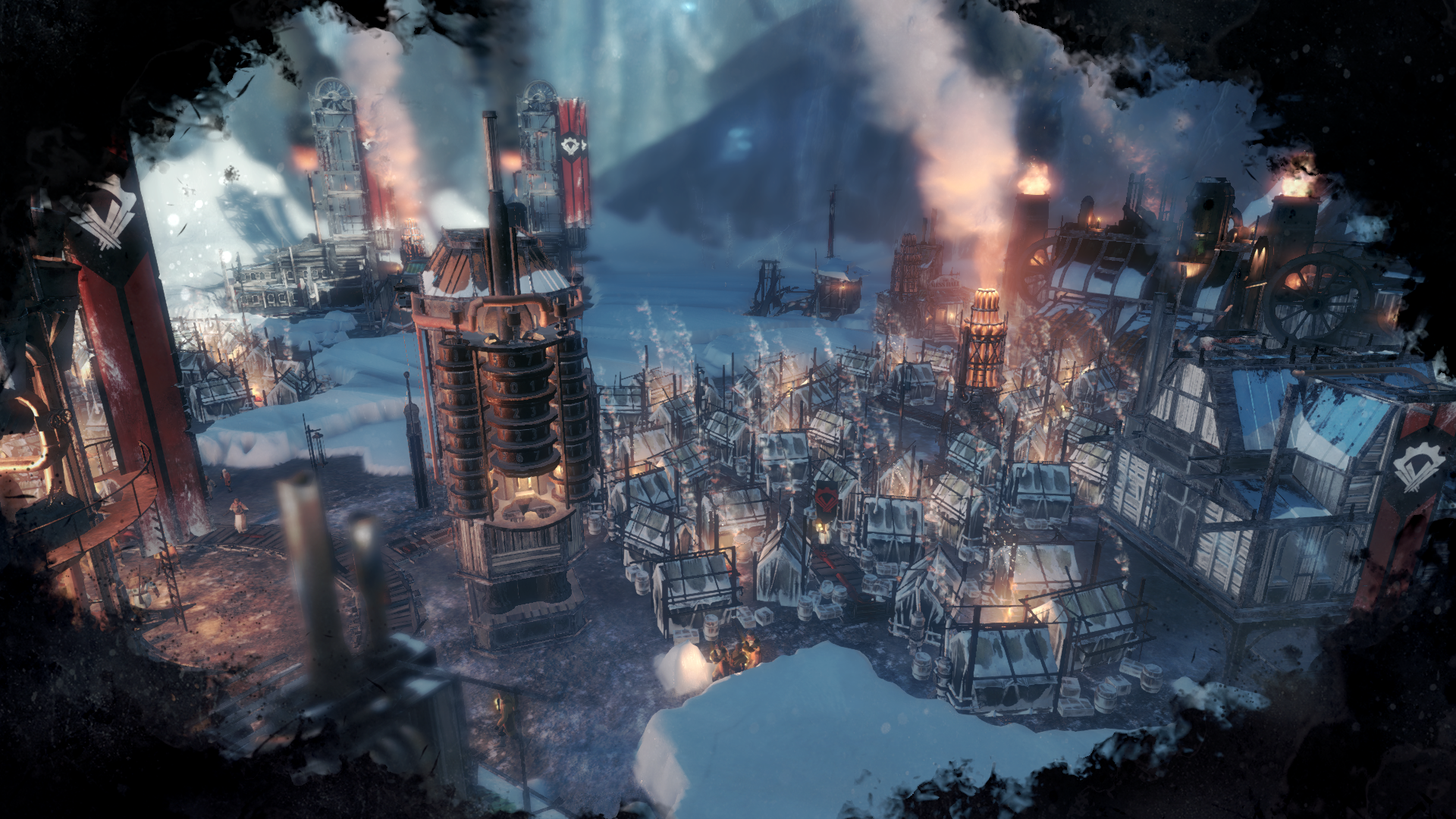
A particularly weird piece to it that's visible in this screenshot is that passing New Order in particular causes citizens to intermittently pull out a banner bearing the icon upon it and then keep walking to wherever they're going, still flying that flag. Like, okay? This especially is something I suspect 95% of even the people who actually have passed New Order have no idea exists: you normally have no reason to get that good a look at your citizens. I only caught it because I was trying to get the earlier Guard Station banner screenshot and as a result was zoomed way in, more than normal gameplay even lets you go, and there happened to be banner-toting citizens in frame.
You can also see on the left side an Order banner hanging from the Generator. I suspect this is one of the main Order banner proliferations players actually notice given how large the Generator is and how much time players are liable to end up spending looking at it.
A final weird detail: executing people causes them to be commemorated forever on the Execution Platform, where selecting it will show their name and face and tell you how 'long they survived' (Relative to when they arrived in your city, for some reason), and also assign a random made-up 'crime' to them that's ostensibly why they were executed. That last element is pretty on-point to authoritarian regimes, but otherwise the whole thing is weird. Memorialization of this sort is something people do to honor and remember people they have a positive view on: authoritarian regimes heavily prefer for most executions to be out of sight so they'll be out of mind.
Mind, Frostpunk's scale is also way too small to really be accurate to authoritarian regime dynamics. No scenario will let you go above about 700 people. That's a small enough scale it's decently likely most people will be at least kind of aware of most other people in their community, where it's nearly impossible to have secret extermination camps and the like. This is another reason Frostpunk trying to do this whole thing with authoritarian regimes doesn't work very well. Like yes, people can absolutely be bullies at a small scale, I'm not trying to suggest small groups are 'inherently nice' or something, but what Frostpunk is trying to depict and have the player fall into is not the behavior of an individual running their little metaphorical fiefdom cruelly, but rather is a specific type of awful that you see from nation-states.
-----------------------------------
Next time, we wrap up Purpose with those Faith Laws I keep talking up so much.
See you then.