For a variety of reasons, I don't see myself doing a full series on Monster Train 2 in the near future, but I was sufficiently impressed by one particular change that I wanted to do a post on it, in part because this improvement is multi-faceted in its effect, solving several different problems with Monster Train 1's design, but also in part because it's replacing a flawed system from Monster Train 1 that's completely invisible, so it's really easy to underestimate or misunderstand the nature of the change.
So first I need to explain that invisible system that's being replaced.
In both games, you've got Banner Units. What sets Banner Units apart from other units is never actually spelled out by either game, unfortunately, but I imagine most players reasonably pick up on one of the main points of distinction; that Banner Units are predominately acquired from the Banners between battles, and more generally don't share a 'pool' with other card types. That is, when a battle rewards you with a 'clan draft', Banner Units cannot be found in that clan draft, and conversely when you visit a Banner (Or get a 'unit draft'), you will only be offered Banner Units, not other card types.
However, while none of that is really explained by either game, the 'invisible' system in Monster Train 1 that I'm referring to is actually the Banner Unit priority queue.
Both Monster Train games of course use a card game framework, with decks you pull 5 cards from per turn. (Well, 5 by cards by default) I imagine most players intuitively assume that their deck is randomly shuffled and then the game simply pulls 5 cards per turn until it runs out, and this is basically accurate to Monster Train 2, but in Monster Train 1, if your deck currently contains any Banner Units, it actually invisibly makes a separate draw, searching only your deck's pool of Banner Units, and then pulls from the deck conventionally to fill out the remainder of your draws. You thus might notice that something odd is happening when you have a low count of Banner Units: if you have exactly 1 Banner Unit in your deck, the first turn of battle will always have that Banner Unit in your draw, and similarly if you have 2 Banner Units you will almost always draw one of them on turn 1 and then the other on turn 2. ('Almost always', because you might in fact draw both on turn 1 instead)
Now, I actually like the basic idea of what Monster Train 1 is trying to do here. It's clearly trying to produce a system in which Banner Units are a stable anchor for your deck strategy: if you've got an Awoken Hollow in your deck, you can't get maximally unlucky and have it be buried at the very bottom of your deck. This is especially noticeable in early battles: in your very first battle in a Monster Train 1 run, it is in fact possible (if rare) to have a run take catastrophic damage not because you made any actual mistakes, but because you drew zero Train Stewards until the absolute last possible turn. This can be especially painful when playing Primordium, who is a Champion completely dependent on another unit existing to actually do his useful things, but even for the more self-sufficient Champions it's a bad experience. By contrast, your second battle will normally have a Banner Unit and so be guaranteed to have something ready to fight on the first turn.
But while I like the idea of what Monster Train 1 is attempting to do here, it has a lot of wonky jank to how it actually plays out.
First Issue: Welcome to the Casino
I already implied one of its problems earlier: that adding more Banner Units massively reduces reliability. If you have two Banner Units, you'll have any given one by turn 2. If you have four Banner Units, you might not get an essential anchor to your strategy until turn 4. In a game where battles start out only lasting 6 tuns and end at only lasting 12 turns, a key piece not arriving until turn 4 is a big problem!
This above issue is exacerbated by a design rule to Banner Units: most of them are either suited to front-line placements (High durability, poor damage output) or back-line placements. (Poor durability, high damage output) When you have a Thorned Hollow and a Horned Warrior in your deck, you really want to draw them in exactly that order, so you can have the Horned Warrior protected immediately. Notably, many Champions also fall into this type of split, such as how the Sentient is an incredible tank with literally 0 Attack in all her Forge paths; the Champion being reliable actually emphasizes the jank of this 'more Banner Units reduces reliability' issue. Umbra and Melting Remnant have design elements that move things a bit away from this dichotomy, but they don't at all escape the core point of reliability concerns: a Wickless Baron might be a tough frontliner that also makes sense to put in back to maximize his time Harvesting, but he'll perform much better if drawn on turn 1 than on turn 4.
By a similar token, there's several Spells that are pretty strange to even exist in the context of the Banner Unit priority queue system and overall unit design. The Awoken and Umbra both have a Spell for immediately drawing and powering up a unit, but these Spells will often either have nothing to draw (They can't 'loop' to grab from the discard pile, for one), or will only be able to pull non-Banner units, which are generally designed to be poor at combat, meant to contribute through support effects rather than stats. Channelsong gives vastly more value to an Animus of Will than to an Edge Prior, but arranging that to actually happen is nearly impossible. Theoretically you could apply Frozen to Channelsong, deliberately skip playing two Banner Units, and so probably have one Banner Unit sitting in the deck with Channelsong ready to be played when the deck 'loops', shuffling the discard pile into the draw pile, but that's pretty clearly not what the thought process was for Spells like Channelsong.
Second Issue: But Thou Must, Urgently
The Banner Unit priority queue has a severe distortive impact on early turns and by extension a distortive impact on deckbuilding strategy. In Monster Train 1, cards that cost more than 1 Ember to play are very problematic: your early turns have to budget on the assumption that 1 Ember per turn is going to a Banner Unit, because Banner Units are so much of a deck's power, especially its stable power. This has all kinds of wonky implications; for example, above-average Ember costs are vastly more flawed than the game rates them as being, because it's really important to be able to play your Banner Units as they come, but it's also really important to have Ember available for other tasks. For Spells this can be reliably mitigated some by just visiting a Merchant of Magic and slotting in 1-2 Emberstones, but for units (Banner or not) the only solution is to luck into the Eternal Flame. And even for Spells, this has notable limitations and flaws, especially as the Ember cost goes up: slotting an Emberstone into a 2-Ember Spell is easy enough, but for 3-Ember or more the issues stack up fast. All this means that expensive cards are often very dubious picks, even in cases where they're pretty solid value for their cost.
Third Issue: Casino Noises Intensify
The banner unit priority queue is only partially separated from regular drawing, and so its value at creating consistency is itself inconsistent. That is, earlier I suggested that one could discard two Banner Units in support of a Frozen Channelsong, and said you'd probably get to then use it on a banner unit; it's 'probably' because you could in fact draw both Banner Units in one hand through sheer chance. This haunts Monster Train 1 constantly in an incredibly infuriating way; for example, if you put two Banner Units in your deck that cost exactly 2 Ember apiece, and you don't improve your Ember generation, you'll probably never draw the two Units together... but you actually can get severely unlucky and be forced to choose which of the two gets played. Given how Monster Train 1 is designed, whichever one you don't play now will probably never be played in that battle!
Fourth Issue: Read The Manual. What? "What Manual"? Eh, Not My Problem.
One of the biggest jank aspects surrounding this system is the fact that Monster Train 1 never suggests this invisible priority queue system even exists. I imagine plenty of players figured out the basics by just playing the game a lot, but equally I'm sure there's plenty of more 'casual' players who, say, did a run here and there with a week or more between individual play sessions, and thus went dozens of runs entirely unaware this system exists.
Fifth Issue: Don't Fly Your Flag
Worsening Issue 4 is that while all units that come from Banners are Banner Units, not all Banner Units come from Banners. A few units that come from events -such as Dante the Deceptive- are invisibly Banner Units and so will slot into this priority queue, with absolutely no indication in-game you should expect this. And on initial release, there was even a Melting Remnant unit that had Banner Unit priority while not being a Banner Unit!
This isn't even all the ways the invisible Banner Unit priority queue system was a janky problem, to be clear. They're just some major examples to my mind worth pointing out, in part to help contextualize why the Deployment Phase is such a huge improvement.
On that note.
------------------------------------------
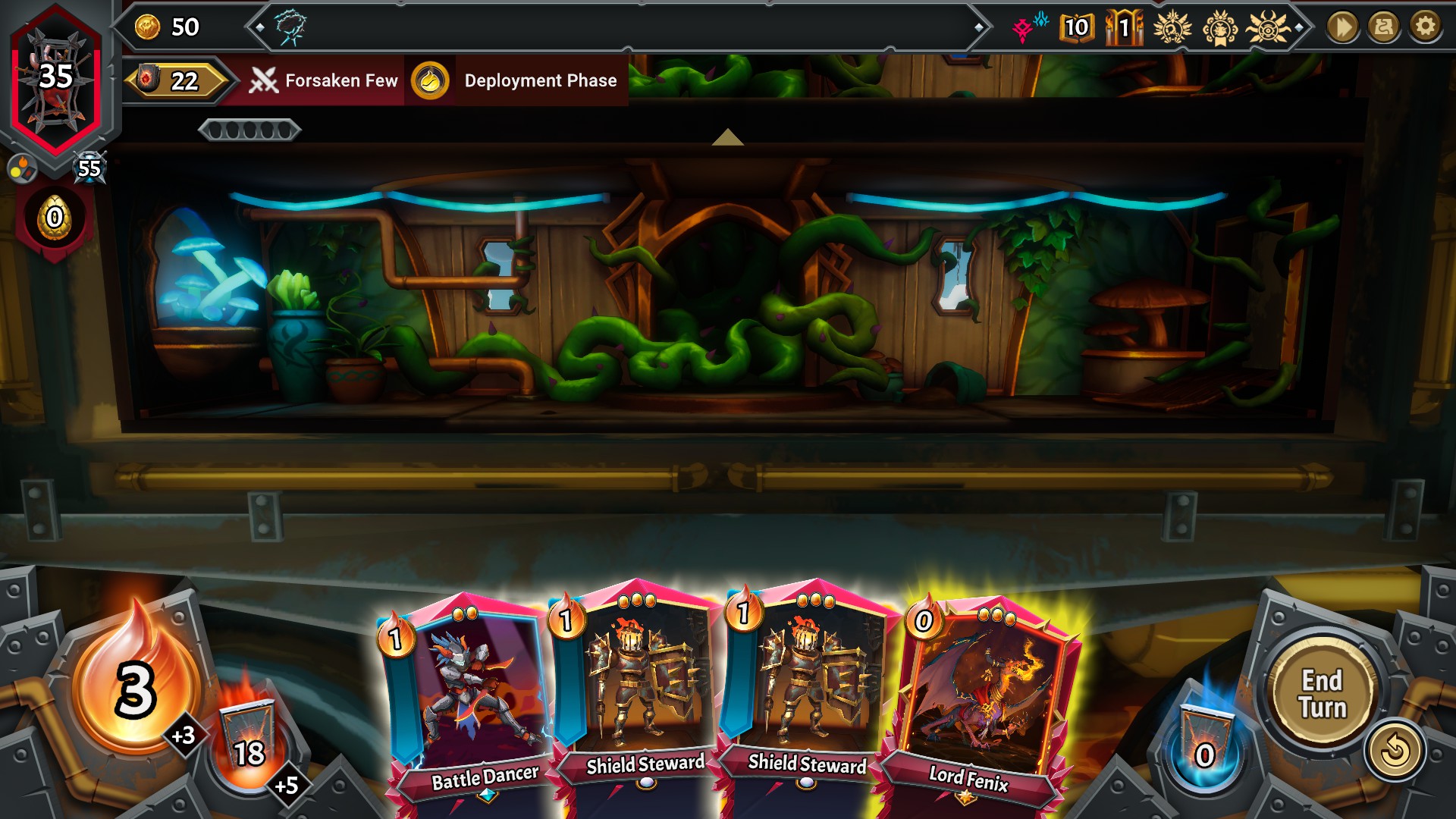
In Monster Train 2, the entire above system is gone, replaced by the Deployment Phase: now, before the first proper turn of battle starts, a special turn occurs in which the player attempts to draw all their Banner Units and nothing else, and gets to play them with a full turn of Ember before enemies show up and before the regular flow of draws starts. Not only that, but in fact the Deployment Phase comes with a new concept: Deployment Ember, which is extra Ember you only get in the Deployment Phase, with a run starting with 1 Deployment Ember in addition to the normal 3 general Ember. (ie you can spend up to 4 Ember in the Deployment Phase at the start of a run)
There's a lot of improvements brought by this system, starting from how most of the prior problems dissolve away, and of course the Deployment Phase isn't an invisible mess a player may fail to realize even exists. The game does a somewhat poor job of explaining the Deployment Phase, unfortunately, most notably completely failing to communicate that Banner Units are in fact now visibly marked by a blue banner down the left side of the card and so eg event Units can in fact be determined at a glance whether they count as Banner Units or not, but it's still a significant improvement in many ways, many of which aren't obvious at a glance.
So let's rattle off several of these.
1: Teamwork Empowered
As noted earlier, in Monster Train 1 especially but still to a degree in Monster Train 2, the devs are fond of designing Banner Units to be either a frontline tank or a backline damage dealer who will disintegrate if exposed to enemy attacks, encouraging you to use each archetype in concert with the other. In Monster Train 2, this is executed effortlessly: simply play them together in the Deployment Phase.
2: Ramping Consistently
Monster Train 1 and 2 have a decent rate of Banner Units who have some capacity to grow stronger over the course of the fight. In Monster Train 1, such units are often decent in the earliest fights, but become an inconsistent performer as you accumulate Banner Units because you become less and less likely to draw them early enough for them to get maximum ramping. Slay-trigger Units are particularly egregious about this, but even Units like the Thorn Hollow still resent missing out on 1, 2, 3, or more turns of ramping potential, becoming inconsistent performers that might be amazing or might contribute barely anything, purely at the whims of the deck RNG. Only Champions escape this problem since they cheat and get drawn for free as an extra card on the first turn.
In Monster Train 2, ramping Units are much more consistent. RNG can be a factor depending on how they ramp, of course, but you can at least be assured that a Banner Unit who ramps will be in place to soak ramping opportunities from the first turn of combat.
3: More Banner Units! More!
As noted earlier, Banner Units in both games are meant to be powerful anchors that the player values more greatly than most cards, but the Banner Unit priority system means that every Banner Unit you add past the first one reduces your strategy's consistency, making for a weird tradeoff the design clearly isn't intended to account for.
The Deployment Phase substantially erases this problem. Unless your Deployment Phase cards are over 10 (And in general play, 11 Deployment Phase cards is difficult to achieve), you at worst simply don't immediately play extra Banner Units: they won't interfere with your existing strategy in a serious way. Furthermore, since Deployment Phase Ember can only be spent on Banner Units, up until you have more than 4 Ember of Banner Units further such Units are essentially free; while Train Stewards were reworked so half of them are Deployment Phase Shield Stewards, they remain substandard units you will usually prefer to replace, so for many runs you'll add a Banner Unit for completely free, then add two more for mostly-free by displacing the Shield Stewards. As 3 Banner Units added was what Monster Train 1 was shooting for as your most common occurrence this gets you there for very cheap.
This is further supported by the fact that upgrading your Ember generation includes a Deployment Ember on top of the Ember. Thus, if you increase Ember generation to support your deck's overall Ember load per turn, suddenly you can fit 2 more Ember of Banner Units for free! This makes high numbers of Banner Units actually good to have, rather than a reliability nightmare.
This also touches on...
4: A Good Price
Banner Units costing additional Ember to play is a crushing flaw in Monster Train 1, but a tolerable tradeoff in Monster Train 2. Notably, in Monster Train 2 your starting Uncommon card has switched to being a starting Uncommon Banner Unit; in the event this card rolls to be a 2 Ember example, your first fight shoulders that load for free (You will simply leave 1 Ember unspent if you instead start with a Banner Unit that costs 1 Ember), and as you progress it first means you just start displacing Shield Stewards more quickly. You should certainly be careful about eg making more copies of expensive Units, but you can fit one in without all the nightmare jank they impose in Monster Train 1.
Indeed, the Banner Phase makes it acceptable for a Banner Unit to cost up to 4 Ember. Not ideal, no, but possible to fit in at all, and in general more costly units don't automatically produce the danger of 'I can either play this Spell I desperately need to play right now, or play this expensive Banner Unit I ideally do play, not both'.
This all by itself helps a lot with Banner Unit balance: no longer are slightly-expensive Banner Units a dangerous risk to take at all, easing pressure on the design.
5: Consistent Anchors, Consistent Switches
One of the most sinister problems with Monster Train 1's priority queue system was how much it discourages changing your strategy. Having 2 Banner Units you anchored your strategy around was pretty consistent so long as you were fine deploying them to the middle or top floor, but if you were offered, say, a Rare Unit that's a great fit to your deck and Artifacts, actually taking it would reduce your reliability, and fixing this problem would require Purging one of your existing Banner Units.
In Monster Train 2, however, it's perfectly viable to rely on a couple of Banner Units for your first few battles, and then pick up and enhance a different set of Banner Units and anchor your strategy around them instead. The transition occurs smoothly and safely, and you usually will still use the old Banner Units, just not getting as much use out of them.
6: Insensitivity to Wave Timing
One of the most infuriating things about Monster Train 1 was how it was, in general, a game that centered very heavily on drawing cards with correct timing, while offering you very little control over this aspect. Infuriatingly often in Monster Train 1, I would have a run crash and burn not because my deck was flawed or because I'd made poor strategic decisions or because I'd been too consistently careless with my Pyre Health, but because the game decided to arrange my draws in a manner that was perfectly anti-suited to the fight at hand: my Quick Sweep Banner Unit doesn't draw in time to prevent the first wave of frail backliners from arriving, I draw my 2-Ember Banner Unit simultaneously to when I must play 2 Ember of Spells or else these enemies will reach my Pyre and do outrageous damage, my tank arrives but I will draw literally no healing until it's unavoidably killed by enemies...
... this was all a fundamental issue, but it was particularly exacerbated by Monster Train 1's high Covenant effects, where your middle floor suffers a Capacity reduction and your top floor applies 1 Emberdrain to the first unit played on it each turn. This could -and frequently did- create situations where eg if I play my first-turn tank on the bottom floor, it dies basically immediately, if I play it in the middle then I can't play anything behind it, and if I play it on the top floor then I don't have enough Ember on turn 2 to play my new Banner Unit and the Spell or Spells I desperately need to play.
In Monster Train 2, the Deployment Phase removes the single biggest offender from this equation: the Banner Units themselves. (Also, its Covenant Ranks don't include the Capacity reduction and Emberdrain effects) If I need X Banner Unit by Turn Y, I just play it in the Deployment Phase. Unless something like a Sweep enemy kills it, or the incoming damage is way too much for my tank, it'll be present when I need it. This also quietly does away with many other timing problems: in Monster Train 1, you can easily draw a support Spell before the Banner Unit it's intended to support, or worse yet right alongside each other where that's too much Ember. (eg Ritual of Battle costing 3 Ember and being a big damage boost, and so great to put on a Horned Warrior but impossible to play in the same turn without Ember support) This type of RNG-screw is simply much less able to happen in Monster Train 2 thanks to the Deployment Phase.
Interconnected with this is:
7: Destiny vs Savescumming
One of the most frustrating, sinister aspects of Monster Train 1's setup is that when you enter a battle, the game locks in its RNG seed. If you're going to draw your two expensive Banner Units on turn 2 and so not be able to play one of them, this is guaranteed to happen and there's nothing you can do about it. If a card you really need to draw by turn 3 is 6 turns deep into your deck, you probably can't do anything about that. If your Spells for deleting key backliners are going to fail to show up for the three turns a key backliner is in the train, you probably can't do anything about that.
I had a frustratingly large number of runs in Monster Train 1 where the game gave me an absurdly perfectly wrong draw order such that having a human who personally hated me control my draw order would probably have been less problematic, where I spent an hour or more trying to win a fight I unambiguously should have been able to win, in fact should have won easily virtually guaranteed but simply couldn't contrive a victory even if I restarted the fight and abused my Future Knowledge of what I would draw when to make counterintuitive decisions; I soured on the game without quite reaching Covenant 25 because these experiences were so deeply unpleasant and made me feel my skill at the game ultimately didn't factor much into my chances at victory.
In Monster Train 2... well, in the first place these types of things virtually never happen. I might restart a battle if I realize I deployed my main defense force on the wrong floor -Ring 7 in particular is very punishing to putting units on the top floor and I often forget until Rax or Athane actually arrives- but most of the time if I feel I'm doomed, it's that my strategy, my deck, etc, isn't up to snuff. And usually when I do feel RNG-screwed, it's in the sense that eg my strategy would've stomped Rax but rolled Athane; this is its own design issue, but more part of the general Roguelike design philosophy where sometimes defeat cannot be avoided by superior skills.
In the second place, while Monster Train 2 locks in the RNG seed just like the first game when entering a battle, your deck's shuffling is affected by what Banner Units get placed within in, and how many of them.
As such, the handful of times my deck has been so crazy-uncooperative that I was getting an unearned Destiny of Defeat via Exact Draw Order... I've usually been able to effectively 'reroll' my deck RNG seed by deploying fewer and/or different Banner Units.
------------------------------------------
Monster Train 2 isn't perfect, but the Deployment Phase all by itself makes the core experience so, so much better. I almost wish we'd get a Monster Train 1 Classic mode that uses the old enemies and events and so on, but just replaces the Banner Unit priority queue with the Deployment Phase and Deployment Ember: this would make MT1 so, so much better of an experience.
That's all I'll say about the Monster Train games...
... for now, at least.