
For Warriors of the North, we're starting with Vikings this time, not Humans, because in Warriors of the North Humans are no longer the 'default' early game faction, and indeed mostly don't show up until more in the mid-game, whereas the brand-new Vikings are going to be your primary army type for the early game.
Speaking more broadly... well, Morale hasn't changed any since Armored Princess, actually. Indeed, most of the broad mechanics are reasonably solid at this point in the series, and don't need much modification.
The one major exception is that now all damage can crit. Yes, all of it. Damaging Talents. Damaging Rage skills. Damaging Spells. Even damage from Burn/Poisoning/Freezing/Bleeding can crit! In the case of Talents the crit chance is lower than with performing a normal attack, starting from 50% of your regular crit chance at neutral Morale and rising up to 80% of it at +3 Morale; as such, if you're hoping to gamble for a crit, you should avoid Talent use.
For Spells and Rage, the base crit chance can be called 3%. This is extremely misleading, particularly for Rage, because your Mana or Rage resource count rescales it; if you cast a Spell with full Mana or use a Rage move when your Rage is maxed, you get that 3%, but if for example you cast a Spell at 50% Mana then you halve the crit chance to 1.5%. This is why I say it's particularly misleading with Rage; while it's more common in Warriors of the North to hit maximum Rage, you'll still regularly use Rage moves at less than maximum Rage. Also note that this rescaling effect only applies to the base chance; the Destroyer Skill boosts Spell crit chance, for example, and its crit chance doesn't care about your current Mana.
Annoyingly, AI Heroes have a different formula for Spell crit chance that gives them 0.35% crit chance per point of Intellect, and then furthermore sets the minimum base crit chance to 15%. As such, enemy Heroes will crit a lot more often with their Spells, pretty much always. It is at least fully scaled to their current Mana count, so if they open with expensive Spells that don't do damage they can basically 'waste' their crit chance advantage.
Also note that when it comes to units conceptually casting Spells (eg the Book of Evil), this just uses the Talent crit mechanics, not Spell crit mechanics.
Returning to the topic of Freezing being able to crit, instead of Freezing being a limited effect that shows up in a handful of cases and just slows down some units, now it's your third damage over time effect that's tied to a damage type; the new Ice damage type. Oh, did I mention Warriors of the North has made Cold Ice an actual damage type now? Because it has. It's awesome, and about time. Anyway, Freeze still slows units down, mind, but often you'll be paying a lot more attention to the percentile damage, especially since serious Ice resistance is fairly rare in Warriors of the North, making Freeze arguably the best of the over time damage effects, even if you ignore that slowing the enemy down is usually more useful than a penalty to Attack or Defense.
On a similar note, Bleeding joins up with Freezing as a fourth damage-over-time effect, doing Physical damage in addition to lowering the maximum Health of a victim. (As opposed to the minor penalties to Attack and Defense it previously imposed) There's still not a ton of things that inflict it, but while only a few units natively inflict it the game does things like provide Items that allow units to inflict Bleeding, so it's not quite as rare as these posts might lead to you believe, at least not in terms of the player's ability to inflict Bleeding.
Oddly, all four damage over time effects -Burn, Poison, Freeze, and Bleed- actually use the Spell crit mechanics, and so will crit more often when your Mana is high and have their crit chance boosted by the Destroyer Skill. This includes that enemy Heroes get much better odds of critting with them than you. What about unled armies, then? Well, they get a flat number; 15%. So yeah, for a long time enemy armies that include damage over time effects will have a pretty noticeable edge in effectiveness with them, period.
Vikings themselves have two racial gimmicks. The first is Hardened, which is basically a renamed version of Cold Resistance. Let's get that description out of the way...
Hardened
The unit has 10% Ice resist and gains 50% more Defense in snowy battlefields.
Yes, it's actually been nerfed from when it was Cold Resistance. No more Freezing immunity, and going from 25% resistance to 10%. Ouch.
The other new mechanic is Runes. It's not actually limited to Vikings, but it's common to all their units, and rare outside of them as an innate effect (As least before you account for the leveling mechanic in Ice and Fire), and my digging inside the files indicates Runes are half as effective on non-Viking units to boot. (ie halve the following values when using Runes on a non-Viking unit) Runes come in three flavors;
 Attack. Increases Attack by 20% and crit chance by 16% until the unit's next attack hits or the start of their next turn.
 Defense. Increases Health by 16% and Defense by 20% until they're hit by a unit's attack or the start of their next turn.
 Luck. Provides a 30% chance for the unit to get a second turn, assuming it successfully performed an aggressive action of some kind. (ie Luck can't trigger simply from walking, or from using a Talent that summons units or bolster allies or imposes a negative effect on enemies) This second turn comes after all other turns are finished, and the unit only has 1 Action Point for this second turn.
(Note that in the base game the Runes all have a fairly similar brown coloration instead, relying primarily on the different symbols to be distinguished. This is one of the smaller changes Ice and Fire makes, and yet I think it's a really good change)
Note that crit chance going up '16%' does not mean that a 1% crit becomes a 17%. It means that a 10% crit goes up 1-2 points. Attack Runes are honestly pretty ignorable, unfortunately. I'm not sure why it wasn't made to affect damage outright.
You can activate a Rune anytime you like during a unit's turn, no AP loss or turn ending or anything, but the Rune is consumed and you can only have one active at a time. (ie applying a new Rune, such as when your Attack or Luck Rune is lingering due to a Miss, will overwrite the old Rune) Units that have Runes mostly start a battle with 1 of each, but this is influenced by the player's Skills, unit Abilities, etc, and in Ice and Fire units can even acquire Runes from leveling. And I don't just mean that units with Runes can acquire more; units that normally lack Runes can get them from levels. As such, if you're playing Ice and Fire, Runes are considerably more common on enemies, and more consistently usable on your own units if you're diligent about actually leveling units.
Further note that Runes are mechanically just a regular buff. This is most significant for the fact that Morale is still impacted by positive and negative buffs. As such, Runes can be used to offset Morale penalties from negative effects, such that even a Defense Rune or Luck Rune can increase your damage sometimes.
Also note that Runes aren't used up until the start of a proper turn if eg a unit Misses or never gets attacked. This primarily crops up via effects that grant units additional turns, such as Fit of Energy, but it means you can potentially give a unit a second chance to benefit from a Rune if eg they Missed their target the first time around.
Finally, Runes are completely inapplicable to units with Spell immunity. You can't use Runic Word to give them Runes, they can't be given Runes by Runic Magic ranks at the start of a battle, Items that give Runes don't work on them, and they can't even gain Runes from leveling.
Also, something worth commentary: reload timers on Talents that reload, as well as duration on ongoing effects, only advance their 'clock' when a unit's first turn of the Round ends. This has always been true in these games, applying in any case where a unit gets an additional turn at the end of the Round (eg Paladins using Second Wind in Armored Princess), but it's a lot more prominent in Warriors of the North thanks to Luck Runes. This means a unit can potentially use a reloading Talent a Round early by getting a second turn, but it also means that ongoing effects can have a more pronounced effect if they're getting bonus turns. (eg an Archmage can potentially make 3 ranged attacks benefiting from Fighting Trance, instead of the usual 2)
Also, since I've already brought it up: Ice and Fire. I'm using the base stats of units from Ice and Fire for all these numbers, so there may be inconsistencies between what I describe and what you experience if you don't play that expansion/mod. Ice's and Fire biggest effect of relevance here is the aforementioned leveling, though I'll be getting into the details of that in its own post instead.
Anyway, on to the Viking units.
The Vikings as a faction are interesting, being an expansion on the Barbarian and Berserker units from The Legend and Armored Princess that's been made into its own faction outright. Indeed, those two Neutral units no longer exist, though they have clear counterparts within the Vikings, one of which even retains their historical name. (Curiously, the Neutral Barbarians and Berserkers seem to still be in the code, up to and including that the experience configuration file in Ice and Fire includes them in experience classes)
The Vikings themselves at first glance appear to be a melee-focused faction, much like the Orcs and Dwarves before them, but in actuality they're shockingly stacked toward ranged combat, with even their melee units tending to function as pseudo-ranged units in terms of being able to do damage without retaliation and/or in circumstances a 'pure' melee unit wouldn't be able to do so. Their biggest consistent theme, overall, is that they tend to lean toward a heavy offensive presence, with defense being handled primarily by avoiding being attacked in the first place, plus some backing from healing and revival to make their relentless aggression a bit less casualty-prone.
In spite of being the beginning species of the game, Vikings actually do get a racial bonus for a mono-racial army. Delightfully, Humans have also acquired a mono-racial bonus at last!
On an aesthetic note, Vikings have a strikingly different visual style from every unit that's come before. It's a lot more colorful and exaggerated. I'm kind of curious as to why that was done, what the thought process was.
Race relations-wise...
 -3 Morale for Undead presence in allies.
 -3 Morale for Undead Lizardmen presence in allies.
... Vikings really hate the Undead, and that's it.
So time for the units.
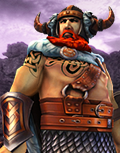
Viking
Level: 2
Hiring Cost: 65
Leadership: 40
Attack/Defense: 12 / 10
Initiative/Speed: 5 / 3
Health: 30
Damage: 4-6 Physical
Resistances: 10% Ice
Talents: Shield Bash (Reload: 2. The Viking charges in a straight line out to their current Action Points+1, doing 3-5 Physical damage to a single target with a 50% chance to Stun the target. Requires at least one empty space between the Viking and the target, but the target cannot retaliate), Berserk (Charge: 1. For 3 turns, the Barbarian Viking has doubled Attack, Initiative, and crit chance, halved Defense, and goes out of control. They are additionally immune to mental effects for the duration. Does not end the Barbarian's Viking's turn)
Abilities: Hardened, Vengeful (50% or more casualties equals automatic crits), Runic Knowledge (Begins battle with 1 of each type.)
Compared to Armored Princess' Barbarian unit, Vikings have 2 more Attack and Defense, but actually have 5 higher Leadership required. (In addition to Hardened being actually worse than Resistant to Cold) They also cost 5 Gold more, but whatever. Of course, they've also picked up Shield Bash, access to Viking support/racial Morale, Vengeful (Which for some reason Berserkers have actually lost), and Runic Knowledge, so they're still ahead by quite the margin. Shield Bash in particular is a huge spike in their utility, as it makes them a melee unit that can contribute damage without necessarily taking damage. Huzzah!
And of course they've got a spiffy new graphic in the Viking's distinctive, strangely cartoonish art style. I like it, don't get me wrong, but they really stand out alongside a lot of the classic units, and indeed alongside many of the Ice and Fire units, given those are all more-or-less just reskins of classic unit graphics.
Overall, Vikings are very useful for helping buy time for your ranged units while getting in some free damage of their own, and in even-ish fights can even go Berserk to reduce casualties on your end by virtue of simply wiping out enemy stacks entirely. Do note, however, that Berserk Vikings never use Shield Bash of their own volition. If you set it up so the only sensible move available to them is to Shield Bash a target in a straight line from their current position, they'll just walk closer to the enemy. It's generally a good idea to plan around having Vikings Shield Bash first or second turn and then Berserk the following turn.
As enemies, Vikings are primarily notable for pretty much the same reason Barbarians were: by screwing with your plans via spiking their Initiative with Berserk. I'm not entirely sure I've ever seen the AI actually use Shield Bash; it's possible they don't actually understand how to use it, and certainly even if they do know how to use it it's in the form of 'either they can use it from their starting position or they won't use it at all'. (The fact that your own Vikings refuse to use the Shield Bash when Berserking is suggestive) This makes AI Vikings surprisingly un-threatening; a base Speed of 3 is noteworthy, but in real terms that tends to be the only thing AI Vikings have going for them. In particular, they tend to stand out far less than Berserker and Pirates, both of which are 3 Speed melee units that have much more problematic secondary qualities.
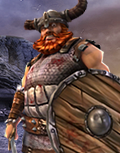
Berserker
Level: 3
Hiring Cost: 130
Leadership: 60
Attack/Defense: 20 / 14
Initiative/Speed: 6 / 3
Health: 52
Damage: 4-7 Physical
Resistances: 10% Ice
Talents: Dash (Reload: 2. +2 Action Points), Berserk (Charge: 1. For 3 turns, the Barbarian Viking Berserker has doubled Attack, Initiative, and crit chance, halved Defense, and goes out of control. They are additionally immune to mental effects for the duration. Does not end the Barbarian's Viking's Berserker's turn)
Abilities: Hardened, Shock Shield (If an enemy counterattacks the Berserker, the Berserker makes a follow-up attack that does 4-5 Physical damage and has a 20% chance to Stun the target. Additionally, their counterattacks always use this shield-based strike, Stun chance included), Mad Fury (After 50% casualties, the stack auto-Berserks, doubling their Attack and Initiative, halving their Defense, and rendering them uncontrollable and immune to mental effects. If they rise back above 50%, this effect will end), Ignores Pain (+5% resistance to all damage types each time the Berserker takes damage, up to a total of 25%), Runic Knowledge (Begins battle with 1 of each type)
Compared to Armored Princess' Berserker, Warriors of the North's version has been massively overhauled into an almost unrecognizable unit. Their Health has spiked by 22 points, their Defense has gone up by 10, Running has been replaced with a Reloadable version of itself, and instead of being auto-Berserked and getting Vengeful they can manually Berserk (Taking them to an obscene twelve Initiative) and they've gained a whole slew of passive Abilities. Extremely unusually, their Level has gone up by 1, as well! The only tradeoffs they've gotten is that they're no longer immune to Mind spells, they cost 130 Gold instead of 70, and admittedly their Leadership has nearly doubled. (60 instead of 35) That's an amazing trade.
Mad Fury is the new Berserk (Ability), of course, but it can be played around and even canceled out by resurrection, making Berserkers a lot more cool of a unit all-around. It also actually provides the stat modifiers of a Berserk, which leads to Berserkers getting that utterly insane twelve Initiative if their numbers are halved, which can actually make a big difference in their performance. AI Berserkers, in particular, can put you into tricky situations where if you start shooting them right now you're risking them crossing the Mad Fury threshold and immediately attacking a unit you might otherwise have been able to move out of their reach, that kind of thing.
Also note that Ignores Pain's description in-game is wonky. I'm using the numbers the game gives, but while the game inexplicably claims the effect kicks in when Misses occur, it very obviously activates when the Berserker takes damage.
Also note that the in-game numbers listed for their damage and shield bash damage are inexplicably lower than their actual damage. I've listed their actual damage above.
Berserkers actually tend to shove aside Vikings overall as the game progresses; when fights are closer to even, they tend to do way better, and when you're either not trying to completely avoid casualties or just plain can't avoid them, the combination of Ignore Pain, superior base stats, and Shock Shield means they actually tend to take fewer casualties than Vikings while dishing out more damage and frequently shutting down enemy Talents for a turn. If you expect to be able to carefully control a battle, Vikings are usually a bit more useful, but if things are going to devolve into barely-controlled close-quarters combat the Berserker is pretty much always better.
As enemies, Berserkers are a giant pain in the butt. They can cover an insane amount of ground on the first turn, the very act of beating them up risks giving them the Initiative advantage on the second turn, the more you hurt them the less effective follow-up attacks are, and once they're in melee they tend to do shocking amounts of damage. The Stun potential can unexpectedly take away key Talents or prevent a unit from moving in time/as far as necessary, too, and even stalling out a Berserker with tools like Slow+Freeze runs into the problem that after a couple of turns they Dash anew! There's trickier enemies out there, in terms of how difficult it is to prevent them from getting in hits on your troops -most ranged units, for one- but Berserkers still stand out as a very serious problem that has to be properly managed or else you're not going to like what happens. Indeed, Berserkers are one of the biggest reasons why I tend to delay fighting Viking battlegroups until I'm rated as notably stronger than them -without fairly specific tools or force compositions (eg a bunch of Level 5 units that thus can soak a hit from a moderately weakened Berserker without taking a casualty) that's what it takes to be able to take out Berserkers without suffering casualties.
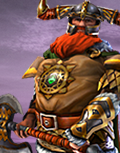
Jarl
Level: 4
Hiring Cost: 1470
Leadership: 320
Attack/Defense: 32 / 36
Initiative/Speed: 4 / 3
Health: 240
Damage: 20-30 Physical
Resistances: 25% Physical, 10% Fire , 10% Ice
Talents: Sweeping Strike (Reload: 2. Attacks not only the target but also enemies to its side for 20-30 Physical damage. No friendly fire risk), Battle Cry (Charge: 1. Adjacent enemies of 320 Leadership per Jarl or less that are below Level 4 become Frightened for 2 turns and immediately move 1 tile away from the Jarl. For each enemy successfully frightened, the Jarl gains +2 Morale for 2 turns. Battle Cry is impossible to recharge, but using it does not end the Jarl's turn), Call to Battle (Reload: 4. A target ally who is below Level 5 and whose Leadership total is below 800 per Jarl is granted a full second turn after all other turns are done with. If the target was a Viking-the-race, they also receive +8 Attack for 2 turns. Using Call to Battle does not end the Jarl's turn)
Abilities: Hardened, Enchanted Armor (25% Physical resistance, 10% Fire resistance. When attacked, 20% chance to halve incoming damage), Daring (+2 Attack per crit landed by the Jarl, to a maximum of +10 Attack), Elemental Axe (Has a 30% chance of Freezing or Shocking targets with melee attacks, including Sweeping Strike. This effect cannot trigger against Level 5 units), Shoulder to Shoulder (+10% to Attack and Defense for allied units below Level 4 that are adjacent to the Jarl), Runic Knowledge (Begins battle with 1 of each type)
I talked about how Armored Princess and especially Orcs on the March was fond of complicated units, and... Warriors of the North and Ice and Fire don't really reverse this, though they're a bit better about making the use and understanding of these complicated units relatively straightforward. The Jarl has a ton of stuff to read, but in practice they can be boiled down to a tough melee unit that does well in the thick of things that also has a couple of supporting effects available.
Battle Cry is a weird Talent that can potentially be very useful -mass Fear is nothing to scoff at, and forcing enemies to move in predictable manners can be nice for eg working on Trapper progress- but is also very easy to misuse. It's easy to shove enemies out of the Jarl's reach and only then realize that oops you can't actually follow up on that Morale bonus you just earned, and rather irritatingly the game won't prevent you from wasting Battle Cry on a unit that could be affected by Battle Cry but whose current Leadership is too high to be affected in actual fact. Battle Cry is also hampered a bit by how often you fight Undead; anything that's immune to mental effects cannot be affected by Battle Cry at all.
An unusual mechanics point is that Call to Battle's stat boost for Vikings is not an explicit buff and thus cannot be Dispelled, but also can't buffer an ally against Morale penalties from negative effects. It also means it's easy to forget about it (Both in the sense of 'oh yeah, that's a thing Call to Battle does' and in the sense of 'wait, who did I Call to Battle, again?'), which can be genuinely a little problematic if you use Call to Battle on something like a Soothsayer and then promptly start using their support abilities instead of leveraging the decent damage boost.
Toward the beginning of the game, the Jarl is amazing and can be thrown fearlessly into combat (In part because Hardened will frequently be boosting their already-significant Defense; be warier with them if the battlefield doesn't look snowy), shrugging off tons of damage and dishing out useful negative effects in the process, all while providing support utility via Battle Cry and Call to Battle. As Leadership rises and it becomes increasingly plausible for the Jarl to actually take a casualty in a melee exchange, their incredible support utility keeps them relevant, and it just becomes more important to eg arrange to use Sweeping Strike to finish off a weakened stack while also catching one or two more dangerous stacks. Eventually things reach the point where actually using the Jarl pretty much demands you accept a slow burn of casualties, and even if you're obsessive-compulsive about Grand Strategian ranks that point arrives long before you've maxed Grand Strategian. So optimally you drop them for a while at that point and only come back to them once you're done with Grand Strategian -but they still hold their own even into the endgame if you're fine with minor casualties and/or babying them with Level 3 Resurrection. (The Spell)
As enemies, Jarls are... erratically annoying? Enchanted Armor randomly halving damage can botch plans to take them out early, and sometimes they'll use Call to Battle in a manner that seriously inconveniences you, but quite frequently they just end up a modestly fast reasonably durable melee unit you end up killing before it accomplishes much of anything. It's really weird and annoyingly RNG-dependent, which is a bit of a theme with Warriors of the North as it happens.
Level-wise, the Jarl has one of the better level-up sets, belonging to 3 classes beyond the Base class, albeit there's a bit of inefficiency since you can't get more than 1 Initiative and two of their classes give Initiative. (On the other hand, Initiative boosts aren't actually that desirable for Jarls anyway, since they want to go after other units for Call to Battle purposes) Conveniently, they're also really good at rapidly gaining levels, since they're very capable melee combatants and have two different Talents that don't end their turn; Talents that don't do damage to enemies always provide a fixed amount of experience when used, so units with turn-free Talents tend to level faster than other units. This means in Ice and Fire Jarls tend to stand out even more in the early game than they already did, as they'll pretty consistently pull ahead of basically every other unit in experience.
Note that Daring's maximum bonus to Attack is actually half what the game claims. Most battles aren't going to have a Jarl get to crit the 6+ times it would take to matter, so whatever, but oops?
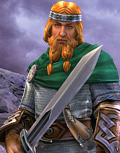
Skald
Level: 2
Hiring Cost: 50
Leadership: 35
Attack/Defense: 8 / 8
Initiative/Speed: 5 / 3
Health: 22
Damage: 3-4 Physical
Resistances: 10% Ice
Talents: Paean (Reload: 3. All allies are granted a random positive effect), Evil Taunt (Reload: 3. All enemies below Level 4 are afflicted with a random negative effect)
Abilities: Hardened, Cautious (Once 30% casualties occur, 30% chance for incoming attacks to Miss), Pangs of Conscience (When the Skald performs a melee attack, there is a 20% chance for them to zap the target with Magic damage equal to half the damage of their last attack, scaled relative to the Leadership difference between the Skald stack and their attacker eg the smaller the Skald stack the weaker the damage. This will do at minimum 1 damage per Skald), Singer (Non-Skald Viking allies have +1 Morale), Escort to Valhalla (+1 Initiative for 2 turns for allied Vikings when an allied stack is wiped out), Runic Knowledge (Begins battle with 1 of Attack and Defense each, and 2 of Luck)
Paean and Evil Taunt roll randomly per individual; it's not 'Doom on all enemies' or 'Avenging Angel on all allies', it's 'Doom on that guy, Curse on this other guy...' and 'Battle Cry on this buddy, Bless for that friend...' Unfortunately, this makes Paean terrible, while Evil Taunt is... okay when you're fighting enemy armies that are 10+ stacks, and mediocre against normal-sized battlegroups. As for specifics, Paean can cast...
Avenging Angel, Battle Cry, Bless, Timelessness, Haste, Negation, and Stone Skin
... which is an unpredictable mess of effects you can't really do a lot to plan around fully leveraging. Generic melee with a wide damage range is the closest you'll get to optimizing, and it's not very optimal. Especially since you have to have your entire army be such to avoid any possibility of stuff like Avenging Angel being slapped onto a ranged unit. So Paean is less than ideal. Also note that Paean does not benefit the Skald stack itself, further hurting it. As for Evil Taunt...
Slow, Helplessness, Doom, Weakness, and Pygmy
... it's closer to reliable. 3/5ths of its possibilities reliably enhance damage output against the target, so a Soothsayer run might consider slotting in a Skald for a while as an okay option for enhancing damage output. Further, Weakness will never be rolled against targets that are immune to the Weakness Spell, which of course includes Undead; you'll quite often have Evil Taunt have 75% of its results be damage enhancers. Slow is usually an acceptable alternative against Undead battlegroups, too, especially if you're able and willing to drop something in melee with enemy ranged units abruptly; in that case, Slow hitting an Undead ranged unit can let you prevent them from attacking a target you don't want them attacking.
Both Paean and Evil Taunt are effectively casting these Spells as Level 1 versions, but scaled as if cast by the owning Hero -among other points, this means Avenging Angel will have better damage in Soothsayer runs than in Viking runs, because it benefits from the Soothsayer's high Intellect. Though this also means that overall Paean and Evil Taunt lose what luster they have as a run progresses; when you're only casting Level 1 versions yourself, the Skald casting them for you is giving up control in exchange for not paying any Mana and getting more Spells slapped down than you could do manually, which is a pretty nice trade. When you're at the point of largely casting Level 3 Spells, it's a lot less appealing.
Also note that Paean and Evil Taunt will never roll a result that's already sitting on the target unit. If you had an enemy suffering from all of Slow, Helplessness, Weakness, and Pygmy, then Evil Taunt would be guaranteed to hit that unit with Doom. This isn't super-important, but if you're using Skalds it can be nice to know. Also notable is that Paean is selective about Timelessness and Negation; if the target has more debuffs than buffs, then Negation is part of the pool and Timelessness is not, otherwise Timelessness is part of the pool and Negation is not.
Escort to Valhalla doesn't seem to actually work in my experience. It plays an animation with appropriate timing, but I've never seen an Initiative bonus occur as a result of Skald presence. Or any other mechanical effect, for that matter, with the exception of an insanely broken bug. I'm not sure the exact conditions it triggers under, but sometimes when Escort to Valhalla triggers at the same time a Skald stack would otherwise die, the Skald stack is instead reduced to a 0-member stack that has no Health, does not block units from entering its tile, cannot be directly targeted by attacks, and prevents the battle from ending until it dies. Fortunately, in this state they'll instantly die when exposed to any kind of area of effect attack, such as Gudrida's Rage, and will sometimes keel over spontaneously for no obvious reason. Sometimes they'll manage to try to attack one of your units, at which point they'll keel over dead.
So overall the bug is usually not a big negative impact on the game, just... really bizarre and moderately frustrating.
Pangs of Conscience's English description is worded -not to mention named- such that it's easy to think it's a 20% chance to trigger when the Skald is attacked, not when they make the attack, but no, it's a side effect of them attacking. So feel free to have ranged units shoot them up; they won't ever feel so guilty the sky itself smites them. It also has a very strange mechanic where its damage is modified by the target's ratio of Physical resistance to Magic resistance, rather than by their raw Magic resistance; against a target with no Physical resistance but some Magic resistance, you get more or less the intuitive result of Pangs of Conscience doing reduced damage. However, against something like a Paladin, Pangs of Conscience will instead have its damage be unmodified, because the Paladin's Physical and Magical resistances are identical to each other. Strangest of all, if the target's Physical resistance is higher than its Magical resistance, such as with a Knight, Pangs of Conscience will have its damage increased! It's all very weird and not in any way alluded to by the game itself.
Anyway, returning to normal gameplay.
Skalds are a very strange unit all-around, and unfortunately they're not very good. They're a melee glass cannon sort of unit that lacks ways to do damage without taking damage, and that's always a weak unit type, and then they slap in RNG-based tools all over the place, and they're not even synergistic! The idea of a melee glass cannon who's meant to support its allies is interesting, but they're narrow in their application and not even very good there -Singer means you should go mono-Viking if you're using Skalds, but if you're mono-Viking you already have +1 to Morale, and will very possibly have another Morale boost from the Jarl Skill, and Morale's benefits are subject to diminishing returns. So maximizing Singer's benefits means making Singer's benefits fairly redundant. Their Talents are too random to count on, and not all the effects they include are straightforwardly a good thing to inflict; Stone Skin lowers Initiative, for example. As such, Paean can outright make things worse!
The only reliable element of Paean and Evil Taunt is that it intersects with the Morale-being-modified-by-nerfs mechanic. In the case of Paean, it can be used to buffer your entire army against negative effects while throwing in some free bonuses, though of course this really demands you're dealing with enemies mass-inducing negative effects, which even with how common Necromancers are to fight isn't as default a state as you might think. Evil Taunt's Morale penalty is more consistently useful, but there's other, more consistent units for doing that bit... Necromancer's tossing out Plague, for example.
The fact that Pangs of Conscience is scaled to their stack size is basically just icing on the cake. It's already a weak, extremely unreliable effect, but with it being scaled to their stack size, when they're a melee glass cannon that thus expects to take casualties as they fight, it'll tend to be even weaker than just its raw numbers imply.
It's surprising how bad Skalds are, because every other Viking unit is so good it borders into being unfair.
As enemies, Skalds are annoying but still not very threatening. Their 3 Speed means they can cover ground decently fast, but normally they'll stand around using Paean and Evil Taunt on the first two turns, so in actuality they're de-facto slower than non-Running 2-Speed melee! They can randomly dodge attacks, but you can work around this with Spells and Rage and anyway it occurs rarely enough and Skalds are fragile enough that it's perfectly practical to just reload and try playing a little bit differently. You'll often kill them in 2 or maybe 3 unit attacks.
I really like the idea of Skalds, but the execution is one of the worse in the series.
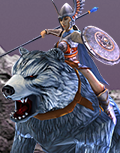
Warrior Maiden
Level: 4
Hiring Cost: 1300
Leadership: 200
Attack/Defense: 29 / 25
Initiative/Speed: 6 / 5
Health: 150
Damage: 14-18 Physical
Resistances: 20% Physical, 20% Magic, 10% Fire, 10% Ice
Talents: Spear of Wrath (Reload: 3. Ranged attack with an effective range of 5 that does 21-27 Physical damage to a single enemy. If it finishes off the target stack, the stack's corpse is replaced with a Rage Cluster and all adjacent enemies that are susceptible to mental effects have their Attack raised and Defense lowered by 20% for 2 turns. Cannot be used if there's an enemy adjacent), Call of Valhalla (Reload: 4. An allied stack below Level 5 that is not completely dead nor is the casting Warrior Maiden resurrects up to 2 members per Warrior Maiden in the casting stack. Casualties from more than 2 turns ago are not eligible for resurrection)
Abilities: Armored (+20% Physical resistance, +10% Fire resistance), Gift of Odin (Enemies who are lower Level and lower Leadership do not retaliate against the Warrior Maiden's attacks), Messenger of the Gods (-10% Attack and Defense to adjacent enemies), Beautiful (30% chance for male humanoids to miss when attacking), Magic Resistance (+20% Magic resistance), Bear Cavalry, (+1 Morale for allied Bears, Ancient Bears, and Polar Bears) Runic Knowledge (Begins battle with 1 of each type)
Call of Valhalla is fairly unique, being an infinitely reusable resurrection effect and also being based entirely on quantity, with Leadership and Health not factoring in at all. As such, it's more effective with higher-end units, other than the caveat about not working with Level 5 units.
Conveniently, no Viking is Level 5. What a coincidence.
Note that as far as I can tell, Call of Valhalla's definition of 'two turns ago' is 'two of the target's turns ago'. So bonus turns from Luck Runes, a Jarl using Call to Battle on the target, etc, can actually make a unit an invalid target for Call of Valhalla; if you want to be sure your Warrior Maidens get their opportunity to resurrect units, you should avoid giving the intended target extra turns -maybe even use Wait, if the unit is going to go before the Warrior Maidens- and/or give the Warrior Maidens an extra turn.
One last mechanical point about Call of Valhalla: it doesn't affect Health. That is, if a stack suffers five casualties and is sitting on 1 Health remaining, having your Warrior Maiden stack of 3+ individuals use Call of Valhalla on them will result in the stack being back at its original numbers but still sitting on 1 Health. In such situations it can be worth trying to arrange for the stack to take a little bit of damage (To roll over into another casualty but close to full Health) before you hit them with Call of Valhalla, if you can do so without taking them outside Call of Valhalla's time range.
Also note that, in-game, the description for Messenger of the Gods claims to boost the Initiative of allied Vikings, but this is not only not true but is a strange localization error -the original Russian says no such thing.
A couple notes about Spear of Wrath; firstly, its damage loss for firing beyond its effective range is actually only 30% instead of the usual 50%, so it's more okay to toss at distant targets than you might expect. Second, its Attack and Defense modifications when finishing off a stack are, logically enough, classed as mental effects and so won't trigger on units that are immune to mental effects. Which... includes all Undead, so there's a lot of fights where Spear of Wrath's stat-modifying side effect is completely irrelevant. Oops.
Broadly speaking, Warrior Maidens are a fantastic unit, pretty much the new Royal Snake for overall effectiveness. They lose some of their luster when you're facing units of Levels 4-5, since their No Retaliation effect will never kick in against those, but even then they can take potshots with Spear of Wrath, use their insane mobility and Initiative to collect chests and get you priority for casting Spells and kicking off Rage effects, and resurrect other units you position to absorb punishment. They're also amazingly effective when combined with high-end units below Level 5, since Call of Valhalla only cares about raw numbers rather than Leadership; you can just throw fairly bulky decent/high Leadership units like Jarls into the fray, let them suffer egregious casualties in terms of percentages, and then Call of Valhalla half the stack back at once kind of wackiness. On the flipside, Warrior Maidens are terrible at supporting low Leadership units, with you generally better off relying on alternate resurrection-capable options like Inquisitors in such cases. This is particularly true as unit levels rise, because resurrection-in-others-capable units are all in the class that improves healing rates, excepting Warrior Maidens and Demonologists, so the Warrior Maiden will fall even further behind almost all the competition.
Warrior Maidens are also impressively durable if you manage to get a hold of them in the early game, allowing you to just have them tank hits for a decent portion of the early game without worrying about casualties, between their decent Health ratio, moderately high Leadership value, notable Physical resistance, and tendency to just randomly dodge male humanoids. Not to mention they passively lower adjacent enemy Attack, making melee units that little bit less effective against them.
There's some odd elements of a lack of focus on the Warrior Maiden's design, with Gift of Odin making her utterly monstrous against low-Level units -with her insane Speed, it's easy to hit an enemy, then back off, Wait, and hit them again once they obligingly walk adjacent to her, all while never taking damage- and yet Messenger of the Gods is most pronounced against high Level units with their high Attack and Defense. Bear Cavalry is also kind of lolrandom, especially since there's not really any larger incentives to combine bears with Vikings or anything of the sort, even aside how bears rapidly become difficult to justify. Admittedly Call of Valhalla combines decently well with Polar Bears, who are more durable than you might realize, but it's still kind of weird in game terms, and from an aesthetic standpoint it's a bit odd how bears are apparently cheered to see one of their own carting around a human warrior.
As enemies, Warrior Maidens are a bit annoying but not as big a deal as you might think. Yes, they eat ground at a ludicrous pace, yes they have a ranged attack Talent to hit you from right off the bat, yes they can randomly dodge attacks, and yes it can be inconvenient if they Call of Valhalla something you put a lot of work into murdering half of... but in real terms? They don't move before firing Spear of Wrath, pretty much ensuring it does reduced damage. They're really bad about using Call of Valhalla the very instant anything has any casualties at all, with no attempt to prioritize high Leadership units nor any aspect of going 'that'll only use 2% of my resurrection value, I'll hold off until later/target that other unit that will use 78% of my resurrection value'. Between the two Talents, they tend to not actually reach your units until the fourth turn, in spite of their incredible Speed.
The overall result is that they can be irritating -particularly if you're trying to get Grand Strategian ranks- but they're often a fairly low-priority target that doesn't do a lot to menace you. The very act of focusing on other stacks first frequently leads to them essentially wasting a turn! They're mostly potentially irritating if you're using an army of male humanoids, entirely due to Beauty Misses. (So beware them if you're having fun with Dwarves)
An interesting aside: the internal designation for Warrior Maidens is 'valkyrie_horse', and if you pay attention to the concept art that pops up in loading screens one of the pieces looks to be pretty much exactly the Warrior Maiden but on a horse. (Well, aside that the horse seems to have wings) Apparently they were intended to be just a generic horse-riding valkyrie for a while. I actually kind of wonder if what happened was something like the modeler just making a bear cavalry version and everyone else shrugging, saying they liked it, and throwing in the Bear Cavalry Ability, with no other changes made.
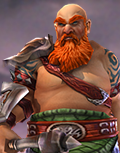
Axe Thrower
Level: 3
Hiring Cost: 360
Leadership: 120
Attack/Defense: 20 / 16
Initiative/Speed: 5 / 3
Health: 90
Damage (Ranged): 4-7 Physical
Damage (Melee): 6-10 Physical
Resistances: 10% Ice
Talents: Tandem Throw (Charges: 2. 7-12 Physical damage to a single enemy up to 3 tiles away), Circular Blow (Reload: 2. Deals 5-8 Physical damage to all adjacent units, with no risk of friendly fire. Still has to select a target, which can retaliate against the attack)
Abilities: Hardened, Nimble (20% chance for enemy attacks to Miss), Axe Thrower (Can ranged attack up to 3 tiles out, and no more. Considered in certain respects to be a Shooter), No Melee Penalty, Runic Knowledge (Begins battle with 1 of each type)
Nimble remains an annoying Ability on enemies and I'm disappointed Warriors of the North didn't ditch it, but at least the game only rarely puts you up against Axe Throwers. Rage is also even more viable than it was in Armored Princess, and in particular mass damage is common, making it a lot easier for the player to work around enemy evasion effects, even ones unit matchup can't get around. Warriors of the North also has cases of units being flat-out unable to miss (and actually bothering to tell the player this, unlike Armored Princess), making it easier to build an Evasion-bypassing force.
On top of all that, Warriors of the North finally hits the point where it has enough randomness. My issue with Armored Princess is that most battles are fairly low randomness, and then you'll run across a fight with two Sea Dog stacks, and that's simultaneously really annoying and yet also kind of trivial to use save/load shenanigans to effectively do away with RNG. In Warriors of the North, the player increasingly stacks on so many major, powerful randomization effects that it stops making sense to reload because any given piece of RNG went against them. Maybe your first attack against an enemy Axe Thrower misses, but then your second attack triggers Berserk, and the doubled damage from the second attacker actually more than makes up for the lost damage from the first. Or maybe you activate Rage, and Runic Power gives you a second use. Or maybe the battle is going as well as it is because Diversions ate some other unit's turn, and that's more important than getting this first hit on the Axe Thrower stack.
That's a whole different beast from 'I'll just reload until the Sea Dogs don't dodge too many times/when it counts'.
Axe Throwers themselves are a bit of an odd unit, being a ranged unit whose range is limited and whose second Talent and access to No Melee Penalty make it clear they're really meant to take potshots either as they're closing or at enemies who are closing in on them, and then get into a major melee. Indeed, in raw mechanical terms the game actually constructs them as a melee unit that has a hidden Talent for performing their short-range ranged attack -among other points, this leads to them being a ranged unit whose listed damage in-game reflects their melee damage. Which is unfortunate, since their melee damage is noticeably higher than their ranged damage, so a player is liable to have higher expectations on their ranged damage than are merited and be unable to figure out why they don't hit as hard as a player would intuitively expect!
Regardless, at the beginning of the game, they're pretty good at this 'take potshots while advancing/being advanced on before fighting in melee' because they're quite tough for so early on, allowing them to absorb a surprising number of attacks without taking a casualty. As Leadership rises, though, their flaws increasingly show through, and so too do matchups act as a major factor in their utility. They're at their best when fighting 2-move melee, which is nice given how common that is, and yet 2-move melee is pretty much the least threatening general type of enemy throughout the series, so fielding a unit that's at its best against them is... a bit of a dubious idea. It's also harmed severely by playing Ice and Fire, since so many melee units will ultimately end up with boosted Speed, where even generic 2-Speed melee will cease to be 2-Speed melee at some point.
As enemies, they're similarly underwhelming. Nimble is obnoxious when it kicks in, but it's easy to wear them down from a distance or ignore them for higher priority targets before chopping them up with your own melee or smashing them with Spells or whatever. They'll close the distance at a respectable speed, with a minor boost to their engagement time from having a short-range ranged attack, but there's tons of enemies that can say much the same, but more so, while having more problematic qualities. Such as Berserkers.
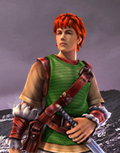
Slinger
Level: 1
Hiring Cost: 25
Leadership: 22
Attack/Defense: 4 / 3
Initiative/Speed: 4 / 2
Health: 12
Damage: 2-3 Physical
Resistances: 10% Ice
Talents: Hail of Stones (Reload: 2. 1-2 Physical damage to a target with an effective range of 5, and half damage to adjacent units)
Abilities: Hardened, Shooter (Range: 5), No Melee Penalty, Accurate (If a ranged attack crits, there is a 20% chance it will additionally inflict Weakness), Runic Knowledge (Begins battle with 1 of each Rune)
Annoyingly, Accurate's English description is worded incredibly vaguely. The description I give above is how it actually works, but is only one possible way of reading the in-game description -this is an issue introduced by localization, too, just like the Warrior Maiden's claimed Initiative boost. Admittedly Accurate's effect comes up so rarely it doesn't really matter, but it's still an unfortunate bit that can leave a player with a very inaccurate idea of how Slingers work...
Slingers themselves are a neat little unit, but not very great. The oddity of having No Melee Penalty is interesting (You can see the little knife/sword thing they use in melee in their portrait), but they're so fragile it's extremely ill-advised to put them into melee anyway. You'll probably end up using them in the early game a fair amount anyway, just because they're a ranged option and there's precious few of those toward the beginning of Warriors of the North, but they tend to have difficulty justifying themselves once your options open up in that regard. Especially since there's a lot more interesting and useful specialized support for various other ranged units than there is for Slingers, such as a Regalia that gives all bow-wielding ranged units a free Dragon Arrows use while lowering Leadership requirements by 5%. Slinger-oriented support is stuff like a sling that slightly increases Attack and moderately increases crit chance, while benefiting nearly no units.
It is worth pointing out they don't care about Bone providing arrow resistance. As you fight Skeletons and Skeleton Archers a lot throughout significant portions of Warriors of the North, this is an important quality to be aware of, and it means even once you are unlocking access to eg Human Bowmen or the assorted Elven archer units you shouldn't necessarily make that jump, even though for most purposes Slingers are the less useful unit.
As enemies, Slingers are less threatening than they really ought to be. They have an extremely strong preference for using Hail of Stones on a target without even bothering to move and without necessarily bothering to make sure it hits multiple targets, which means they frequently end up hitting a target for something along the lines of a third of what they'd be hitting for if they bothered to move closer and used their default attack on a target. Since Hail of Stones can be used every other turn, simply keeping your units spread out cuts fairly heavily into their damage output. (This flaw unfortunately applies to your own Slingers when eg under Fear or Berserk) Beyond that, they're one of the most fragile ranged units around in a Leadership-to-Health sense, and have no special protections to make up for this problem. (Where eg Skeleton Archers have Bone and significant resistance to Poison)
The overall result is that you treat them like a less threatening version of eg Bowmen, which at least have percentile damage effects.
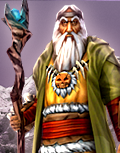
Soothsayer
Level: 4
Hiring Cost: 1220
Leadership: 240
Attack/Defense: 20 / 28
Initiative/Speed: 5 / 2
Health: 160
Damage (Ranged): 12-16 Magical
Damage (Melee): 6 Physical
Resistances: 35% Magic, 10% Fire, 10% Ice
Talents: Ice Storm (Reload: 2. Targets an arbitrary tile. Does 10-14 Ice damage to that tile, and half that to all adjacent tiles, with a 30% chance to Freeze the target for 1 turn and a 15% chance to Freeze units in the adjacent tiles for 1 turn), Loki's Touch (Reload: 3. A target enemy below Level 5 and whose Leadership total is less than 216 per Soothsayer in the casting stack becomes hostile to all units. Cannot be used on the Undead, and in any event the Soothsayer is afflicted with Weakness for 4 turns afterward), Arcane Healing (Charge: 1. Heals a single allied unit for 16 Health, as well as clearing Plague, Poisoning, and Bleeding. If the target ally is below Level 4, this healing can resurrect it, but only half the healing value gets applied to resurrection eg a unit with 16 Health would require 2 Soothsayers to be able to undo a casualty at all)
Abilities: Witching Staff (Range: Infinite. Attack has a 50% chance of removing a single positive effect), Divine Hand (Anytime a friendly unit gets a crit, +1 to the Soothsayer's Attack, to a maximum of +15), Magic Resistance (35% Magic resistance), Persistence of Mind (Immunity to mental effects), Keeper of Knowledge (Allied Vikings that are not Soothsayers get +4 Defense. Additionally, all allies get an additional random Rune to carry into battle), Elemental Shield (10% Fire and Ice resistance at base. Taking damage from one or the other will raise that resistance by 4% and lower the other by 6%, out to a max of +20%[ie a total of 30% resistance]/-30%), Runic Knowledge (Begins battle with 2 of each type)
The other ridiculously complicated Viking unit that's actually fairly simple in practice.
Though I have a bad habit of forgetting about Loki's Touch.
The in-game description for Arcane Healing claims it purges Plague, and even the battle log will agree with this claim when you use it, but I've never seen it actually purge Plague. It actually works on Poison, thankfully, which is more important to be able to purge.
Arcane Healing's resurrection capacity is also incredibly limited -8 Health of resurrection for every 240 Leadership, and only on units below Level 4?- and so in real terms is primarily useful as a way to avoid missing out on a Grand Strategian rank in cases where you just barely lost a single Slinger kind of thing. In general Arcane Healing is best used for purging Poisoning (And I guess maybe Bleeding, though Bleeding is fairly rare even in Ice and Fire) and to a much lesser extent extending the Health of moderately-durable units like Jarls as a preemptive way to prevent casualties. It's fairly useful toward the beginning of the game, but the deeper you go the more it becomes relegated to purging Poisoning and Bleeding.
Also, notice that Soothsayers are actually exceptionally unhappy with being forced into melee combat; their melee attack is 50% of the low roll on their ranged attack! Which is to say they're effectively suffering a greater than 50% penalty for being forced into melee. After so many ranged units that actually hit harder than 50% of their ranged attack in melee, this is quite the surprise -though do remember that they can use all their Talents even when pinned, so just getting a unit next to an enemy one isn't as crippling as you might hope. Also note that Witching Staff can trigger in melee; you might intuitively expect it to only work at range, but nah.
Soothsayers are pretty decent at building Rage, are free to stand far back in safety, are surprisingly durable for a ranged unit, and their damage output isn't too bad. They also passively make your army perform better -particularly Vikings- and can contribute by stripping away positive effects. While it can occasionally be unclear why specifically you'd want a Soothsayer in your army, their collage of effects is so widely useful/effective it's not hard to justify putting them in with your forces.
As enemies, Soothsayers can potentially be really annoying, but they tend to get distracted by wasting time healing their forces for nearly nothing or dropping Loki's Touch on whatever unit of yours is positioned to be unable to reach the rest of your forces anyway, so they're actually even worse than Slingers about the AI shooting itself in the foot and reducing their threat level. Slingers at least consistently do damage your forces.
Of course sometimes they'll just drop Ice Storm on three of your units you foolishly left close-ish to each other and Freeze all three of them and argh, so I prefer to treat them as priority targets anyway, but it's still weird how erratic they are.
Also note that, like with Jarl's Daring, Divine Hand's in-game claim about its cap on Attack boosting is different from its real cap -but in its case its real cap is higher (50% higher, in fact), and is also a lot more relevant given that it's pretty easy for your army to collectively roll more than ten crits even in a relatively short battle.

Mystic
Level: 4
Hiring Cost: 1600
Leadership: 300
Attack/Defense: 26 / 28
Initiative/Speed: 5 / 2
Health: 170
Damage (Ranged): 14-18 Magical
Damage (Melee: 8 Magical
Resistances: 35% Magic
Talents: Mind Games (Reload: 3. Mind controls a single target that is below Level 5 and whose Leadership total is below 270 per Mystic. The Mystic stack retains control until their 'trance' state is ended, said trance state causing them to miss their next turn normally but ending on that turn as well. Plants, inorganic units, Undead, units immune to Magic, and other Mystics cannot be targeted. Units with Persistence of Mind can be targeted, but there's only a 50% chance of success, and failure lowers the Mystic stack's Initiative by 2 for 1 turn), Empathy (Reload: 4. The Mystic stack enters a trance for 3 turns. So long as the trance state is maintained, all allies gain 30% of the Mystic's current Attack and Defense, unless they're a unit immune to Mind Games, in which case they get nothing)
Abilities: Magic Missile (Range: 6), World of Spirits (+30% damage against Undead, +1 to Morale when facing Undead, no Morale penalty for allied Undead, and cannot be converted into Undead), Magic Protection (35% Magic resist), Persistence of Mind (Immunity to mental effects), Trance (Talents activate a 'trance' state. During a trance, Mystics will not counterattack and miss their turn entirely. Being attacked ends the trance state), Runic Knowledge (Begins battle with 1 of each)
To my surprise, actually new to Ice and Fire. I suppose I shouldn't actually be surprised the only Viking unit that's blatantly a reskin of an existing graphic is from the expansion made entirely of reskins (That's not an exaggeration, by the way, unless you count the fact that regular Lizardmen weren't in the base version of Warriors of the North), but I am anyway.
Also note they lack Hardened. This makes them frailer than you might expect in the early game, relative to eg Jarls, since they won't regularly be getting a 50% Defense boost.
The in-game description claims you can't use Mind Games on the Undead, but you totally can, it's just got the 50% success rate. I'm not sure if that's a bug or a tooltip fail or a translation fail. Units that are immune to magic are genuinely immune, though.
Regardless, Mystics impress in the very early game when a unit with 170 Health is borderline-invincible -and they're a caster, not a melee unit!- but as Leadership rises you tend to find them primarily being useful for Mind Games and to a lesser extent Empathy. Mind Games itself, due to its Leadership limits, is primarily useful for grabbing a weakened or unusually low-Leadership stack to act as a distraction or pin an enemy ranged unit in place, and it's hampered by how often you fight Undead and how many other things it's unreliable or even worthless against.
Mind Games is also a bit weird in that unlike most mind controlling effects its duration is effectively variable, being determined by how long the Mystics maintain the trance state rather than lasting a fixed number of the target's turns. Say an enemy unit that goes before your Mystics Waits, and then you use Mind Games on it: you get to control it for two turns as a result, because you get its post-Wait turn and then it goes before your Mystics and so you get to control another turn as well. On the flipside, if you have your own Mystics Wait, then use Mind Games on a unit that is after them in the turn order and that used up its own turn, you won't even get a single turn of control over the unit!
Empathy is awkward and I've not found it to work very well. On paper it makes design sense; the Mystic is a relatively elite unit with decently high base stats, so it gifts decent stats out the box, and as Olaf's Attack and Defense rise, this will in fact raise the Empathy bonus, so on paper it scales into the late game. In practice, I tend to find it adds less damage than just having the Mystic stack attack, and the Defense bonus isn't decisive. In the very long haul, it also suffers from the fact that even Soothsayer Olaf ends up with a lot of Attack and Defense; it's easy to be hitting the cap on Attack and Defense benefits (Or be close to the cap) such that Empathy's increases don't help any. (Or only help a little bit) Empathy's limitations further drag it down, where there's dozens of units it literally can't support, and it can be cut off by even a single hit on the Mystic stack. This latter point can get really awkward if the Initiative tiers work out so that the Mystics eat their turn, then an enemy acts, then your other units get turns, where the Mystics can end up losing a turn to channeling Empathy but not actually provide any benefit in that Round. Notably, Warriors of the North is much more insistent than prior entries about enemy battlegroups including ranged units, making 'ranged enemy interrupts the trance' a pretty constant concern.
World of Spirits is a weird, gimmicky idea. I do actually like the part where the enemy army including Undead at all makes your Mystics stronger, as it means the Mystic's performance is consistently higher against even mixed forces rather than specifically demanding they open fire on Undead, so it's a neat idea. It's hampered a bit by the fact that Mystics are clearly meant to be focused on their Talents -neither of which does damage- and that taking damage at all is bad for them since it prematurely ends their Talents. (ie making the Defense bonus positive Morale provides something you don't want to be taking advantage of) But I do like the idea.
In any event, Mystics are actually pretty consistently decently useful in the early game, where you fight a lot of Undead, and where a decent fraction of those Undead are Ghosts, Cursed Ghosts, and more intermittently Pirate Ghosts, and where your options for ranged attackers are limited anyway. If you're struggling to get past battlegroups due to Ghost presence, swapping in a Mystic stack may make all the difference.
They tend to fall off once you're solidly into the midgame, especially on higher difficulties. Mind Games technically becomes more reliable due to more regularly fighting non-Undead forces, but in practice enemy Leadership rising means you're a lot less likely to get use out of it, Priests are overall stronger if you want a specifically anti-Undead ranged attacker and become reliably available in the midgame, Empathy tends to be a bad trade, and as your own Leadership rises their per-head durability being decent for a caster becomes less and less useful, leaving you to focus on the fact that their per-Leadership durability is not so hot. They're still worth considering if you want a mono-Viking force simply because you have precious few ranged options, but you spend a long enough portion of the game tending to use Vikings heavily that it's far more likely you'll be actively avoiding Vikings from being tired of them.
As enemies, Mystics almost never exist. When they do crop up they have a bad habit of using Empathy, which you can instantly shut off by shooting them. If they do use Mind Games, you just shoot them to end it, so in most cases it's not a problem. And if they choose to attack your forces, their damage just isn't very good.
----------------------------------------------------
You might notice there's something of a trend that Viking units are mostly pretty amazing in player hands -or at least serviceable- and pretty awful in AI hands. This is further compounded by the existence of several Skills that provide incidental bonuses to Vikings, Medals that encourage using Vikings (eg the Viking class has a Medal that enhances the damage of some Viking units), and of course pieces of equipment oriented toward Vikings that are unusually common relative to other unit-focused Items.
In short: for the player, Vikings are something of a super-faction, while for the AI they're actually one of the lower-quality/less threatening factions. Elves and Demons tend to be far bigger of problems.
Next time, we check out how Humans have changed.
See you then.