Ah, A New Home, the scenario whose narrative hinges most heavily on, "It's a video game, don't worry about it."
Why are there piles of apparently-empty wooden crates lying around the Generator? Because Frostpunk's game design intends for the player to start with direct gathering and graduate to specialist resource buildings later; there's not true in-universe logic here. Same for the Steel Wreckage piles, and really the Coal Piles as well. They're all just vague, 'generic' attempts to justify being able to collect raw materials with bare hands.
Why is there a fully functional Generator just... sitting in the middle of nowhere with no buildings around it (Except the Stockpiles, I guess) and no prepped resource stocks? Because this is a civilization-building game and those love to have the player 'start from zero', even though this is a really difficult to realistically justify being a thing in most civilization-building games.
Why are your 80 people starting the game in a fit state, nobody hungry or sick? Because this is a Video Game Start State, that's why; from an in-universe standpoint, they really ought to be in a pretty bad state after days or weeks of traveling the Frostlands...
... which also brings us to: how did your 80 people even get here? Am I really just supposed to assume they walked here? Well, no, I'm not; the actual answer is (once again) that this is a Video Game Start State, where all my gameplay essentials spawned in because this is a video game. These people didn't travel here, they just sprang into existence around the Generator.
All of this fades into being mostly-irrelevant as the scenario progresses, mind, but it's still a pretty striking contrast with later scenarios. The Refugees, in particular, revisits the A New Home framework but now with a narrative and gameplay that fit much better to 'a bunch of desperate people travel on foot to an unclaimed Generator and have roughly the intended Frostpunk gameplay flow from there', and it's a very different setup and framing.
I imagine plenty of players don't register just how little sense A New Home's start makes since it's the intended first experience and you'll be going in with no context, but yeah, it's very much a case of Game Design's Needs deciding things, with narrative coherency having been given little thought.
The kind of... frustrating, I guess... thing for me is that A New Home's setup actually could be realized pretty narratively smoothly with not much modification. Just have some (steampunk, presumably) sleds loaded down with a modest amount of supplies act as your Initial Resource Piles, with the implication being your 80 people used these sleds to get here in relative comfort. Ideally also skip the whole 'research and build a Beacon' part and just let the player send out Scouts whenever they can spare the resources, or even better make emptying a sled resource pile free up a Sled 'resource' to then spend on a Scout Team; either way, the point is that researching and building the Beacon to gain access to the ability to travel outside the city is something I'd rather see removed. It's realistically difficult to justify 'you traveled to the Generator, but now you can't leave without Special Efforts being made', and honestly I'm pretty sure the only reason the devs force you to jump through those hoops is Tutorialization Logic, where the player is made to unlock things that really ought to be baseline capabilities purely because the game is trying to ease the player into the game, which it's... not very good at, if so, as it actually increases the initial learning curve of identifying what you should be prioritizing and all.
Anyway, I'm not going to do a step-by-step explanation of How To Win At A New Home; that's not what this site is for in general, and A New Home is really, really easy anyway. Instead, I will be touching on a few not-necessarily-obvious mechanical details specific to this scenario, and then do an overarching bit talking about the game design and narrative design of A New Home.
If you haven't already assumed so: I will be casually dropping spoilers. In the difficult-for-me-to-imagine scenario where you are excitedly looking forward to experiencing Frostpunk yourself but are reading my pages first, you may wish to come back to this page another time. (Or not, I dunno) You're more likely to appreciate this if, say, you've cleared A New Home on Medium but would like a little bit of help optimizing your play for higher difficulties or for funky self-inflicted challenges. Or if you just think game design, narrative design, and the intersection of the two are interesting.
Anyway, as I discussed before, Automatons get to look nice in A New Home precisely because Scouting can get you access to a free one very early: I've sometimes wondered if the devs were themselves fooled by how useful the free one was and that's part of why they overestimated Automatons as a whole. You also get an outrageous number of Steam Cores if you are quick to access Tesla City and send an Outpost Team out to it: the wider internet will characterize it as 'unlimited', which isn't really true since the scenario has a hard time limit and Outposts become unusable noticeably before the actual deadline, but between all the Scouting loot and Tesla City, you can easily have over 20 Steam Cores worth of stuff at the end of the scenario.
This is another thing that kind of hides how mediocre Automatons truly are: them costing a precious Steam Core isn't a serious limiter in A New Home, and indeed only Infirmaries, Hothouses, Factories, and Automatons both use Steam Cores and don't have a clear absolute maximum number of copies you can build. Within A New Home, you get 3 Coal Mine spots and 2 Wall Drill locations, so that's a maximum of 15 Steam Cores you can possibly invest into those, and while Infirmaries and Factories can technically be built in unlimited numbers, in actuality there's little reason to have more than one Factory, and there's only so many Infirmaries you're realistically going to want. Hothouses are in the same basic boat, but more ambiguous or flexible. Regardless, the point is that it's easy to end up dumping Steam Cores galore into infrastructure, meet your needs, and then shrug and build Automatons because you still have Steam Cores lying around or being shipped in daily.
Though Tesla City also brings us to a thing I complained about in the Exploration and Industry page: Scouting nodes that give a chance of instant death to interact with. The Tesla City Steam Core stockpile requires a Scout Team survive interacting with the node, which is just a random chance of success vs death, simple as that, which is really inane. If you're not ironmanning things, it just means you reload and try again until it works. Even if you are ironmanning things, it's absolutely worth getting a few Scout Teams fried trying to unlock Tesla City (Just don't have them carrying loot when they do), it's just a question of how much the RNG punishes you in the process.
Also frustrating is an early Scouting node that's a cave, which of course turns out to have a bear fighting several people and you can either abandon them to die or run in and randomly win and get free survivors or lose and there goes your Scout Team. If Frostpunk had built itself as a roguelike, I... probably would still be down on this type of design, but a lot less so than in the current state of bespoke, largely-predictable scenarios. Throwing in moments of the RNG getting to step in and swing things in your favor or against you with no skill component is deeply inappropriate to Actual Frostpunk, and the bear cave is particularly egregious for how you get no warning ahead of time and can't step away for now and come back later with preparations: Endless Mode revisits the idea of Dangerous Scouting Nodes, but its version always lets you pay resources to make them safe and always lets you step away for now and come back later. (Such as if you don't have the resources to pay for safety) That still doesn't work great, but it's way better than the bear cave.
Anyway, the first Interesting Moment in A New Home beyond just acclimating yourself to Frostpunk is really the discovery of Winterhome: this can happen either by you having a Scout Team explore the node, or by virtue of you taking too long, in which case on day 15 the game will have a guy show up, tell everyone that Winterhome died, and then keel over dead himself, getting a corpse in your city. So, uh, don't let that happen if you want a truly deathless run. Either way, at this point your society is Split In Twain, Riven By A Difference Of Opinion: most people want to stay in the frozen wasteland and survive by the Generator, but a bunch of people inexplicably decide Winterhome's fate means it'd be bettr to run right back through the ice all the way to London, dying of cold and starvation on the way, because somethingsomething 'at least we'd be in real houses'? Like, the game could have really focused on Winterhome's Generator having exploded and made the Londoner Movement the 'we'd rather not live in the shadow of a giant bomb, thanks' Movement, which would genuinely be a pretty solid reason to not want to stay here, but instead it's just... nonsensical panic pushing for an obviously bad answer, when nobody seems to hold any actual beliefs of relevance beyond 'we weren't supposed to be alone out here'?
Pop culture is of course fond of the notion of a crowd panicking and becoming completely irrational as a result, and there even is some truth to the notion, but for one thing normally such is bound within a relatively tight timeframe. A panicked rush to an exit that isn't really an exit because it's at least away from the pursuing danger, say. The Londoners instead spontaneously form as, effectively, a splinter political group that is bound and determined to leave, but waits several days before actually setting out; this gives you time to persuade them, of course, but the whole thing is very, very strange if you don't treat it as A Video Game Problem To Solve...
... which is a nice jumping-off point for one of the problems Frostpunk wrestles with throughout its scenarios, but is probably at its worst within A New Home in particular: that Frostpunk wants to both present Difficult Questions that don't necessarily have a Cleanly Correct Answer, but it clearly defaults to reaching for the classic video game toolkit, specifically the part where traditionally all problems in a video game exist for the player to solve them, all obstacles exist to be overcome, and so on. The Londoner movement is the most obvious casualty of this impetus: it is, at its core, designed to be A Video Game Problem You Solve, with a clear Success State of getting the Londoners down to zero so nobody leaves. And this classic video game design mentality is, quite bluntly, directly opposed to presenting the player with Difficult Questions that may simply Have No Correct Answer. You can't make these kinds of moments something where the player has a clear and reliably achievable goal whose outcome is simply superior to not succeeding.
As such, the whole thing where the player is supposed to pump Hope because at low Hope the Londoners gain a few people every day, at more medium Hope they stay stable, and at high Hope their numbers will actually reduce every day... fine as a Video Game Goal To Achieve, but that shouldn't have been the mentality here given what Frostpunk is trying to do.
This whole thing is also where it's particularly painful how just... cleanly nice and mechanically superior Faith is. If you go Order, you end up with a minimum amount of moral ambiguity, a 'do the ends justify the means here?' sort of question, where you're going to be using at least the implicit threat of force to get the Londoners to give up on their suicidal quest. "Did we do the right thing, saving these people's lives by scaring them into staying?" a player might ask theirself going partway into Order and successfully ending the Londoner movement.
Going Faith by default just destroys the Artsy Moral Questioning potential of the whole thing, though. You just patiently reassure people and make them feel safe and welcomed until they stop panicking and so prevent them from committing obvious suicide in a perfectly nice way. The cultish, controlling aspects that show up very late in it needed to be prominent right from the beginning for this to work at all as intended.
Later scenarios get only maybe slightly better about this: The Arks simply sets such design goals aside and gives you a pretty clean feel-good experience, The Refugees tries to do a class warfare thing that... works poorly... The Fall of Winterhome relies on there being only so much room to save people, with it less than the population you have, to create some grittiness, but mostly amounts to a Video Game Challenge Thing. I'll skip The Last Autumn here as I'll be devoting so many words to it later, but I'd argue that only On The Edge kind of manages to gesture in vaguely the right direction on this topic. (And is, unfortunately, a very flawed scenario for other reasons)
Anyway, regardless, finding out Winterhome's fate is also what unlocks Purpose Laws. This is handled in a mildly exploitable way, as whichever you pick of Faith or Order has its root Law immediately pass and put Law-passing on a 36-hour cooldown, but finding out Winterhome's fate doesn't care about your Law cooldown state: as such, you can do stuff like get a Scout Team to Winterhome when you're close to being able to pass a new Law, have the Scout Team idle, then pass an Adaptation Law and immediately have the Scout Team actually scout Winterhome, effectively skipping one Law's cooldown. Prosthetics is a great choice for this since its cooldown is long for an Adaptation Law, or Triage or Organic Fertilizer are also both 45 hours. Technically Alternative Food Source is also a long cooldown, though trying to apply this exploit to it wouldn't exactly be optimizing your play.
Returning to the Londonders again for a moment, another example of janky game design stuff is the consideration of an event chain where a guy speechifies to convert more people to the Londoner movement. The way this event chain is designed, you should simply always let him talk every time, because if you do so, the last event will arbitrarily let you give your own speech, which will more than undo all the progress he made over his multiple speeches. I can kind of see what the devs are going for in a 'fables instilling moral lessons' sort of way, but it just ends up being a dull, mindless bit of optimization if you know how it works. I'm not a fan: thankfully, no later scenario has a directly comparable event chain.
Once you're done with the Londoners, it's time for the game to fill time and you just kind of play for some number of game days. After a bit, you'll start getting people streaming in, and you'll get to choose between letting them in and helping them, or, uh, not? There's really no reason to not help them, though, unless you're just... playing very badly. Regardless, this isn't meant to be a new challenge (Or if it is, it wasn't meant to be a big one), it's just the game starting to forewarn you of and hype its actual finnal challenge: a supermassive storm of death everybody is terrified of.
This eventually results in the game pushing you to make this research:
 Beacon: Stereoscopic Lens
Costs 100 Wood and 100 Steel.
5/7/11/13 hours needed with 1 Workshop at 100%.
Tier: 0
Requires: Nothing.
Triggers explaining your next goals.
Which is unique to A New Home and is placed in the Industry And Exploration, but doesn't... really do anything of mechanical substance. Completing it just prompts your folks to declare the storm is indeed massive and scary and the game gives you your new objectives: stockpile a week of Food Rations because it will get so cold you won't be able to bring in more food, preferably stockpile a week of Coal, get the Generator basically maximally upgraded, and get the housing as warm as you can and stuff.
You also get told to bring in all the Scouts and Outpost Teams, and the game is dead serious about this. The superstorm does in fact slowly advance from a specific direction ('East', relative to your initial camera facing, but the superstorm arriving also turns your Scouting Map camera to face the storm, which can be very disorienting since for one thing you may not even realize you can rotate your camera on that map), and as it advances Scouting nodes will get a 'frozen' visual on them, giving a relatively clear demarcation of its actual progress, much better than the storm's own visuals. You can't interact with such nodes anymore, if for no other reason than because Scout and Outpost Teams will instantly die if they get they are ever in the storm's shadow for even a moment: as such, you better have cleared out all the nodes that direction earlier!
Exasperatingly, completing Beacon: Stereoscopic Lens also spawns a few new Scouting nodes and gives you a bonus objective to find and rescue the three batches of survivors that have inexplicably spawned in now that you've stared at the storm with a binocular. (Considering the prior: prioritize hitting the ones closest to the storm) Even more exasperatingly, some of the new nodes that spawn in at this point specifically will reward you with a new tech: it's kind of interesting that the game is able to do this, but it works very poorly, so poorly I'm perfectly happy with the fact that no later scenario revisits the idea of making tech rewards a part of the appeal of Scouting. (The Arks reuses the mechanic, mind, but that's for next page)
The biggest problem is of course that you're at the end of the scenario, have had plenty of time to do research, and the devs wayyyy underestimated how quickly research can actually be done in Frostpunk: on Medium, it's entirely possible to have literally all researches done so you hit up one of these nodes and get literally nothing out of it. Even up on Extreme... well, you probably mostly have a bunch of researches you don't care about to potentially get as a payday, so it's still unlikely to be appealing.
It's also just handled awkwardly in its mechanics. A Scouting node research is decided at the moment you actually have a Scout Team hit up the node, and will always pick something you don't already have if it can, but it's perfectly happy to pick something you're currently researching, which is barely any better than picking something you've already researched. You also don't actually get the tech until the Scout Team gets back, and all the nodes that give techs are far enough out that even on Extreme it may well be faster to just research the tech yourself!
In general, this phase is unfortunately mostly likely to be reasonably engaging or tense for a first-time player. Such a player might now have to scramble to get all the necessary stuff done; for a repeat player, though, it's entirely plausible to complete the Stereoscopic Lens research and have your new objectives list pop up with everything already accomplished except finding the three survivor groups. Repeat players will mostly just be waiting for the superstorm to get here so they can Officially Win already.
The superstorm arriving has some jank to it plus events that... really don't have the impact the devs were going for. (And that are marred by jank too, of course)
The first bit of jank is that Hunters Huts and Hothouses (Including their upgraded forms) will be disabled arbitrarily once the storm hits, but anybody assigned to them will continue to make temperature checks. This is especially unexpected since the usual mechanic for a building being disabled -it refusing to work if at -3 Heat or less- causes citizens to wander off and do other things instead of still going to the building and make temperature checks. The game warns you to stockpile food, but it doesn't warn you to pull food gatherers off their buildings,
A sub-section of jank to this is that any hunters who were still hunting when the superstorm hits are... fine? Not that I'd want to lose a bunch of hunters given how easy it would be to even know they were still out hunting, but it feels weird. I suppose it's at least kind of consistent with an event where a father wants to go find his daughter, and if you let him go, they do both come back safely partway through the superstorm? (This costs some resources, but come on, you should have tons)
Anyway, the two main event chunks I'm talking about for 'not having the intended impact' are...
1: At some point you'll get everybody raiding the stockpiles for Wood because they're terrified. Unless you've built way, way too many Houses (For some reason, the Wood demanded is decided not by your population count, but by how much housing you currently have), you really ough to have 2000+ Wood lying around and just shrug it off as no big deal. It's not like you have any remaining use for Wood anyway: the game including the option to send in your thugs to beat them up is totally gratituous.
2: My least favorite event chain in the entire game. You'll get kicked with no warning into an Event Choice Screen, which is not something the game otherwise does, and with good reason! I've literally had this event kick in while I was trying to do something such that I clicked an option unintentionally because my click was occurring right as the screen popped up! This is terrible!
The event itself is also attempting to enforce the overall vibe or feeling Frostpunk wants you to feel here, and kind of failing. The extreme cold is causing the Coal Mine tunnels to collapse, which sure okay, with the implication being that will reduce their base Efficiency to 20% if nothing is done, but if you actually send people in to try to fix the problem, they will definately die, and you'll be prompted twice more to get people killed to keep Coal productivity up. But, again, you really ought to have thousands of Coal piled up already: my first run where I didn't know what I was doing and was being very inefficient all-around still had so much Coal stockpiled it could've kept the city running fully for 3 days with zero Coal intake at the point this event triggered, and my later runs pretty consistently had 8+ days of Coal stockpiled, even up on Extreme.
As such, it's trivial to ignore it, accept the Discontent and Hope hits because they almost certainly don't matter, and blow off the later event where your citizens want you to build a Coal Thumper and a couple Gathering Posts because they can't believe you have enough Coal even if you have way, way, way more Coal than you need. The whole thing just ends up feeling less like a deeply worrying experience driving people to desperation and terror and more like you're having to reassure (or ignore) exasperating fools who really should know better. Seriously, folks, why do you want to consign several people to death to try to preserve the Coal Mines? This is ridiculous.
Anyway, the temperature does in fact get ridiculuosly, insanely low. The temperature summary on buildings will eventually just represent the current weather with a dash, but the actual final Heat level is -13 Heat. That's so low that upgraded Housing with a fully upgraded Generator is still at -5, meaning risk of instant Amputees: to get through that final day without harm, you'll need to run the upgraded Overdrive, exactly as the game pressed you to, leaving you merely at -3 Heat in the housing. By the same token, you better have your medical facilities fully upgraded on 'insulation', and they better all be Infirmaries and/or Houses of Healing, as otherwise they won't be able to run even if you have the Generator maximally upgraded and running the upgraded Overdrive!
That said, this -13 lasts only briefly before you get to the end of the scenario and instantly win because the superstorm passes and apparently the temperature very rapidly goes way up.
The last 'survive the cold' chunk also breaks the game's normal Illness mechanics, annoyingly enough, causing people to start falling Ill at all hours of the day: this is yet another reason why a player is very unlikely to readily figure out the absolutely bizarre rules around when Illness is allowed to occur, because the starter scenario very memorably breaks those rules!
But yeah, victory, then roll the game's text scroll and slightly-cool sped-up repeat of how your city changed over the course of the run.
----------------------------
Overall, A New Home is basically what I expected from Frostpunk going in. And to be clear, I mean that in a negative way: it's poorly-assembled in many ways, makes fumbling attempts to raise difficult moral questions but in so mechanically inept a manner they basically all don't work at all, and overall prizes graphical fidelity and Artsy Philosophy over solid gameplay fundamentals, while being a game style where most of the effort into visuals is basically irrelevant to the player and the Artsy Philosophy isn't exactly compelling.
I thus exited my first completion of A New Home with extremely low expectations for the rest of the game...
... but to my surprise, the later scenarios are genuinely better. A New Home's flaws are those of a first draft even the creator looks askance upon, hoping to do better next time: my expectations were so low after completing it specifically because the game gave me the impression that it viewed A New Home as something of a masterpiece that all its other scenarios would simply sit in the shadow of. I've played games that viewed their first effort this way, and even when I agree that the first effort is genuinely good, this perception tends to leave later efforts lacking; if your first effort is Perfection, then what are later efforts supposed to be adding?
Now, I've already implied before that I think all of Frostpunk's scenarios are notably flawed: the game struggled to figure itself out the entire time, and always labored under difficulties caused by how the core systems are constructed. There was probably never a possibility of Frostpunk achieving a Perfectly Designed Scenario. But every later scenario revisits flaws with A New Home's execution and refines some parts here and there into being something a bit better than A New Home's attempt at this and that and the other idea, and The Arks and The Fall of Winterhome especially manage something well-executed. Not... the Core Frostpunk Experience, which no scenario manages to get fully correct, unfortunately, but still.
This is indeed why I look upon the future question of Frostpunk 2 with interest instead of just trepidation, and, well, the dev journals for Frostpunk 1886 look not-very-promising to me unfortunately, but I'm willing to be sort of pessimistically optimistic, expecting it to be bad but not so committed to such a belief that I will be completely blindsided if Frostpunk 1886 turns out to be genuinely great. (Unlike, say, XCOM 2, which I went into expecting to be disappointed by, and was genuinely shocked when it turned out to be fantastic)
Oh, and:
Beacon: Stereoscopic Lens
Costs 100 Wood and 100 Steel.
5/7/11/13 hours needed with 1 Workshop at 100%.
Tier: 0
Requires: Nothing.
Triggers explaining your next goals.
Which is unique to A New Home and is placed in the Industry And Exploration, but doesn't... really do anything of mechanical substance. Completing it just prompts your folks to declare the storm is indeed massive and scary and the game gives you your new objectives: stockpile a week of Food Rations because it will get so cold you won't be able to bring in more food, preferably stockpile a week of Coal, get the Generator basically maximally upgraded, and get the housing as warm as you can and stuff.
You also get told to bring in all the Scouts and Outpost Teams, and the game is dead serious about this. The superstorm does in fact slowly advance from a specific direction ('East', relative to your initial camera facing, but the superstorm arriving also turns your Scouting Map camera to face the storm, which can be very disorienting since for one thing you may not even realize you can rotate your camera on that map), and as it advances Scouting nodes will get a 'frozen' visual on them, giving a relatively clear demarcation of its actual progress, much better than the storm's own visuals. You can't interact with such nodes anymore, if for no other reason than because Scout and Outpost Teams will instantly die if they get they are ever in the storm's shadow for even a moment: as such, you better have cleared out all the nodes that direction earlier!
Exasperatingly, completing Beacon: Stereoscopic Lens also spawns a few new Scouting nodes and gives you a bonus objective to find and rescue the three batches of survivors that have inexplicably spawned in now that you've stared at the storm with a binocular. (Considering the prior: prioritize hitting the ones closest to the storm) Even more exasperatingly, some of the new nodes that spawn in at this point specifically will reward you with a new tech: it's kind of interesting that the game is able to do this, but it works very poorly, so poorly I'm perfectly happy with the fact that no later scenario revisits the idea of making tech rewards a part of the appeal of Scouting. (The Arks reuses the mechanic, mind, but that's for next page)
The biggest problem is of course that you're at the end of the scenario, have had plenty of time to do research, and the devs wayyyy underestimated how quickly research can actually be done in Frostpunk: on Medium, it's entirely possible to have literally all researches done so you hit up one of these nodes and get literally nothing out of it. Even up on Extreme... well, you probably mostly have a bunch of researches you don't care about to potentially get as a payday, so it's still unlikely to be appealing.
It's also just handled awkwardly in its mechanics. A Scouting node research is decided at the moment you actually have a Scout Team hit up the node, and will always pick something you don't already have if it can, but it's perfectly happy to pick something you're currently researching, which is barely any better than picking something you've already researched. You also don't actually get the tech until the Scout Team gets back, and all the nodes that give techs are far enough out that even on Extreme it may well be faster to just research the tech yourself!
In general, this phase is unfortunately mostly likely to be reasonably engaging or tense for a first-time player. Such a player might now have to scramble to get all the necessary stuff done; for a repeat player, though, it's entirely plausible to complete the Stereoscopic Lens research and have your new objectives list pop up with everything already accomplished except finding the three survivor groups. Repeat players will mostly just be waiting for the superstorm to get here so they can Officially Win already.
The superstorm arriving has some jank to it plus events that... really don't have the impact the devs were going for. (And that are marred by jank too, of course)
The first bit of jank is that Hunters Huts and Hothouses (Including their upgraded forms) will be disabled arbitrarily once the storm hits, but anybody assigned to them will continue to make temperature checks. This is especially unexpected since the usual mechanic for a building being disabled -it refusing to work if at -3 Heat or less- causes citizens to wander off and do other things instead of still going to the building and make temperature checks. The game warns you to stockpile food, but it doesn't warn you to pull food gatherers off their buildings,
A sub-section of jank to this is that any hunters who were still hunting when the superstorm hits are... fine? Not that I'd want to lose a bunch of hunters given how easy it would be to even know they were still out hunting, but it feels weird. I suppose it's at least kind of consistent with an event where a father wants to go find his daughter, and if you let him go, they do both come back safely partway through the superstorm? (This costs some resources, but come on, you should have tons)
Anyway, the two main event chunks I'm talking about for 'not having the intended impact' are...
1: At some point you'll get everybody raiding the stockpiles for Wood because they're terrified. Unless you've built way, way too many Houses (For some reason, the Wood demanded is decided not by your population count, but by how much housing you currently have), you really ough to have 2000+ Wood lying around and just shrug it off as no big deal. It's not like you have any remaining use for Wood anyway: the game including the option to send in your thugs to beat them up is totally gratituous.
2: My least favorite event chain in the entire game. You'll get kicked with no warning into an Event Choice Screen, which is not something the game otherwise does, and with good reason! I've literally had this event kick in while I was trying to do something such that I clicked an option unintentionally because my click was occurring right as the screen popped up! This is terrible!
The event itself is also attempting to enforce the overall vibe or feeling Frostpunk wants you to feel here, and kind of failing. The extreme cold is causing the Coal Mine tunnels to collapse, which sure okay, with the implication being that will reduce their base Efficiency to 20% if nothing is done, but if you actually send people in to try to fix the problem, they will definately die, and you'll be prompted twice more to get people killed to keep Coal productivity up. But, again, you really ought to have thousands of Coal piled up already: my first run where I didn't know what I was doing and was being very inefficient all-around still had so much Coal stockpiled it could've kept the city running fully for 3 days with zero Coal intake at the point this event triggered, and my later runs pretty consistently had 8+ days of Coal stockpiled, even up on Extreme.
As such, it's trivial to ignore it, accept the Discontent and Hope hits because they almost certainly don't matter, and blow off the later event where your citizens want you to build a Coal Thumper and a couple Gathering Posts because they can't believe you have enough Coal even if you have way, way, way more Coal than you need. The whole thing just ends up feeling less like a deeply worrying experience driving people to desperation and terror and more like you're having to reassure (or ignore) exasperating fools who really should know better. Seriously, folks, why do you want to consign several people to death to try to preserve the Coal Mines? This is ridiculous.
Anyway, the temperature does in fact get ridiculuosly, insanely low. The temperature summary on buildings will eventually just represent the current weather with a dash, but the actual final Heat level is -13 Heat. That's so low that upgraded Housing with a fully upgraded Generator is still at -5, meaning risk of instant Amputees: to get through that final day without harm, you'll need to run the upgraded Overdrive, exactly as the game pressed you to, leaving you merely at -3 Heat in the housing. By the same token, you better have your medical facilities fully upgraded on 'insulation', and they better all be Infirmaries and/or Houses of Healing, as otherwise they won't be able to run even if you have the Generator maximally upgraded and running the upgraded Overdrive!
That said, this -13 lasts only briefly before you get to the end of the scenario and instantly win because the superstorm passes and apparently the temperature very rapidly goes way up.
The last 'survive the cold' chunk also breaks the game's normal Illness mechanics, annoyingly enough, causing people to start falling Ill at all hours of the day: this is yet another reason why a player is very unlikely to readily figure out the absolutely bizarre rules around when Illness is allowed to occur, because the starter scenario very memorably breaks those rules!
But yeah, victory, then roll the game's text scroll and slightly-cool sped-up repeat of how your city changed over the course of the run.
----------------------------
Overall, A New Home is basically what I expected from Frostpunk going in. And to be clear, I mean that in a negative way: it's poorly-assembled in many ways, makes fumbling attempts to raise difficult moral questions but in so mechanically inept a manner they basically all don't work at all, and overall prizes graphical fidelity and Artsy Philosophy over solid gameplay fundamentals, while being a game style where most of the effort into visuals is basically irrelevant to the player and the Artsy Philosophy isn't exactly compelling.
I thus exited my first completion of A New Home with extremely low expectations for the rest of the game...
... but to my surprise, the later scenarios are genuinely better. A New Home's flaws are those of a first draft even the creator looks askance upon, hoping to do better next time: my expectations were so low after completing it specifically because the game gave me the impression that it viewed A New Home as something of a masterpiece that all its other scenarios would simply sit in the shadow of. I've played games that viewed their first effort this way, and even when I agree that the first effort is genuinely good, this perception tends to leave later efforts lacking; if your first effort is Perfection, then what are later efforts supposed to be adding?
Now, I've already implied before that I think all of Frostpunk's scenarios are notably flawed: the game struggled to figure itself out the entire time, and always labored under difficulties caused by how the core systems are constructed. There was probably never a possibility of Frostpunk achieving a Perfectly Designed Scenario. But every later scenario revisits flaws with A New Home's execution and refines some parts here and there into being something a bit better than A New Home's attempt at this and that and the other idea, and The Arks and The Fall of Winterhome especially manage something well-executed. Not... the Core Frostpunk Experience, which no scenario manages to get fully correct, unfortunately, but still.
This is indeed why I look upon the future question of Frostpunk 2 with interest instead of just trepidation, and, well, the dev journals for Frostpunk 1886 look not-very-promising to me unfortunately, but I'm willing to be sort of pessimistically optimistic, expecting it to be bad but not so committed to such a belief that I will be completely blindsided if Frostpunk 1886 turns out to be genuinely great. (Unlike, say, XCOM 2, which I went into expecting to be disappointed by, and was genuinely shocked when it turned out to be fantastic)
Oh, and:
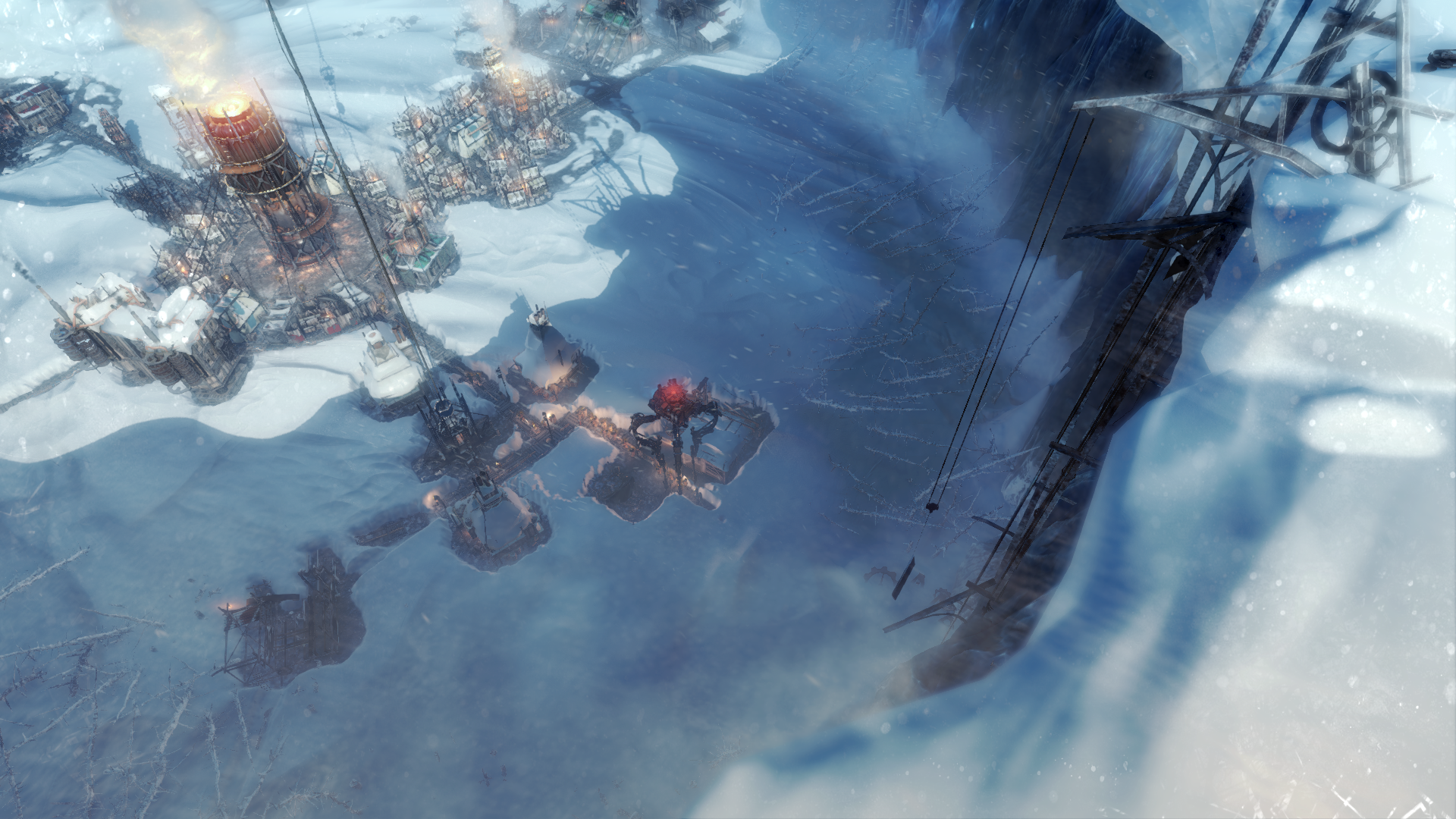
Here's where people enter your city from in A New Home. It's... one of the less strange entry points in this game, as that is at least onne of your Outpost build locations, but yeah, building your city southeast is the thing to do if you want to make sure new arrivals go as smoothly as possible.
----------------------------
Next time, we move on to scenario two, the first of the two I praised just now: The Arks.
See you then.