Time to side with the intellectual elite and beat the working class!
I already explained the basics of this in the core Labour Laws page, where you don't start with Labour Laws, unlock them a few days in, then partway through building the first Generator component an Accident happens and forces you to pick a side: this is The Last Autumn's version of the Purpose Laws choice, and the overall framework is pretty similar as far as things like 'always ends badly if pursued to the end'. Compared to Purpose Laws, these Labour Laws are a little more structured: they don't have a noticeably long 'side branch' the way Order and Faith both had, instead being a linear chain that has optional 1-step Laws you can pick up if you like or ignore. The Labour Laws are also not particularly preoccupied with Motivation the way Purpose Laws were both focused on Hope, and there isn't a standardized 'send in the thugs' event resulution thing. (Which is a little surprising, as both Labour routes do in fact include a 'we should have armed thugs ready to kill people!' Law)
Also like Purpose Laws, these Law chains don't show everything right away, but more so: you can only see Laws you've passed or that are directly unlocked by Laws you've passed. In practice this isn't too bad since only the main trunk is ever more than 1 step out, but I'm not a fan; a first-time player will have no idea that none of the side Laws gates access to anything else, and even if you've done the scenario a couple of times, that doesn't mean you'll necessarily notice bits like that.
Also like the Purpose Laws, there's some noticeable asymmetry between the Law chains. Unlike Purpose Laws, I'm not simply baffled by this, though; the Purpose Laws confused me with things like 'Faith spends way less labor on its stuff than Order' precisely because the two paths were made such close mirrors to each other. Engineers vs Workers is not remotely perfect in its design, but for example the Engineers need to spend labor on their root Law building while the Workers don't... but the buildings do completely different things! So while it is an advantage to going Workers that they don't immediately want labor tied up in a new building, it's not a case of being Better Than The Other Choice In An Obvious Way.
But let's actually get to that root Engineer law:

Factory Inspectorate
Requires: Nothing.
Law Cooldown: 48 hours.
Unlocks the Factory Inspectorate and initiates a quest to build it in 2 days.
The building!

Factory Inspectorate
Costs 60 Wood and 25 Steel.
Size 8x5
Manned by up to 10 Engineers working at all hours. +2 Heat, improves Workplace Safety by 1 at up to 3 buildings, preferring to prioritize the most dangerous locations, with the workplace count scaled to assigned Engineers. (eg if only 1 Engineer is assigned, only one worksite will have its Safety improved) Only one can exist at any given moment.
Alright?
To be honest, I basically never have three places that use Workplace Safety running at once. Phase 1 only has two worksites of any relevancy, and normally you'll run one, then the other. (Building Structural Profiles, then building the Shaft Structure) Phase II has 4 relevant workplacs, but normally you'll only be running up to two at once: constructing necessary materials, followed by the building itself. Phase IV only has two pieces to build, and of course it's the final phase so even though each part requires two types of resources be built, there's seriously no reason to have 3 workplaces running for most of that stretch; once you can start the second part, you don't need to build any more resources. It's only in Phase III of the Generator construction that you have decent odds of actually caring about improved safety at three different buildings for a reasonably long period. Since the Inspectorate doesn't do anything like 'stack' its benefits onto a building if you're only operating one building that cares about Workplace Safety, it's prone to giving less than its full theoretical value.
Tying up 10 Engineers is also a pretty hefty price. You... don't strictly need to load so many on, but if you do want it covering three worksites, you're going to want 40 Logistical Capacity of Engineers available for it at some point, which is around 2 days of Logistical Capacity. (Exact count depending on difficulty)
You need this awkward thing if you're committing to Engineers, though, and it is a passive Workplace Safety improvement, which is genuinely nice; you can run 1 less Ventilation Plant than when committing to Workers, or use Safety Procedures less so work gets done faster, or more easily hit -0 Safety on Generator components to trivialize the forced Accidents.
Also note that Factory Inspectorate has two events it eventually triggers. One is a choice between +10% global Efficiency for 2 days vs -2 Strike Risk for 2 days. I'm... not sure why you'd ever want to go for the Strike Risk reduction. 10% Efficiency isn't a lot, but it applies to literally all workplaces, so the total impact is liable to be decently high, and the event is more or less guaranteed to fire so early that Strikes are unlikely, and if you've reserved Bath House, Public House and Comfortable Housing, your first three Strikes are basically consequence-free.
The second event is your Engineers pushing you to pass Overseers. You can either commit to passing it in the next two days, or go 'I'll think about it' and suffer a minor Discontent hit.
The Factory Inspectorate's general concept is... fine? Kinda? The framing the game itself offers is that it's about making sure the Workers are following the rules, because what Frostpunk is going for with this tree is the Engineers turning into control freaks, but honestly this whole bit makes plenty of sense as 'the Inspectorate is checking for potential problems and getting them preemptively solved'. While Frostpunk is vague about Engineers, it's most consistent about them being experts on, y'know, engineering, and that's sensible to act as a basis for spotting problems that a layperson might not readily notice on their own in the context of a construction site.
The one seriously critical thing I have to say about it is a specific mechanics interaction that's very frustrating: in the event that a Strike lets you promise to improve Workplace Safety and you pick that option, you cannot use the Inspectorate to get Safety high enough to fulfill that promise. The Inspectorate ignores all worksites that are currently non-operational, and this promise renders the site non-operational until Safety reaches the promised value, so you can be in an infuriating situation where you should be able to get the site's Safety high enough to satisfy the Strike promise, but inadequately-considered mechanics are preventing you from doing so.
Next Law!

Internal Promotion
Requires: Factory Inspectorate.
Law Cooldown: 18 hours.
Adds the Internal Promotion ability to the Factory Inspectorate. This ability spends 50 Wood and 50 Steel to instantly turn 5 Workers into 5 Engineers and has a cooldown of 24 hours. Passing this Law also slightly increases Motivation.
Huh? What?
This is possibly the most confusing, or perhaps more accurately the most confused, Law in the Engineer tree. Frankly, possibly in all of Frostpunk 1.
First of all, over in the Workers tree one Law you get lets you assign Workers to Engineer-specific jobs, and they're terrible at such jobs and for medical jobs they will literally get people killed with their ignorance. But over here in the Engineer tree where we mistrust those foolish ignorant Workers and the glorious Engineers must put an ever-tighter leash upon them to make sure they don't screw things up... we get the option of slapping 5 Workers on the back and saying "Yer an Engineer, Harry!" and having these Workers immediately go do tasks requiring an education is... totally fine, completely safe even for medical duties?? This is deeply confusing.
Second, this is deeply thematically dissonant with the rest of this Law tree. The Engineer path is all about Engineer Snobbery, looking down upon and mistrusting those Ignorant Workers because they didn't go to university, a class warfare that entrenches the class divide, but it... includes meritorious promotions whereby the lowly Workers can escape their class? Huh?
Third, this is perhaps the most representative example of The Last Autumn making a broad mistake in assessment of labor value: in other scenarios, your Engineers are clearly more valuable than Workers and you're always glad to have more, and The Last Autumn seems to believe that Engineers are still more valuable than Workers in it as well, putting their Logistical Capacity cost at twice that of Workers and giving you this option to spend a good chunk of resources on turning Workers into Engineers... but in The Last Autumn, Engineers are a specialist option you don't need very many of. Unlike in other scenarios, Engineers cannot work almost all jobs that Workers can work; only a tiny handful of buildings allow either at them, with the overwhelming majority of your labor needs being for Workers. (Literally every Generator tab building will never accept Engineers if you commit to Engineers) While Internal Promotion has some value for letting you get more out of your Logistical Capacity, it's not much, and frankly the main reason it has any value is that the Enginers tree specifically increases your Engineer needs with multiple of its Laws.
I basically wish the game had created a 'middle' class of Trusted Workers or something, where you didn't promote Workers to full Engineers but instead to thugs who could be entrusted with some of the violent jobs that we'll be getting into later but still couldn't be assigned to medical buildings, Workshops, etc. That would be more realistic, more consistent with what the Engineer tree is like overall, is absolutely a thing that has happened in real life repeatedly, and if it came with this effect costing a bit less, it would make this whole thing more mechanically worthwhile.
Next Law!

Overseers
Requires: Factory Inspectorate.
Law Cooldown: 48 hours.
Unlocks Overseer's Station, and initiates a quest to build two within 2 days. Completing this quest slightly raises Motivation.
The building!
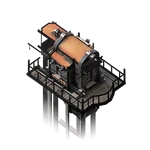
Overseer's Station
Costs: 15 Wood and 5 Steel.
Size 3x2
Manned by up to 5 Engineers at all hours. +1 Heat, raises Efficiency of workplaces in its radius by 15%, but for very workplace covered it also raises Discontent a little. Can be placed within the Generator Build Zone. Has the ability Overseer's Inspection, which costs 10 Food Rations and has a 24-hour global cooldown, raises Motivation by 25% for 24 hours, but also increases Discontent and Strike Risk for 24 hours.
Another big increase to your Engineer needs, demanding 10 more Engineers at minimum and even more if you eg want to get more Efficiency at all your Fishing Harbors/Docks. This is a notavle flaw with the Engineer route: you have to spend tons and tons of Logistical Capacity on Engineers (Or tons and tons of Wood and Steel on Internal Promotions) to really leverage its benefits, and the benefits aren't very good. Overseer's Inspection is also sucky, since you're spending Rations to (hopefully) get an Efficiency boost at the cost of a Strike being more likely to occur, which can easily put you in the hole for labor, at which point you're just screwing yoursekf all-around.
Overseer's Inspection also has a very confusing description talking about raising Motivation 'in nearby workplaces'; this is probably the bluntest example of The Last Autumn seeming to have at some point intended for Motivation to be a stat on individual employees rather than a global modifiers, and it unfortunately is easy to misuunderstand as a result, such as thinking the game means 'increases Efficiency by 25% for 24 hours' or thinking it means 'Motivation is increased based on how many workplaces are in range', or something else that's reasonable to guess but simply isn't the mechanics.
Also note that the game doesn't offer feedback on where the Motivation bar will end up if you click this button, which is frustrating since this ability is only worth doing to either drag Motivation up from the middle zone into the +30% zone, or up from the -30% zone into the middle zone. It is absolutely possible to try to eyeball things when it's pretty close, and be juuuuast barely wrong, where you've wasted 10 Rations on bringing Motivation to just below a threshold. I should similarly explicitly point out that this cannot be used to get 0% Motivation up into the neutral zone: you'll need to combine it with other Motivation boosters like Evening Service if you want to do that.
I think it might also take more Motivation when it ends than it adds when first activted? I've yet to do a realy precise, tight test of this, and since Motivation drops every day and this lasts 1 day, I could just be getting fooled by that. I hope that's all it is; this is a bad enough ability as-is, it doesn't need further problems.
It's also further hampered by having two negative events tied to it, both of which force you to choose between accepting a Motivation loss or suffering an increase to Strike Risk for 2 days. So that's not great.
The Overseer's Station is also the first sign of a broader point: siding with the Engineers is Frostpunk revisiting Order and trying to make it a less thematically broken and more mechanically appealing Law set. To the game's credit, it succeeds pretty decently at the thematics being better; the Overseer's Station is essentially a Watch Tower, but where Watch Towers were prison towers shining spotlights on convicts your citizens and this inexplicably improved the mood of the people being watched, Overseer's Stations upset people exactly the way you'd realistically expect, and the appeal for the player is using this to squeeze more labor out of people, not improve their mood so they don't revolt.
The 'mechanically worthwhile' part is... much more questionable, unfortunately, and I'm broadly unfond of Frostpunk running with this 'micromanaging people can get more work out of them!' approach being a thing it treats as basically working, just with the caveat that people hate you for doing it. This remains broadly a frustrating aspect of Frostpunk's design, that it so often organizes unethical courses of action as 'objectively superior, it's just unfortunate people hate you when you want them to do the objectively correct thing'.
Next Law!
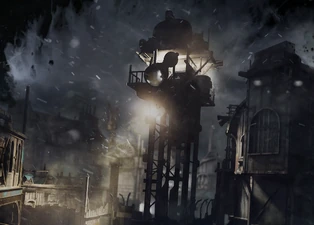
Security Outposts
Requires: Overseers.
Law Cooldown: 48 hours.
Unlocks Security Outposts, initiates a quest to build two in 2 days, and immediately lowers Discontent a little. Completing this quest slightly raises Motivation.
Huh? Lowers Discontent? Uh, anyway, the building:
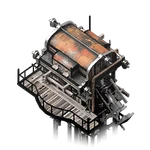
Security Outpost
Costs: 20 Wood and 10 Steel.
Size 3x2
Manned by up to 5 Engineers at all hours. +2 Heat, raises Efficiency of workplaces in its radius by 15%, and for very workplace covered it also lowers Discontent a little. Can be placed within the Generator Build Zone. Has the ability Overseer's Inspection, which costs 10 Food Rations and has a 24-hour cooldown, raises Efficiency in nearby workplaces by 25% for 24 hours and slightly increases Motivation, but also increases Discontent and Strike Risk for 24 hours. Upgrade to the Overseer's Station.
It's an Overseer's Station, but now they lower Discontent instead of raising it. Frostpunk, come on, you were doing kind of okay at this for a moment there...
Security Outposts also have a lot of events associated with them, all bad for you. You'll be asked to pass Strike Busting and suffer a discontent increase if you don't promise to do so, a different event forces you to accept a Motivation loss or a Discontent increase, you'll be asked to dismantle a Security Outpost and if you refuse you'll suffer increased Strike Risk for 2 days, and if you agree, then building another Security Outpost ever again will constitute a 'broken promise' and spike Discontent heavily and also raise Strike Risk for 2 days.... oh, and there's an event pressuring you to pass Penal Colony, where your alternative choices are to kill 5 Workers and suffer a big Discontent spike, or raise Motivation slightly but also raise Discontent and raise Strike Risk for 2 days.
Yeah, this is Guard Stations, but with even more crappy events making it suck.
Ugh...
Note that, thanks to the 'plz dismantle a security outpost' event, you idally build Security Outposts everywhere you will ever care, plus build an extra so you can tear one down without issue. Yeah, the incentives here are ridiculous; the fact that people will complain about feeling watched too much has the mechanically correct response be to preemptively maximize the watching so you can technically make them feel 'less watched' but in a totally inconsequential way, but they'll never complain again anyway. Yikes.
Next Law.
 Class Segregation
Requires: Security Outposts.
Law Cooldown: 18 hours.
Unlocks Engineer's Lodgings. Initiates a quest to build enough Engineer's Lodgings for all your Engineers, which slightly raises Motivation if successfully completed.
What are Engineer's Lodgings? Well...

Engineer's Lodgings
Costs 35 Wood and 25 Steel.
Size 3x2
Houses up to ten Engineers, who will sometimes pretend to sleep inside this building. +3 Heat. Ostensibly affects Motivation, but doesn't seem to actually do so. Upgrade to Tent.
... they're Houses. They are literally just Houses. Same cost, same graphic, same statline. They just tack on the Motivation thing, which... I'm pretty doesn't actually work. Indeed, as I said earlier about Overseer's Inspection, I suspect Motivation was imagined to be tracked per-citizen rather than for the Generator site as a whole; there are multiple bits in The Last Autumn that refer to modifying Motivation where it's worded as a local, personal effect (Such as Engineer's Lodging, which claims to increase the Motivation of Engineers residing in it), but mechanically that's never so. I sort of wonder if the Efficiency delivery of individual employees was intended to be directly controlled by Motivation, or something of the sort.
I suppose it's also possible that having your Engineers in Engineer's Lodgings slightly reduces the daily Motivation loss? I doubt it, but that'd be an implementation that would kind of fulfill the statement and would be easy to not realize is happening.
In any event, note that you're expected to have 50+ Engineers by the time you pass this Law, so you're going to need probably at least 175 Wood an 125 Steel at the ready... and Engineer's Lodgings are in fact affected by Crowded Quarters and Comfortable Quarters, so if you're giving your Engineers super-cushy living spaces it'll be easily over 300 Wood and 200 Steel you need ready. Since Comfortable Quarters is a Strike-ending tool, yuo really should default to assuming you'll pass it at some point.
This Law is particularly underwhelming on Medium where it's super-trivial to complete the Generator before the temperature starts dropping and so the +2 Heat advantage over Tents has no relevancy, but even on Hard and Extreme where it's more expected that you'll be dealing with the temperature drop, this is a supremely janky Law that's notably costly to pass and as far as I can tell the only Motivation it gives is for completing its quest. In practice, its main benefit is potentially letting you stretch your Coal reserves by setting up an 'Engineer district' that doesn't have Braziers running, since their housing will be passively just as warm as a Tent that's nearby a Brazier running its +2 Heat setting.
Also note that Engineers remain willing to sleep in Tents, which can be relevant if you ship in (or promote up) more Engineers, as you don't necessarily have to build more Engineer's Lodgings for them. Conversely, Workers will never sleep in them no matter what, not even if you build enough for literally everyone in the camp, which is a bit exasperating. Maybe in line with the class warfare theme of The Last Autumn, particularly how siding with the Engineers goes down, but exasperating regardless. Don't waste your Steel on trying.
Next Law!

Strike Busting
Requires: Security Outposts.
Law Cooldown: 18 hours.
Security Outposts gain the Strike Busting ability. This can be used to instantly end a Strike within that Security Outpost's range, but Workers will become Ill as a result, with a small chance of outright dying, and Discontent rises when using Strike Busting. Passing this Law also raises Discontent immediately.
This is basically the only part of the Engineer Law tree that more or less makes sense.
It's still a janky Law that doesn't work very well, mind. For starters, Strike Risk isn't a problem so long as you keep Workplace Safety at decent values, unless you're making event choices that increase Strike Risk; I never used Strike Busting in my original Engineer-siding run, and this was only my second run where I was still very clueless about The Last Autumn's mechanics. And even if you get some Strikes, you can appease them really cheaply with Bath House, Public House, and Comfortable Housing, where you need a lot of Strikes to care about Strike Busting. Even jankier is that Strike Busting comes with a three-part event chain that ostensibly is caused by actually using Strike Busting, but in actuality will occur even if you've never used Strike Busting, and indeed even if you've never had any Strikes beyond the mandatory one.
The narrative of this event chain is that a 'popular strike leader' goes missing. Again, even if no such person should exist. You get to choose between stopping all work on the Generator for 4 hours or blowing off the Workers and suffering a Discontent hit; note that the game is perfctly happy to have this event fire in the middle of the night, where you might not care at all about 'stopping work'. If you choose to stop work, a second event fires where you get a free Motivation boost because the Workers appreciate you not immediately giving up on the strike leader. Either way, the final event will fire at some later point, where an Engineer will admit that they killed the strike leader (Ostensibly on accident) and then dumped his body in freshly-poured concrete under the Generator. You get to pick between punishing this Engineer, suffering a Discontent hit for doing so, or endorsing the murder, in which case Strike Risk is permanently reduced by 1 but Workers will periodically be vanished.
So yeah, you implement Strike Busting, and your Engineers want to turn this into secret police nonsense. Okay.
Next Law...
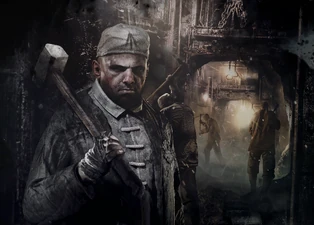
Penal Colony
Requires: Security Outposts.
Law Cooldown: 48 hours.
Unlocks the Penal Colony, initiates a quest to build one within 2 days, and unlocks the option to order Convicts from the Telegraph Station for 1 Logistical Capacity apiece. Convicts can only work most Worker-exclusive jobs (Plus Cookhouses, but not the Public House) but only if a manned Security Outpost is currently covering the building in question, and must be housed in a Penal Colony.
Oh boy, we're returning to the Prison and trying to make it less obviously awful. Let's look at its building:

Penal Colony
Costs 25 Wood and 40 Steel.
5x3 size
Acts as housing for up to 25 Convicts. (Not affected by Crowded Quarters or Comfortable Quarters) +2 Heat. If you have more Convicts than Penal Colony capacity, Motivation will fall slightly, and Convicts have a chance of vanishing forever until you have enough Penal Colony capacity for your Convicts. If a Penal Colony is not covered by a Security Outpost, the Penal Colony will not function, potentially triggering the aforementioned problems. If your ratio of Convtcts to Security Outposts is too skewed toward Convicts, this can result in riots.
Alright, this is... genuinely slightly less awful than Order's Prison. Instead of managing Discontent by tying up labor, which is a terrible trade, the concept here is that you're making up for your 'top-heavy' Engineer focus by piling in cheap labor that the Engineers need to watch at all times, with the Penal Colony being the housing for this cheap labor.
It doesn't really work in my book anyway, mind. The need to cover the Penal Colonies with Security Outposts is awkward, requiring careful pre-planning to ensure you're not needing 20 extra Logistical Capacity of Engineers for every 25 Convicts you want working; if you don't manage the preplanning necessary to make those Engineers 'free', that's 25 laborers at a Logistical Capacity cost of 45. This is technically more efficient than shipping in 25 Workers (50 LC), but you're only saving 10% Logistical Capacity in that scenario. You're also spending 5 extra Food Rations to keep this running, which is a problem sibce food in The Last Autumn isn't super-generous. For a first-time player going in blind especially, it's almost guaranteed you'll be running into this awkwardness.
Furthermore, while I'm unclear what the threshold is, if your ratio of Convicts to Security Outpost Engineers gets too stacked to Convicts, they can cause riots even if all their buildings are correctly covered, so while pre-planning your city correctly can reduce the initial Engineer load to 'functionally a freebie', if you want to lean hard into the Convict thing you'll need to ship in (Or promote up) more Engineers eventually anyway.
That's also when taking the 'local' view, where it's most favorable to this whole 'prison labor' thing because I get to ignore the Logistical Capacity cost of putting Engineers on Security Outposts for every worksite you value. In actuality, siding with Engineers over Workers obligates you to spend a minimum of 80 Logistical Capacity on Engineers, and more likely you'll be spending 120-160 Logistical Capacity on them, unless you spend hundreds of Wood and Steel on converting Workers into Engineers. Either way, this 'cheap labor' option is burdened by significant expenses, including the costs in building Penal Colonies themselves: Workers only need 10 Wood per 10 heads by default for a Tent, whereas each Penal Colony imposes a significant Steel cost, when Steel is always precious and Wood is... not so precious.
Convicts also basically require you to commit to the bit, as something the game doesn't warn you about is that if a worksite has both Workers and Convicts assigned simultaneously, this adds +2 Strike Risk. (To be fair, running only Convicts on a worksite instead makes Strikes basically impossible, imposing a -9 modifier to Strike Risk) As such, you can't just ship in 20 Convicts to push a Generator site from 30 laborers to 50 laborers and expect this to work out.
On top of all these rough aspects, Penal Colony being passed also prompts multiple negative events. There's an event pushing you to pass Roundups, and if you refuse to promise that you get a Motivation loss. Your first batch of Convicts arriving inexplicably results in your Workers greeting them with violence, and you get to choose between 'Discontent rises' or 'Discontent falls, but several Convicts become Ill'. Lastly, bigotry against the Irish occurs, which prompts you to choose between 'Discontent rises' and 'Motivation falls'.
I should also point out that Convicts will never participate in construction or demolition of buildings. I'm having difficulty imagining a way this could be a serious problem for a player, but if you do something like stockpile Logistical Capacity in preparation for passing this Law and then ship out 50 Convicts all at once, don't expect them to pour in and build a bunch of buildings on arrival.
Oh, and let me point out that the Prison is warmer than Tents, which is even more funny/janky than the Order Prison being oddly warm since there's no pulling ahead of the Penal Colony for your Worker housing. I should also explicitly note that the Chapel doesn't count Prisons as housing for its 'raise Motivation based on people sleeping nearby' effect, nor does the Bath House count Prisons as housing for its effect. Even jankier is that if Convicts end up Gravely Ill or Amputees, they will assign themselves to a Care House if possible, exiting the Prison system, which both feels not at all intended and can get you in trouble if you notice your Prisons aren't completely full, ship in more Convicts, and now you're over capacity because the Gravely Ill Convicts got treated and went back to their cells. Make sure to compare Prison capacity to your Convict count; don't just trust the current Prison capacity usage being less than full.
From a more narrative standpoint, the Penal Colony system also works better than Order's Prisons, but still doesn't work well. The game hasn't really given itself the mechanisms for this to land right: for example, the game directly references the notion that prison labor undercuts regular labor, so even free workers are worse off when prison labor gets thrown into the labor pool (Because now they have to compete with ultra-cheap labor), but you, the player, don't cut checks to anyone. The closest thing to a regular paycheck the game has as a mechanic is the need to feed people, which no, Convicts don't eat less or something, and Logistical Capacity only barely gestures in the direction of uneven pay.
Even indirect representation doesn't really exist; Convicts don't threaten the existing Worker jobs, because you can't ship out Workers to ship in their Logistical Capacity in Convicts or anything of the sort. So even generously ignoring that paychecks have no mechanical existence, the game fails to properly represent this hazard it's explicitly pointing to.
Nor does the game bring in any of the real-life perverse incentives prison labor can produce, not properly. It gestures at one of them, and I'll get to that in a minute, but overall they're just not present.
It also is one of the clearer examples of the Law system straining against the context of The Last Autumn. In most scenarios, the player is the Generator Tyrant, unquestioned ruler of all whose word is law, with no higher powers. In The Last Autumn, you are playing what amounts to a kind of middle manager, given a task by distant rulers and relying on the willingness (and ability) of the people above you to support your decisions. With most Laws you can kind of gloss over this because the Generator project is isolated and all, but this is a Law that hinges on Britain being telegraphed "Hey, can you ship over a bunch of prisoners for me to use as cheap labor?" and whoever all is at the other end just going "Sure!" and that's the end of the matter. I'd sooner expect the decision of whether to use prison labor at this site to be something handed down from above, and if indeed the foreman of this project made such a request when their bosses did not impose it in the first place, I'd expect this to not be so straightforward as just 'Yeah, okay, here you go."
It would've made much more sense for Convicts to simply be a mandatory mechanic, introduced automatically not long after the Telegraph Station was unlocked, and for regular shipments of Convicts to occur outside the player's control, or let the player buy them as per the actual game but for there to be some kind of pushback if the player doesn't buy a regular quota of Convicts, the folks back in Britain complaining they need to empty their prisons and you're Not Doing Your Part if you don't help empty the prisons back home. Something in that general vein.
The actual implementation is just... eeeeh...
Next Law!

Rationalized Healthcare
Requires: Penal Colony.
Law Cooldown: 18 hours.
Enables the Rationalized Healthcare toggle at Penal Colonies. Whule this toggle is active, Convicts no longer receive medical care, and if they die they are 'buried beneath the Generator', meaning they don't add to your bodies count for Morgue or Cemetery purposes.
This... somewhat helps with how leaning on Convict labor makes it much easier to overload your medical system, and it's an option for 'phasing out' Convicts when you're either close to completing the Generator or have already completed it but the freeze has already hit. They'll get sick, then die with minimal consequences to you, and so stop eating food and needing a place to sleep. It's a slow way of doing it though, and frankly I'd rather the game had given you a button to execute the prisoners en mass when you're done with them. Make clicking it prompt a little cinema of Engineers shooting one prisoner after another, followed by cutting to bodies thrown in a big pile without care, do your best to communicate to the player that this is brutal and ugly. Maybe throw in audio clips of screaming and sobbing to really rub in how horrific this is.
It would have the bonus side effect of being more mechanically useful.
Oh, and if you're wondering what rational behavior has to do with anything here, this is 'rationalized' as in 'rationing', as in 'we applied rationing logic to the healthcare system'. Which now that I've had this confusion, I'm terribly curious and a bit concerned if 'rational' as in 'logical' is actually linguistically related to 'ration' as in 'parcel out an insufficient amount for an individual because there isn't enough for everybody'. That's kind of a disturbing thought.
Next Law!

Roundups
Requires: Penal Colony.
Law Cooldown: 48 hours
Security Outposts gain the 'Roundup' ability, which converts up to 15 Workers into Convicts, but significantly raises discontent on use. Has a 24-hour cooldown. Passing this Law also raises Discontent immediately.
The first time you actually use Roundups, it triggers an event going basically 'are you sure?' If you back down, Motivation falls and nobody gets turned into a Convict, while if you stick it out Discontent rises.
There's also an event where you choose between 'Motivation falls slightly' and 'Discontent rises and a single Engineer becomes Ill', plus another event pushing you to pass Servitude, which for once going 'not now' is mechanically optimal, giving free Motivation.
Roundups itself is... potentially appealing if you do in fact plan to go to Servitude. If you're not planning on doing that, though, basically the only use I can see for it is to combine it with Rationalized Healthcare in an attempt to thin out your population so they're less likely to starve en mass during the freeze. Convicts are worse Workers, and you can ship in Convicts more cheaply than Workers: turning Workers into Convicts is only beneficial if you're just really struggling with Strike Risk, which yeah, the Engineer tree tries to make that more of a problem, but... not really necessary, certainly not on Medium.
To be honest, I wish this was unlocked by Servitude, not required for Servitude. Once you have Servitude, Roundups makes actual mechanical sense, and frankly this would be a truer representation of how gross the incentives of prison labor can be, where once prison labor is in place and is in some ways better for the people abusing it, it becomes tempting to turn regular working folks into prisoners so they'll be prison labor instead. This ordering doesn't capture that vibe so readily, and mostly just ends up kind of pointlessly continuing the 'descent into evil' sort of vibe of the later Laws in this tree.
Next, final Law for Engineers!

Servitude
Requires: Roundups.
Law Cooldown: 48 hours.
Unlocks Panopticon, and initiates a quest to built it in 2 days. Completing this quest slightly raises Motivation.
Yeah, the apex of the Engineer tree is to fully embrace slavery. Here's the building:

Panopticon
Costs: 100 Steel.
Size 6x4
Only one can exist at any given moment. Must be placed within the Generator Build Zone. (Has 5 separated segments visually, but only one matters mechanically) Has the toggle Forced Labor: while Forced Labor is active, Convicts provide twice as much Efficiency (So long as their workplace has only Convicts), but Workplace Safety is worsened by 3 anywhere Convicts are assigned. (This Efficiency modifier stacks multiplicatively with other Efficiency modifiers: for example, a site sitting at 115% Efficiency due to a Security Outpost will double to 230% Efficiency) Addditionally, a Convict will periodically die so long as Forced Labor is active.
Real quick: this also has three events. One where you choose between raising Motivation or lowering Discontent, another where you either raise Discontent or can make Forced Labor actually lower Discontent while active but at the cost of also raising the rate Convicts fall Ill, and lastly there's an event where teenagers are part of your most recent batch of Convicts and you choose between ignoring that or sending 15 Convicts back.
So here we are at the end of the Engineer tree, and it's Order's Orwellian nightmare revisited, this time focusing less on the personal tyranny of the player and more on an omnipreseent judgmental gaze demanding more and more work of everyone. A panopticon, if you're not familiar, is the idea of arranging things so a large number of people are potentially visible to a much smaller number of watchers, but the watchers cannot be seen by the people they are watching. The idea is that the watched must paranoidly assume at all times they personally are being watched, and therefore don't engage in misbehavior away from the eyes of the watchers because they can't know for sure their misbehavior will go undetected.
Frostpunk will actually namedrop the man who originally put forth the concept when pressing you to pass Servitude, and interestingly this is one of the few cases where Frostpunk comes across as meaningfully informed about the relevant history: the panopticon concept was formulateed in the late 1700s, and the British government did in fact make several attempts at executing the concept in the early 1800s, so The Last Autumn occurring in 1886 and having a British company tempted to build one is actually pretty on-point as plausible alternate history, especially the part where it's tied to prison use; while the man who came up with the original concept imagined it as a pretty broad type of structure, it was most heavily used for prisons, and indeed the British government liked the idea in part because they were trying to put prisoners to use on practical labor, exactly as you use Convicts in The Last Autumn.
Anyway, if the panopticon concept sounds to you like a horrific nightmare that is unlikely to improve behavior and far more likely to unhinge people entirely, then you have correctly predicted how it tends to work out in reality. Frostpunk sadly doesn't seem all that cognizant of this aspect of subjecting people to panopticons, instead viewing it primarily through the lens of being an unethical way to extract more work from employees... this lens admittedly has a lot of relevancy to modern audience given the depressing number of corporations and countries that are actively utilizing 'digital panopticons' and/or wish to push the concept to still further extremes with no explanation for how they imagine this to be a good idea, but I'm still underwhelmed by how the game doesn't really make the panopticon seem all that horrifying a concept.
Also, the visual design of this 'Panopticon' isn't a panopticon at all: it's instead more Searchlights On Prison Towers type logic, with a ring of towers on the outside of the Generator Construction Zone facing inward to monitor people working on the Generator. This is basically the opposite of the original panopticon concept! I'm not sure why the devs didn't make it a tower thing rising up and around the Generator and facing outward in every direction: the Eye of Sauron style of look would've been more properly a panopticon design.
Mechanically, the Panopticon is kind of necessary to justify going for Convicts. Doubling their output finally makes them potentially worth all the bother of setting up this entire prison labor situation... though the massive Workplace Safety penalty makes it a dicey proposition on the most dangerous parts of Generator construction. Once the Core is built and the poison gas mechanic is done, you can power through with the Factory Inspectorate and 1-2 Ventilation Plants, getting the super-massive labor nearly for free, but prior to that point you're probably going to be risking Accidents potentially substantially offsetting the value of your cheap and quick-working labor force.
That said, Convicts can work elsewhere, and Forced Labor is basically free for Convicts working any place that doesn't use Workplace Safety. Unfortunately, Forced Labor is a global toggle, not a worksite-specific toggle: if you want to abuse its utility at eg your Fishing Harbours without dealing with the Safety penalty, you'll have to just not assign Convicts to Generator tab worksites. Also janky is that unmanned worksites will inform you of their Safety level factoring in Forced Labor by default while it's active, which can be very confusing until you figure out what's going on.
Also, while I said that Forced Labor is 'basically free', the deaths happen readily and regularly. As in, you can potentially flip it on and put Convicts to work and have someone die in a couple hours, and in my own testing it seems to kill 1-2 Convicts every day. I'm not sure how to feel about that particular super-quick death scenario being possible, but regardless, the point is you'll need to ship in Convicts regularly. Furthermore, if you haven't passed and enabled Rationalized Healthcare, these deaths do in fact fully count as Real Deaths, which is not ideal if you went for the Cemetery. If you went for the Morgue instead, it's actually kind of abusable, as you can get free Motivation boosts out of shipping the Convict corpses back to London; 'free' in the sense that if you're abusing Forced Labor to improve your Wood or Steel intake, you'll be overall ahead on those resources compared to not abusing Forced Labor. Which feels all-around weird given how your population responds to the Convicts; why would shipping their corpses back to London be a cheering thought for the people who hate these Convicts?
...
Overall, the Panopticon feels like the devs kind of rushed something out? I've compared the Worker vs Engineer Law path choice to Purpose Laws, but even though the Panopticon is the Engineer path idea of New Order or New Faith, it's very unceremonious. There's no cinematic when you pass the Law or upon completing the building, no voice lines, nothing. The Panopticon also has the cute but irrelevant detail that selecting it will show all Convicts and their current status, even dead Convicts, which puts me in mind of how the Propaganda Centre looks to have been meant to be more involved than it ended up being. Was the Panopticon meant to be a bit more mechanically significant in ways that weren't realized? Or was it really just... imagined as the place you toggle Forced Labor at?
--------------------------------------
Overall, siding with the Engineers is a return to Order's themes of authoritarianism, with several specific concepts revisited and trying to make them less mechanically terrible. Compared to Order vs Faith, Engineers vs Workers isn't so blatantly stacked toward one path being mechanically stronger, but as we'll be getting into next page, it's... still pretty stacked, hampered by issues like The Last Autumn not recognizing that Engineers aren't actually very valuable in it thanks to the changes it's made.
Its narrative components are undercut even more than Order's, though, haunted by an issue that plagues all of Frostpunk's scenarios: the game is terribly preoccupied with factionalism for its purely narrative components, but has laid almost no mechanical groundwork for exploring such within gameplay. What mechanics it does have that offer potential for such seem to go essentially unrecognized in their potential to support the factionalism narrative.
For example, within The Last Autumn itself, a recurring thing in events is for the player to be asked to side with the Workers or to side with the Engineers on some topic or another, and a decent portion of these specifically have one choice impact Motivation while the other choice impacts Discontent in a parallel manner. (ie "Do you want Motivation improved, or Discontent improved?" or "Do you want Motivation worsened, or Discontent worsened?") It's pretty easy to imagine a version of The Last Autumn that didn't have Discontent and Motivation, but instead had 'Worker Motivation' and 'Engineer Loyalty' or whatever: point is, have one meter cover how the Workers feel about the player's decisions, while the other meter covers how the Engineers feel. This is a path for using the game's existing mechanisms to support the factionalism narrative, but... while The Last Autumn did rework the two meters, it still fundamentally stuck with the assumption that each meter covers the overall opinion of all your citizens.
Decisions like this severely limit the game's ability to properly engage with the factionalism themes: siding with one faction can't give targeted benefits or penalties through core mechanics. If a decision is mechanically received positively, it's functionally endorsed by everyone, even anyone who explicitly hates it. This really hampers this 'Workers vs Engineers' concept, and the Engineers end in particular gets nothing to properly support it: Strike Risk can be argued as a mechanic for representing specifically Worker opinions since Engineers can't be assigned to any of the relevant workplaces by default, but there isn't a parallel mechanic for Engineers in specific getting very upset. (Or pleased)
The Last Autumn suffers this worst since it puts the class conflict very explicitly front and center, but all the prior scenarios have shades of this same problem: A New Home wants society to be split between the Londoner movement wanting to suicidally flee back to London and everybody else correctly assessing that this is a terrible plan, and both the Purpose paths touch some on further fracturing, such as how passing The Temple in Faith prompts commentary about people not part of The One Faith being pushed to the periphery, and Order broadly trying to depict an authoritarian society developing with a full Us Vs Them mentality between loyalists to the regime and everyone else. The Refugees touches heavily on class warfare in its own right, but in an awkward manner that only kind of works if you specifically refuse to let the nobles in, because once they're in your city the game loses any ability to distinguish between them and your other citizens. The Fall of Winterhome focuses more on fractures in unity forming because not everyone can make it out alive, but this too has shades of factionalism to it, shades the game can't follow through on. The Arks is the only (non-Endless) scenario in Frostpunk that arguably lacks factionalism as a concept, and it still touches on it a little with how you get some people going 'we must help the poor city over there!' and others going 'not if it endangers our mission'; if The Arks weren't designed to be so, so easy to complete your core objectives and also maximally help the other city (Even on Extreme), this actually would have some factional tension to it.
It's not until On The Edge that Frostpunk seems to properly recognize that if it wants to do factionalism things, it needs to be able to track factional opinions rather than global opinions.
My impression is that Frostpunk 2 at last recognizes this desire to focus on factionalism and builds in serious mechanical support, but as of this writing I've no experience with Frostpunk 2, so I'll be only modestly srprised if I get to the game and it turns out to not be that. That's for another day, though.
--------------------------------------
Next time, we look at what the Workers' bloody revolution results in.
See you then.