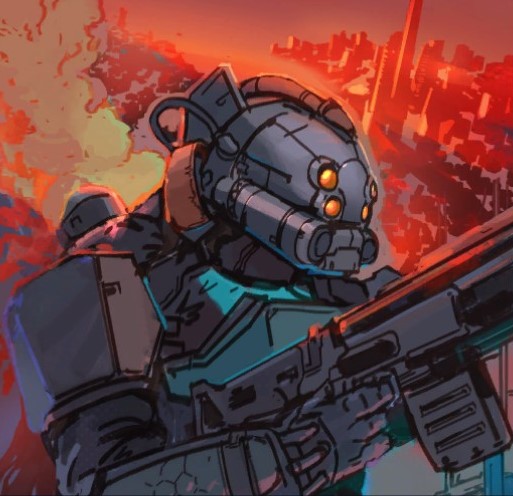
Gray Phoenix probably has the most immediately clear narrative design; Gray Phoenix is a group united under the banner of 'we want to go home'. There are no human or hybrid units in their forces; they are made entirely of the species the Ethereals plucked from their homeworlds and dragged along in the Ethereal crusade across the universe, where these species could theoretically fly back to their homeworlds and try to resume the lives their peoples had before the Ethereals enslaved them.
(Aside the somewhat ambiguous case of Faceless, where XCOM 2 raised the possibility they might be a species created 'whole-cloth' by the Ethereals and Chimera Squad doesn't actually firmly say that this is incorrect, plus one robot unit in their forces that technically falls outside the above description)
Which is a pretty natural group to imagine appearing in the wake of the Ethereals having vanished! Of course there'd be people going 'let's go back home now that this is an option that actually exists', and of course such a group would be made primarily or entirely of the peoples who were forcibly uprooted.
Chimera Squad using them as an antagonist group is a little shakier, but only a little; realistically speaking, while the impetus would exist it would be a pretty naive plan. The Ethereals have been running their roaming operation for some number of centuries; even if, say, Mutons can live upward of 500 Earth years, The Homeworlds Of Our Species are probably basically mythology for most or all of the species the Ethereals enslaved, where nobody currently alive actually has any personal memories of their homeworld, and indeed probably nobody even knew a relative who has such memories. (That is, there's probably no Viper grandmother who lived on The Homeworld and died of old age but beforehand relayed some stories to a current-generation Viper) A Sectoid going back to the Sectoid Homeworld is actually pretty unlikely to find it really satisfies their dreams of Going Back Home; they never lived there, they don't actually have any fond memories of living there, and they probably would run into a bunch of struggles in adapting to it. (Sectoids being particularly extreme about this given the current generation of Sectoids have been modified to be more like humans; whatever ancestral homeworld the Sectoids first evolved on is very unlikely to be a better biological fit to current Sectoids than Earth is)
That's not even getting into the very real possibility that said homeworlds are functionally impossible to find. It's entirely possible the Ethereals didn't bother to archive coordinates or other ways to identify these worlds; they likely had no intention of going back, after all, and possibly only cared to mark them as 'we've been here and we're not going back'. And such an approach to marking out planets would likely mark out basically everything the Ethereals passed by this way, not just inhabited worlds they kidnapped species from; in such a case, a journey to search for the Homeworlds Of Our Species would be stuck just coming manually through all the space the Ethereals passed through.
Which would be a complete nightmare to do, by the way! Retracing historical routes from centuries ago on Earth is actually pretty hard in real life, but at least landmarks don't drift. (Or more accurately, they do drift, but so enormously slowly that for it to be relevant of a problem you have to look so far back that accessible-to-current-humans chronicles of history largely don't exist anyway) Stellar features are constantly moving: if we say the Ethereal route was essentially a straight line through the galaxy, simply pointing some ships in the direction the Ethereals came to Earth from will not hit all the same places they passed by in their route. It will in fact very possibly hit none of them.
So even if the Ethereals documented their overall route pretty accurately and said route is available to the current peoples (Both pretty big 'ifs', it should be noted), the process of searching for these lost homeworlds would actually require plotting out an efficient distribution of search parties, where all of these search parties are liable to spend multiple generations heading out to their assigned planets, and where almost all the search parties are going to end up confirming 'this isn't a homeworld' and then presumably starting a new multi-generational journey to... another disappointment? Back to Earth?
Now, in a depressing amount of scifi, the enormous logistical hurdles I'm laying out would be a criticism of the story; usually when scifi has this kind of plot involving species displaced from their homeworld centuries or millennia ago yearning to 'go home', the plot is taking it as a given that this is a realistic goal, generally one that will in fact be achieved over the course of one movie/game/book, with this tending to in fact mean it will occur within a single person's lifetime.
But in Chimera Squad's case, none of that applies. No one in the game talks like Gray Phoenix could totally get to the Lost Muton Homeworld in a couple years if only they were allowed to take a spaceship and set off, or anything like that. The overall undertone is in fact that Gray Phoenix's goal, though sympathetic in a general sense, isn't really achievable.
Notably, this actually does a lot to make 'Gray Phoenix as antagonists' relatively palatable; the general impulse of 'I want to go home' is reasonable, but successfully pursuing that impulse is realistically essentially impossible, which means people actually pursuing that impulse are liable to skew toward having unrealistic models of the situation (eg "We could get home in a few short years, if only the humans weren't refusing to let us") and skew toward being unlikely to be readily reasoned with by pointing out the factual problems with their plans. ("You do realize your home is probably multiple lifetimes away, pretty much impossible to find, and not liable to feel like a home to you even if you somehow do get there, right?" "LIES!")
Models like 'humans are refusing to let us go home and that's the only thing preventing us from going home' in turn would be models that imply that pushing to be allowed to go should work, and that if it doesn't work then force is a reasonable choice. It's thus believable that Gray Phoenix is driven by a sympathetic motive ("I want to go home"), but is using violence enough to be an enemy faction in this game and where fighting back against this -though it would feed into narratives about being oppressed any individuals in Gray Phoenix might have- doesn't make the player clearly the bad guy here.
That's a pleasant surprise, honestly. One of my concerns with Chimera Squad when it was first revealed was the possibility of it just walking directly into Police Brutality And So On: The Game while cluelessly presenting the player as Heroically Fighting The Evil Criminals. I wouldn't try to argue it dodges that territory perfectly, but it certainly doesn't live down to my worst fears, and is in fact noticeably above-average on this topic relative to what I'm used to seeing from pop culture depicting anything resembling law enforcement in the position of 'the good guys'.
I'll be touching on this a bit more in some later posts, though.
Mechanically, Gray Phoenix probably has the weakest 'identity' as a gameplay faction; it seems likely that the devs' starting point was just throwing together the relevant species and trying to figure things out from there. Which is a fair starting point, but still. It probably doesn't help that the Progeny took up the mantle of The Psychic Faction; Gray Phoenix leaning into the psionic abilities of their Sectoids would step a bit on the Progeny's toes, after all, leaving them mostly to focus on the Muton and Viper end of things. There's a few different ways the diversity herein could've been played for a reasonably strong mechanical identity, but unfortunately the devs seem to have thought of Mutons mostly as The Strong And Tough Guys as far as combat mechanics, and really struggled to think of things to do with Vipers aside the Dodge/Poison/Tongue Pull/Bind set of capabilities getting some remixing.
In practice they mostly end up as the middling-difficulty faction; their units trend durable and they don't really have any clear exploitable weaknesses, so they tend to present a tougher front than the Progeny and you have less ability to build your squad to counter their strengths than with Sacred Coil forces. This means their highs are less high, but their lows are also less low, relative to Sacred Coil.
You might intuitively expect them to be the most close-quarters-combat faction, but in practice that honor goes to Sacred Coil, who have a weirdly high amount of dedicated melee units plus units that aren't melee but are restricted to close-up attacks anyway or have their most powerful attacks require getting close. Gray Phoenix does have more melee-capable units than the Progeny, at least, but not even by that much!
As for their icon...

I'm genuinely unsure if it's meant to be more meaningful than 'an icon assembled from abstract shapes'. Gray Phoenix is the faction centered on non-humans; it may be the intent is that it's a symbol with intuitive meaning to Mutons, where the devs didn't try to come up with a specific explanation for what it's supposed to represent.
I could imagine it's meant to be a very abstract representation of a bird in flight, or of a bird's head, which would fit to the Gray Phoenix name. I'm not convinced that's the intent, but it's plausible.
What it puts me most in mind of is actually the Vigilo Confido icon;

You've got the X-shape of 'negative space', you've got the general downward pointing quality of the overall shape, and the shared use of an X results in some secondary shape overlap (The bottom diamond shape existing in each, specifically) so if you squint they actually look noticeably alike.
Given as of XCOM 2 the XCOM iconography has associations with fighting against the oppressors and all, I find it plausible Gray Phoenix is meant to have derived their icon from XCOM iconography.
That said, I would be completely unsurprised if that's not remotely the intended explanation and it's just something like 'the same artist made both icons and so this artist's aesthetic sense shaped both icons'. On the other hand, if that is why it doesn't preclude the possibility of running with the idea that they're similar icons -if XCOM 3 touches on Gray Phoenix at all and directly states their icon is derived from the XCOM icon I will be only moderately surprised.
On a different note entirely, it's worth pointing out that Chimera Squad's regular mission music is actually faction-specific! The Progeny, Gray Phoenix, Sacred Coil, and sort of Shrike all have distinct musical identities to help set a different tone for how fighting them feels, which is a nice touch. It's a touch I suspect a lot of players don't notice, as for one thing it only applies within missions; the music for puttering about the base does actually change each time you move on to a new Investigation, but it's purely Act-based, where the music you hear in the base during your third Investigation is different from what you hear during your first Investigation, but every run hears the same music in its third Investigation regardless of which faction is currently being Investigated. There's also other stuff going on with the music even within a mission to further obscure things, where for example you get different music playing during the pre-Breach phase as from in combat (And said music changes as you slot in -or remove- agents to Breach points!) and the Breach Phase doesn't actually have music playing at all, instead having distorted audio in support of the slow-motion visualization of everything.
I am unfortunately not sufficiently versed in the relevant musical terminology to know how to describe Gray Phoenix's music. I personally take it as tending to be tense -some of the songs remind me a little of classic X-COM music, actually- but with less urgency than the other factions, which certainly feels appropriate to me, but I wouldn't know how other players take Gray Phoenix music.
The Progeny is easier for me to articulate, with their music low-key evoking 'spooky' styles of music. This is particularly blunt for Take Down the Progeny, where the music is an interesting hybrid of something very military-sounding and something like you might hear from a horror movie sequence going for 'there is something out there, but you're not sure where' or alternatively might hear in an alien abduction movie -oh, yes, I should explicitly point out that every Take Down (Investigation target) mission has music completely unique to it. They're pretty consistently great tunes and I have kind of mixed feelings about them being each reserved exclusively for one mission; the Progeny tune in particular I feel would've been great to be a more general Progeny song, but the Gray Phoenix Song is also great and would've been nice to hear more often.
Regardless, the musical identity stuff is all cool and I wish the game did a better job of drawing the player's attention to it. It's especially easy to overlook or misunderstand this music stuff in one's first run -I imagine there's players who noticed the music changing as they switched Investigations but assumed it was all based on Act- but even if you do multiple runs it's easy to not recognize it. Among other points, the Progeny and Gray Phoenix tunes aren't jarringly different from each other; Sacred Coil's music being very different leaped out at me enough it was what lead to me ultimately realizing this was a general mechanic of faction-specific music, whereas I spent a while thinking the Progeny and Gray Phoenix shared a pool of music. But when you do know it's distinct, the music actually does a good job of helping set expectations about the factional identities; if XCOM 3 does something similar, that's liable to be very nice.
Aesthetically, an interesting point I suspect a lot of players don't notice, or do notice but kind of wave off as meaningless, is that Gray Phoenix troops are widely equipped with beam weapons as opposed to the magnetic weapons that are the game's default. Beam weapons show up on the other factions, but only in cases where a model is recycled with few or no modifications from XCOM 2; Progeny Codices and Archons and Sacred Coil Andromedons all using beam weaponry is somewhat dubious in its 'canonicity'.
Whereas Gray Phoenix are the reverse; the only units of theirs that don't use beam weapons are directly recycled models of units that didn't use beam weapons in XCOM 2.
This is a nice detail, as it makes sense twice over that Gray Phoenix would have greater access to beam weaponry than the other two factions; firstly, they're mainly made up of Ethereal slave-soldiers who used beam weapons in XCOM 2 and so would have greater odds of having beam weapons on hand from that time. Secondly, they're presented as a group of salvagers who've been focused on scooping up advanced technology, where the other factions have had different agendas to focus on; presumably a lot of Gray Phoenix's beam weaponry is looted from battlefields, abandoned armories, and so on.
The exact implementation is strange from an in-universe standpoint, as the models for Gray Phoenix beam weapons are the X-COM beam weapon models from XCOM 2, but it's pretty clear you're not meant to take this piece completely literally; among other points, Epic Weapons are also beam weapons using the X-COM beam weapon models, but multiple of them come with a bit of lore about how the Epic Weapon in question is an experimental ADVENT weapon or the like. Presumably it was simply easier/cheaper to adapt X-COM weapons to other 'generic' soldier skeletons than to adapt the alien plasma weapons from XCOM 2 to new models, but whatever the case you're clearly supposed to take these X-COM beam weapons as stand-ins, where a Legionnaire is 'in reality' wielding the weapon XCOM 2 Mutons carried.
On a different topic, something I find kind of funny is that the game informs you that Gray Phoenix is 'mostly' made of Mutons. I find this funny because the gameplay doesn't support it all that well; Gray Phoenix has exactly two types of Muton unit if you don't count Berserkers, three if you do, and while that's more than any other faction in the game they actually have more Vipers and more Sectoids than any other faction as well, and due to Berserkers and Praetorians being enemies the game doesn't like to use in large numbers it's not at all unusual for Vipers or Sectoids to be the majority of enemies in a Gray Phoenix mission, especially Vipers.
It's not like it's a big flaw or anything, but it still amuses me.
---------------------------------------------------------------
Next time, we start with the overall most common Gray Phoenix unit, the Legionnaire.
See you then.